


India is targeting 5 MMT Green Hydrogen by 2030 with ₹19,744 Crore Investment.
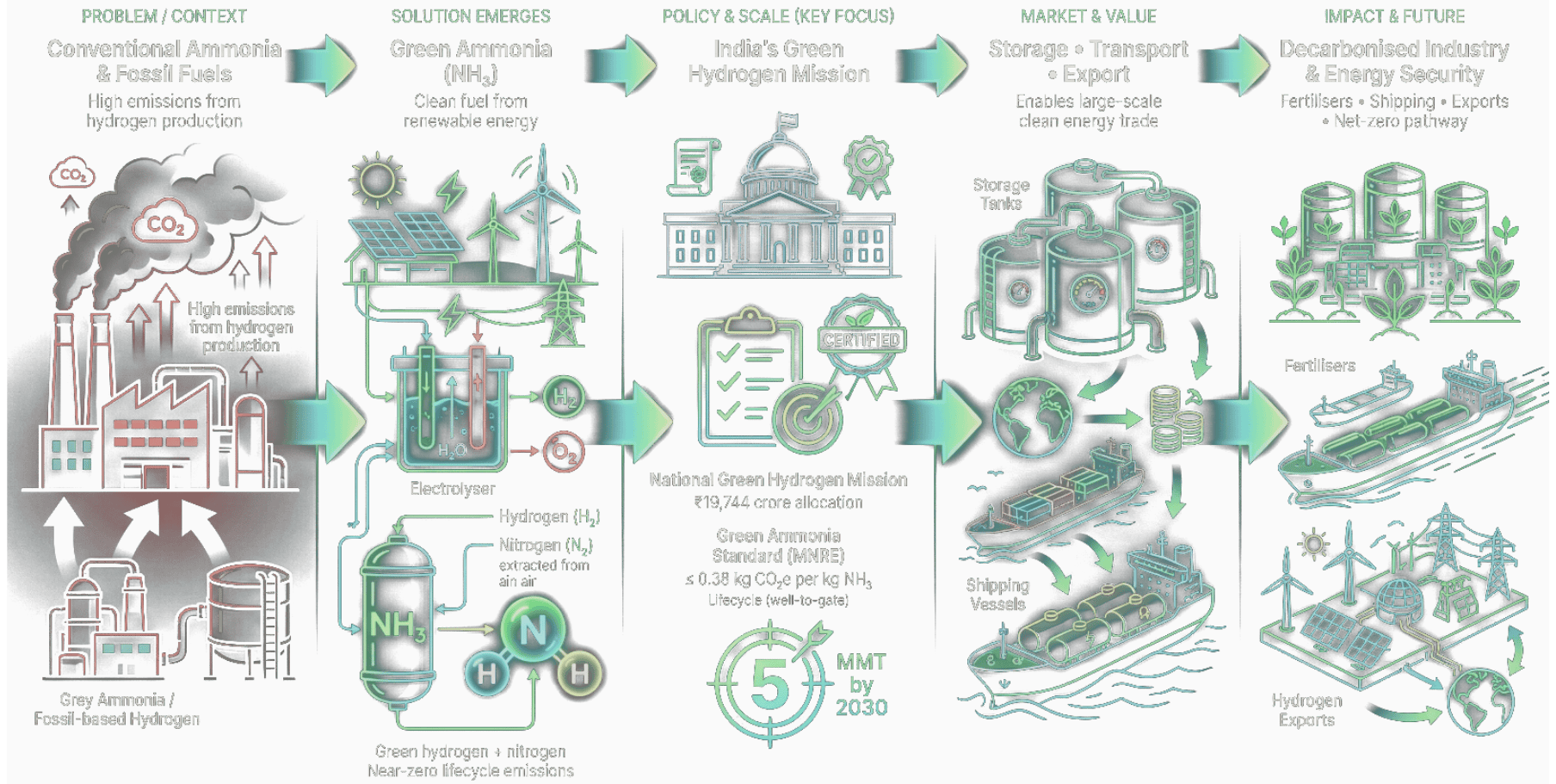
On 27th February 2026, the Ministry of New and Renewable Energy (MNRE) issued a formal notification defining the standards for Green Ammonia in India. As a primary derivative of the National Green Hydrogen Mission, which was launched in January 2023. Green Ammonia is poised to decarbonise India’s most critical sectors.
What is Green Ammonia?
Green ammonia (NH3) is ammonia produced using renewable energy sources such as solar, wind, or hydro power, resulting in substantially lower lifecycle greenhouse gas emissions.
How is it Produced?
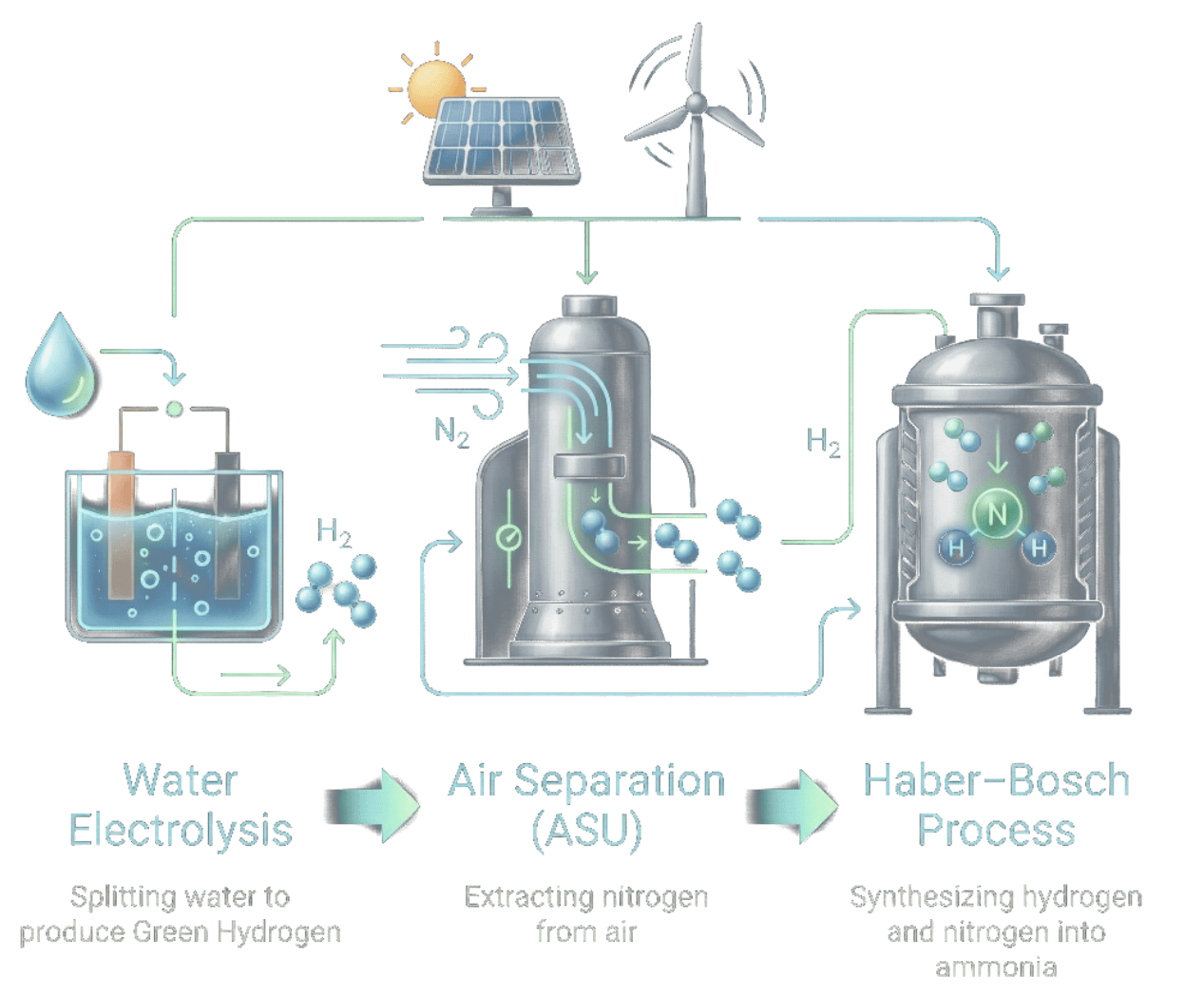
The production process involves three main technological stages powered entirely by renewable energy:
- Water Electrolysis: Splitting water to produce Green Hydrogen.
- Air Separation: Extracting nitrogen directly from the atmosphere using an Air Separation Unit (ASU).
- Haber-Bosch Process: Synthesizing the hydrogen and nitrogen to form ammonia.
Why is Green Ammonia better than Grey Ammonia?
Grey ammonia is primarily used in agriculture as a fertilizer, where it is essential for crop production. However, its production process is not environmentally friendly, as it relies on fossil fuels and releases significant amounts of CO2 into the atmosphere. This contributes to climate change and the greenhouse gas emissions profile of ammonia production.
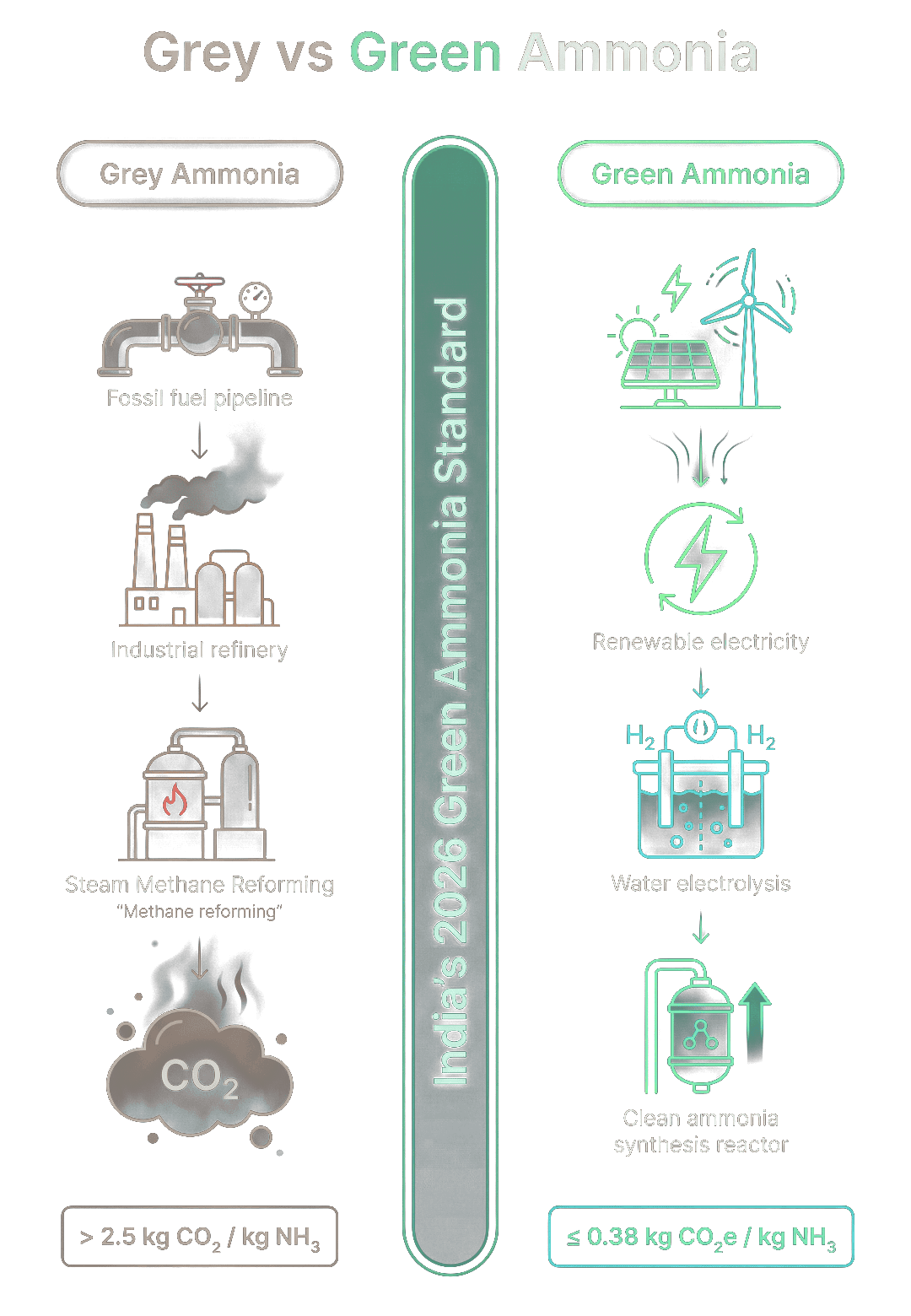
1. Carbon Footprint: Traditional Grey Ammonia is derived from fossil fuels (natural gas or naphtha) through steam reformation, making it highly carbon-intensive typically emitting over 2.5 kgCO2 per kg of ammonia produced. In contrast, Green Ammonia aims for near-zero emissions.
2. Energy Security: India currently imports over USD 90 billion worth of primary energy requirements annually; Green ammonia allows India to use domestically available renewable energy, reducing dependence on imports and strengthening energy security.
3. Logistical Superiority: Ammonia has a higher energy density than hydrogen and is easier to store and transport. While liquid hydrogen requires cooling to –253°C, ammonia only requires –33°C, allowing it to leverage existing global shipping and port infrastructure.
India’s Green Ammonia Standards
To prevent “greenwashing” and ensure international credibility, India has set a rigorous emission threshold.
- Threshold Limit: Total fossil-based greenhouse gas emissions associated with ammonia production shall not exceed 0.38 kg CO₂-equivalent per kg of ammonia (kg CO₂e/kg NH₃).
- Measurement Period: This limit is calculated as an average over the preceding 12-month period.
- System Boundary: The quantification covers emissions from Green Hydrogen production, ammonia synthesis, purification, compression, and on-site storage.
Objectives and Significance of the Standards
The primary objective of these standards is to establish a “Guarantee of Origin” (GO), ensuring transparency and authenticity in the production process. These benchmarks are significant because they:
- Enhance Investor Confidence: A transparent framework de-risks investments for the private sector and attracts international capital.
- Enable Global Trade: By aligning with international norms, India ensures its Green Ammonia is a globally tradable and trusted commodity.
- Support Carbon Markets: Certified producers can use their certificates to claim credits under India’s Carbon Credit Trading Scheme (CCTS).
How the Ecosystem Operates
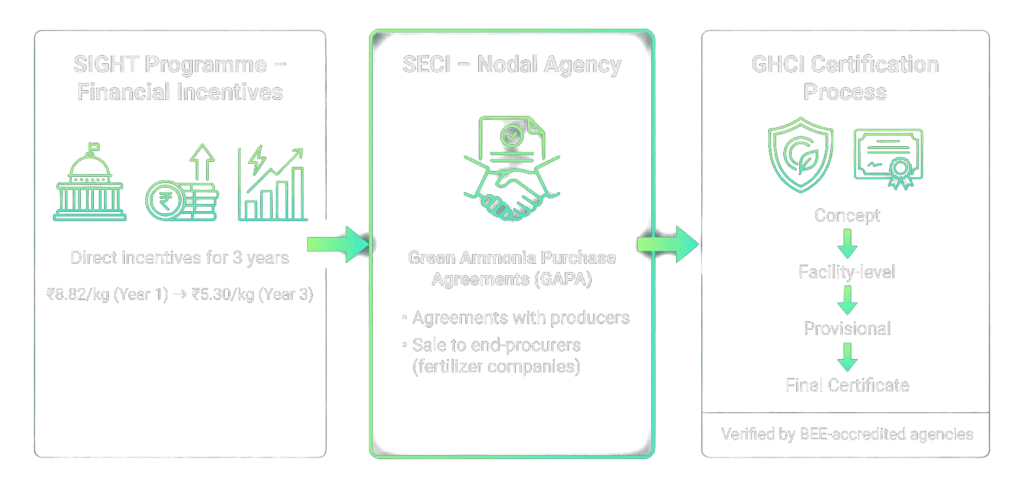
The implementation is a coordinated effort across several government and private entities:
- Financial Incentives (SIGHT): Under the Strategic Interventions for Green Hydrogen Transition (SIGHT) programme, India provides direct incentives for three years. The incentive starts at Rs. 8.82/kg in the first year, tapering to Rs. 5.30/kg by the third year.
- Intermediary Agencies: The Solar Energy Corporation of India (SECI) acts as a nodal agency, entering into Green Ammonia Purchase Agreements (GAPA) with producers and sale agreements with end-procurers like fertilizer companies.
- Certification Process: The Green Hydrogen Certification Scheme of India (GHCI) issues certificates in four stages: Concept, Facility-level, Provisional, and Final certificates, verified by BEE-accredited agencies.
How the Ecosystem Operates
The global demand for Green Hydrogen and its derivatives is expected to exceed 100 MMT by 2030. Many countries will rely on imports due to land and renewable resource constraints. India, with its low-cost renewable energy potential, aims to capture 10% of this global market.
How the Ecosystem Operates
Green Fertilizers: Substituting $USD 6 billion worth of imported Urea and DAP with domestic green alternatives.
- Sustainable Shipping: Used as a zero-emission propulsion fuel and provided via refuelling bunkers at major Indian ports.
- Energy Carrier: Efficiently transporting hydrogen over long distances for international energy trade.
- Power Generation: Co-firing in coal plants to reduce the carbon intensity of electricity.
Green ammonia and hydrogen bound for Europe fall under the carbon border mechanism, detailed on the CBAM Solutions page.
Timeline: From Notification to Implication
|
National Hydrogen Mission Announced |
August 2021 |
|
Launch of National Green Hydrogen Mission |
January 2023 |
|
Green Hydrogen Standard Notified |
August 2023 |
|
GHCI Certification Scheme Launched |
April 2025 |
|
Green Ammonia Standard Notified |
February 2026 |
|
Phase I Completion & Pilot Targets |
By 2025-26 |
|
Achievement of 5 MMT Annual Production |
By 2030 |
|
Full Import Substitution of Fertilizers |
By 2034-35 |
