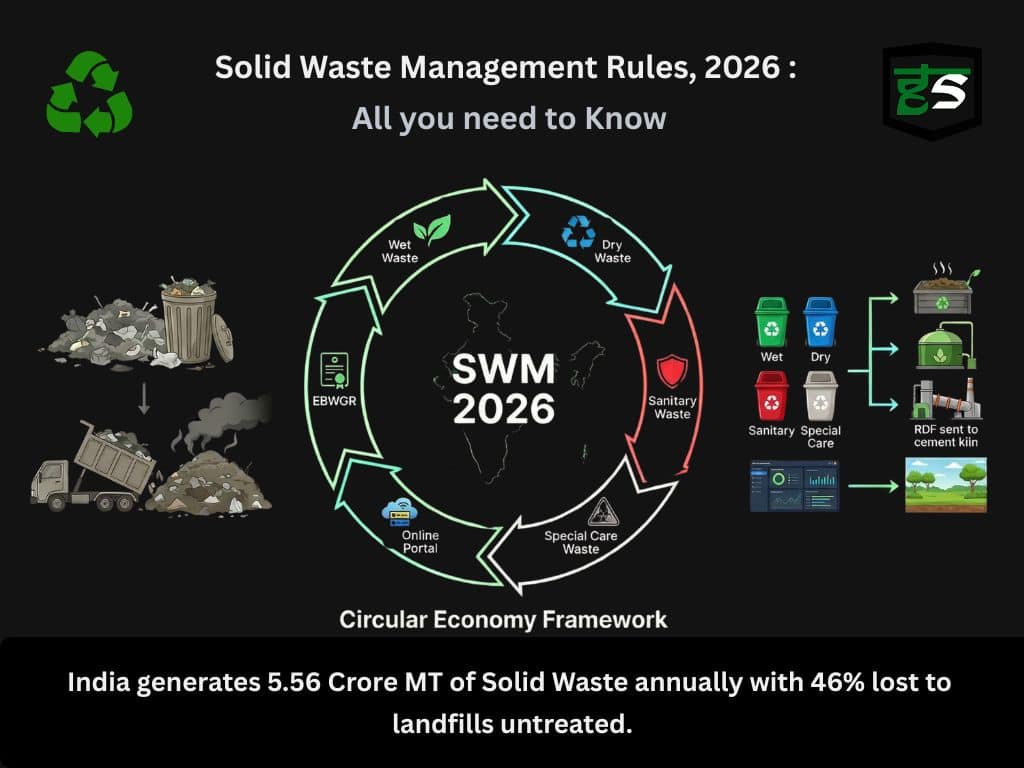
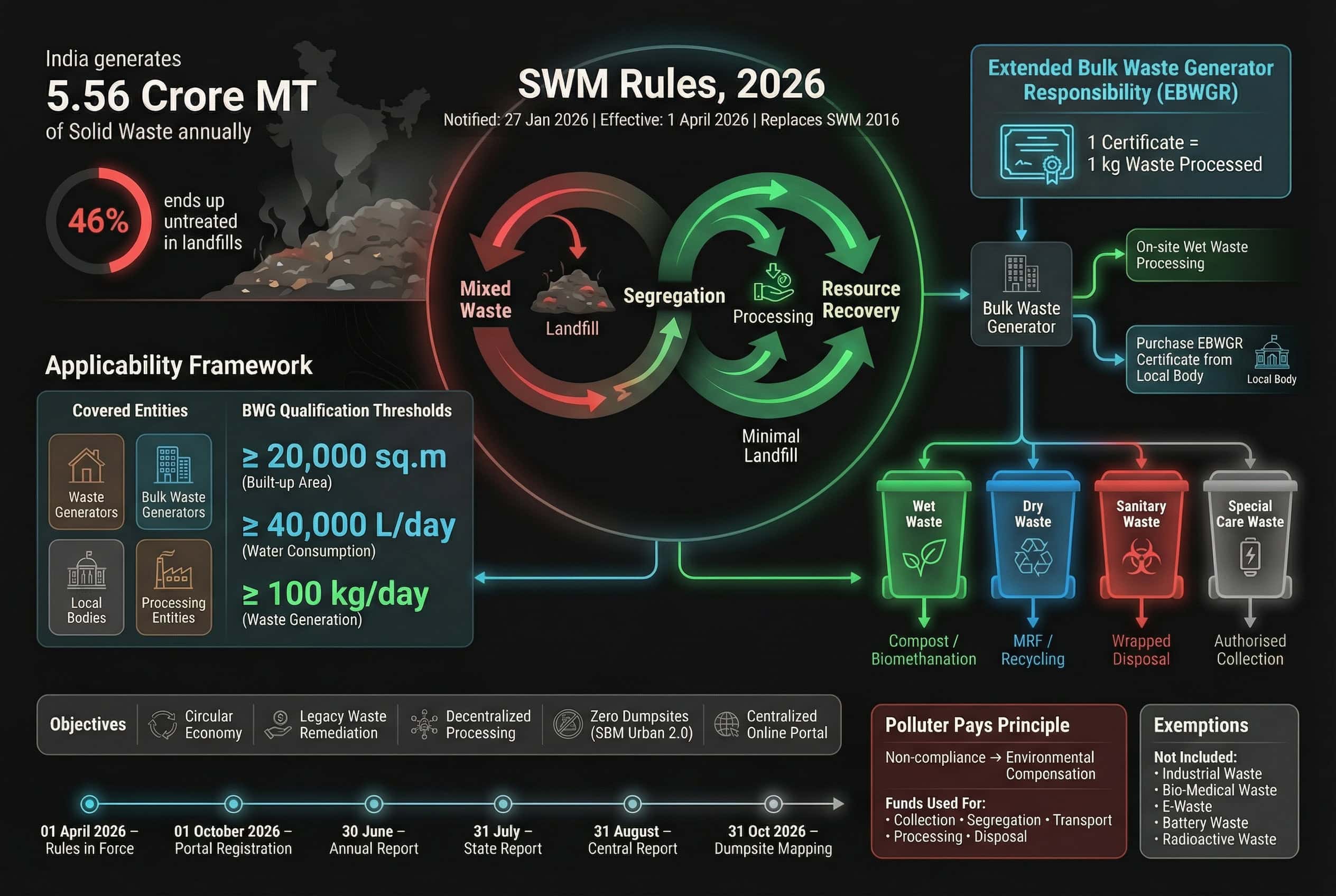

India generates 5.56 Crore MT of solid waste annually with 46% lost to landfills untreated.
Solid Waste Management Rules, 2026 have been notified on 27th January, 2026 by Ministry of Environment, Forest and Climate Change replacing. They replace earlier Solid Waste Management Rules, 2016 and introduce a “circular economy” approach through digital monitoring and the Extended Bulk Waste Generator Responsibility (EBWGR) system. These new rules shall come into effect from 1st April, 2026.
What is considered as Solid Waste?
Solid Waste is any tangible material having the physical state of solid or semi-solid , that has exhausted its original utility, became unsuitable for its intended purpose, or is generated as an unavoidable by-product, such that it no longer holds value for its current holder.
What is Solid Waste Management ?
Solid Waste Management is a systematic process associated with the control of generation, storage, collection, transport, transfer, processing, and safe disposal of solid waste materials to reduce landfill dependency and to eradicate it in future.
Objectives :
- Promoting a Circular Economy: It shifts waste management from a disposal model to a resource recovery model by emphasizing reduction, reuse, recycling, and the mandatory substitution of fossil fuels with waste-derived alternatives.
- Remediation of Legacy Waste: It mandates the time-bound geographical mapping, biomining, and bioremediation of all existing old dumpsites to safely treat accumulated waste and reclaim land.
- Decentralized Processing of Waste: It prioritizes establishing waste processing facilities, such as composting or bio-methanation units, as close to the generation source as possible to minimize transportation and environmental impacts.
- Aiming towards Zero Dumpsites (Lakshya: Zero Dumpsites under Swachh Bharat Mission Urban 2.0): It actively discourages open dumping by strictly prohibiting mixed or wet waste in sanitary landfills, allowing only non-recyclable, non-combustible inert rejects to be landfilled.
- Strengthening compliance using a Centralized Platform: It introduces a mandatory Centralized Online Portal for the registration, annual reporting, and real-time tracking of all waste management activities to ensure transparency and accountability.
Who is it applicable to?
The SWM 2026 framework is applicable to all Waste Generators, Bulk Waste Generators, Local Bodies, and Waste Processing Entities.
Bulk Waste Generators are classified as :
- Buildings with floor area : 20,000 Sq.m
- Water Consumption : 40000 Litres per day
- Solid Waste Generation : 100 kg per day
Mandatory Waste Segregation :

Wet Waste

Dry Waste
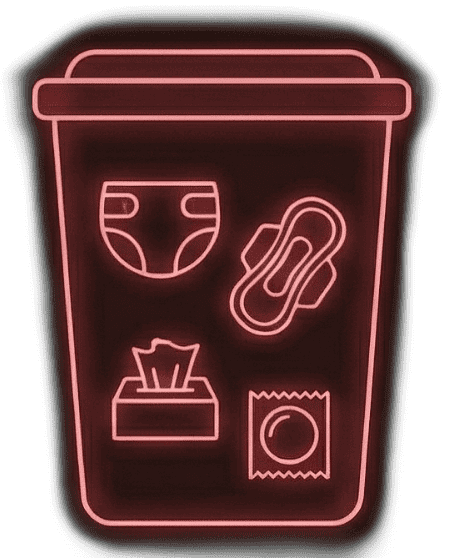
Sanitary Waste
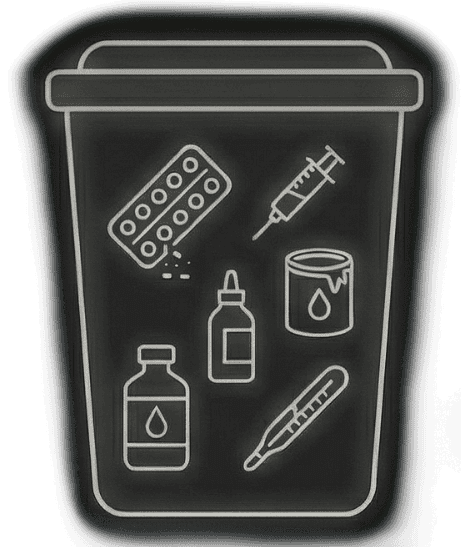
Special Care
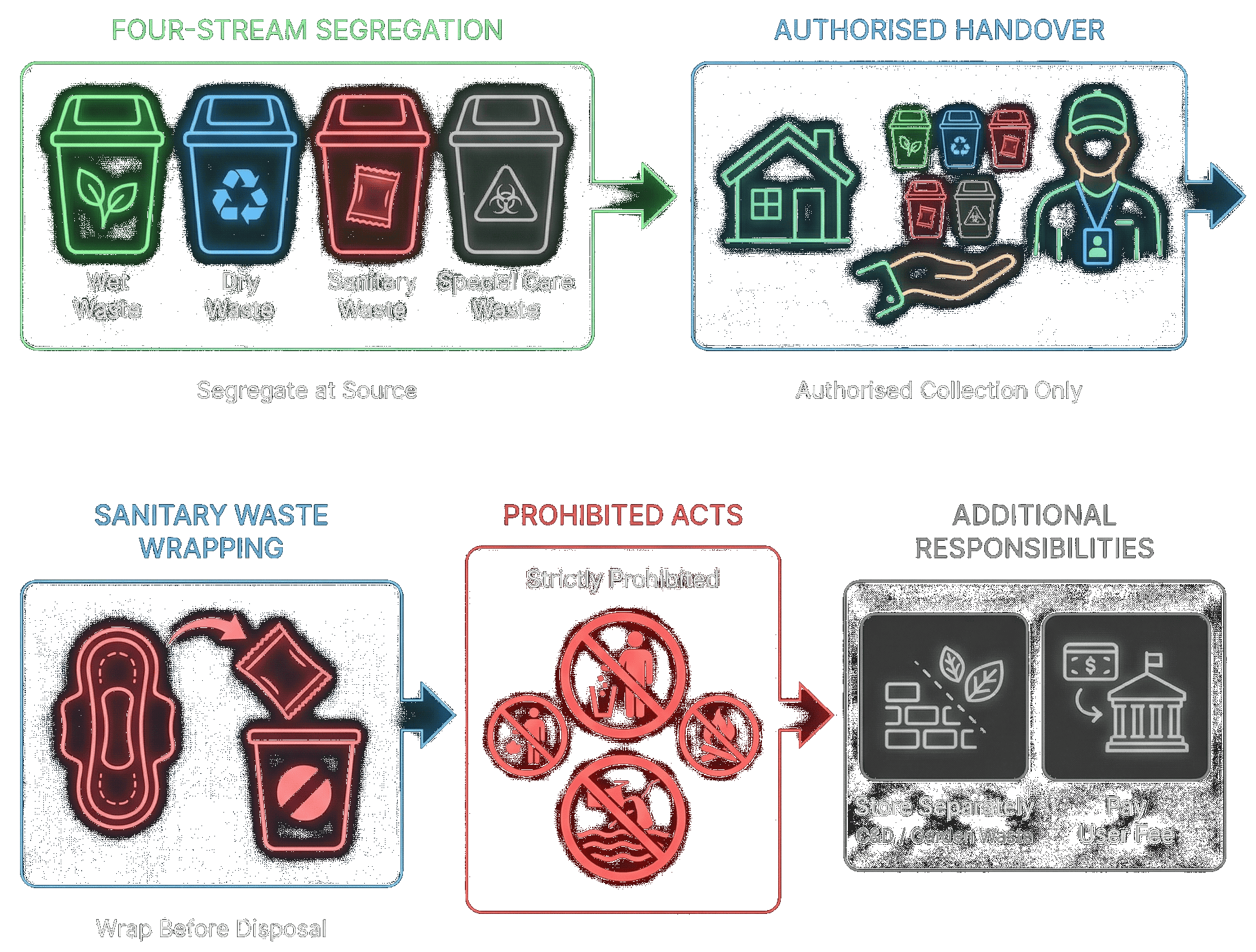
Wet waste includes kitchen waste, vegetables, fruit peels, meat, flowers, etc. It must be processed through on-site composting or bio-methanation to minimize greenhouse gas emissions and prevent leachate contamination.
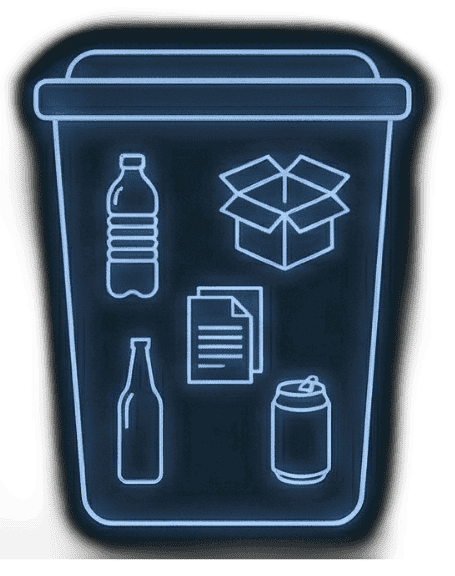
Dry waste comprises plastic, paper, metal, glass, wood and rubber, etc. It must be kept clean and dry to ensure they meet the quality standards required for efficient processing at Material Recovery Facilities (MRFs).
Sanitary waste includes used diapers, sanitary towels, tampons and condoms, etc. Users must wrap sanitary waste securely in manufacturer-provided pouches or suitable wrappers before binning.
Special Care waste includes paint cans, bulbs, mercury thermometers and medicines, etc. It must be segregated at the source and channeled through authorized collection centers to prevent toxic substances from entering the natural environment.
What is Extended Bulk Waste Generator Responsibility?
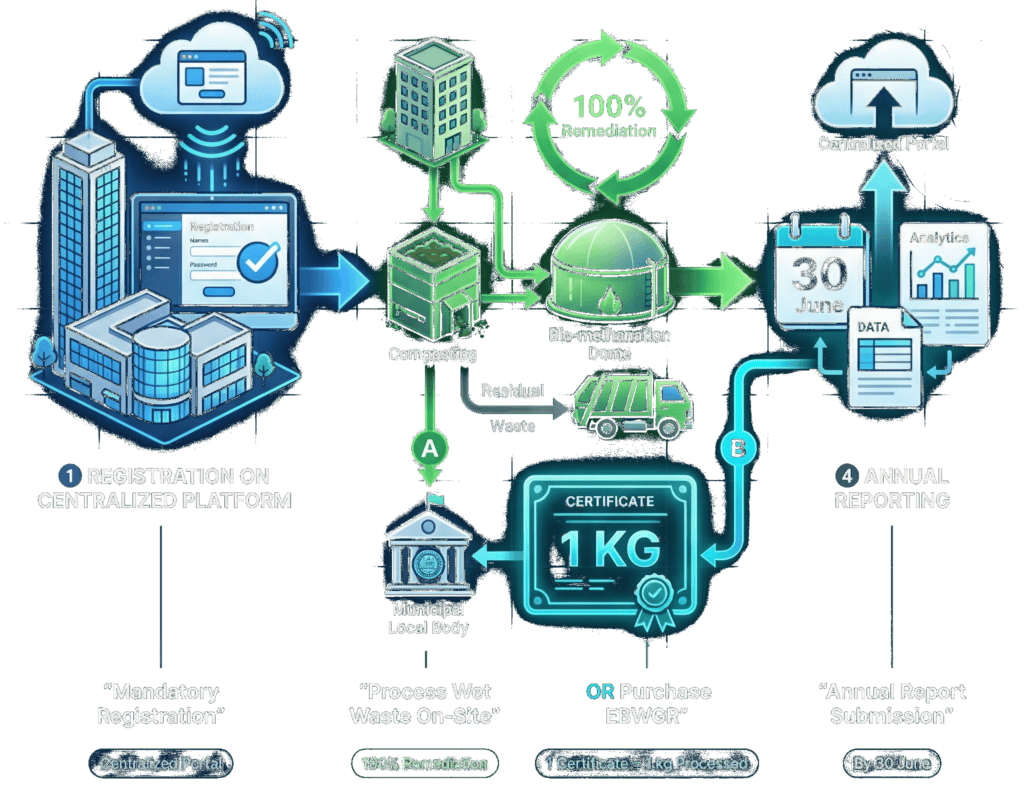
- Extended Bulk Waste Generator Responsibility (EBWGR) is an framework which mandates Bulk Waste Generators (BWGs) to segregate Solid Waste and process the Solid Wet Waste on site or acquire a EBWGR certificate equivalent to Solid Wet Waste generated.
- It is designed to facilitate stream wise waste segregation and decentralized processing of wet waste resulting in remediation of Legacy Waste.
- One Extended Bulk Waste Generator Responsibility (EBWGR) certificate is equivalent to 1kg of solid waste collected, transported and processed via or sent to registered processor.
As per Solid Waste Management Rules, 2026 dated 27th January 2026, Bulk Waste Generators are required to purchase these certificate generated by local body (Eg. Municipal Corp, Panchayat) via a centralized portal in order to fulfil obligations.
Duties of Waste Generators :
Every individual or a group of persons, residential premises, or non-residential establishment that produces solid waste are called Waste Generators.
- Segregation & Disposal: Must segregate waste into the 4 streams such as Wet waste, Dry Waste, Sanitary Waste & Special Care Waste and hand those over only to authorized waste pickers or collection agencies.
- Prohibited Acts: Throwing, burning, or burying waste in public spaces, drains, or water bodies is strictly forbidden.
- Specific Wastes: Construction and Demolition (C&D) waste and horticulture/garden waste must be stored separately within the premises and disposed of per specific local directions.
- Financial Obligation: Must pay a User Fee for waste management specified by the local body.
Duties of Bulk Waste Generators :
- Registration: Bulk Waste Generators (BWGs) are required to register on the centralized platform.
- Solid Wet Waste Processing : Must set up a wet waste processing facility within their premises to ensure 100% remediation of wet waste. Residual waste must be given to authorized local bodies.
- EBWGR Compliance : Entities not having wet waste processing facility are required to procure a Extended Bulk Waste Generator Responsibility (EBWGR) certificate from local body for processing of wet waste equivalent to complete wet waste generated by them respectively.
- Annual Reporting : Submit the annual report containing data about solid waste generated/segregated /processed within the premises by 30th June every year.
Significance :
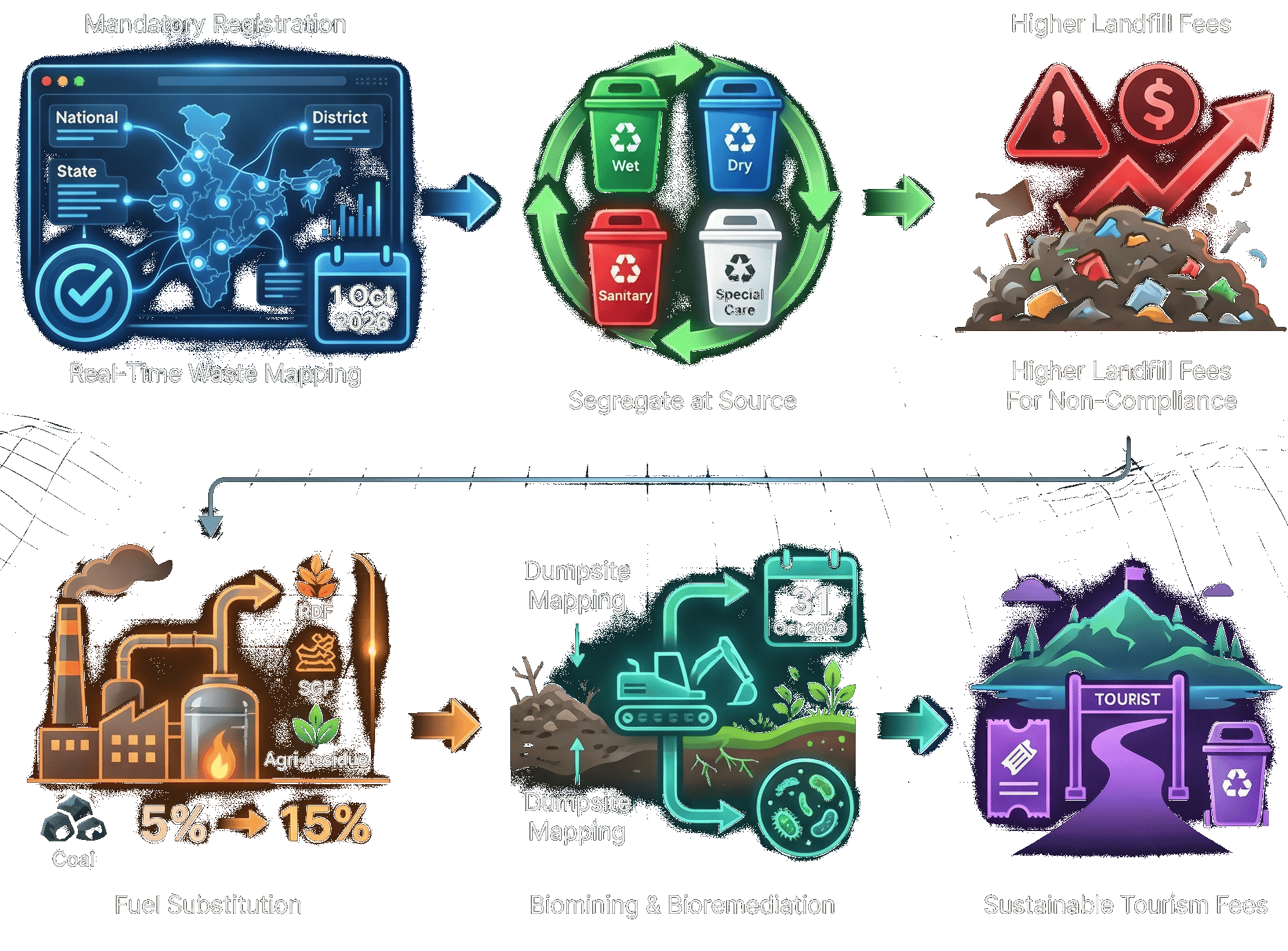
- Centralized Online Portal: All the obligated entities under SWM,2026 are mandated to register at Centralized Online Portal by 1st October 2026. The portal is designed to map total solid waste generated, collected, processed and landfilled at national, state and district levels
- Four-Stream Segregation: Generators must segregate waste into Wet, Dry, Sanitary, and Special Care (domestic hazardous) streams at the source.
- Polluter Pays : If unsegregated waste, recyclable waste, or unprocessed wet waste is sent to a sanitary landfill, the local body or concessionaire will be charged a significantly higher Sanitary Landfill user fee.
- Replacing Solid Fuel : Industrial Units in the close proximity of Waste to Energy Plants, are required to replace existing solid fuel with Refused Derived Fuel (RDF), Segregated Combustible Fraction (SGF) or agri-residue. The fuel substitution rate will increase from the current 5 per cent to 15 per cent over a six-year period.
- Legacy Waste Remediation : All existing dumpsites must be geographically mapped and assessed by October 31, 2026, for time-bound biomining and bioremediation to clear old waste.
- Tourism Regulation: To ensure the sustainability of waste management, local bodies can levy fees on tourists visiting hilly regions and islands at their entry points.
Timeline :
The original Solid Waste Management Rules, 2016 are established.
The Ministry of Environment, Forest and Climate Change (MoEFCC) notifies the New Solid Waste Management Rules, 2026.
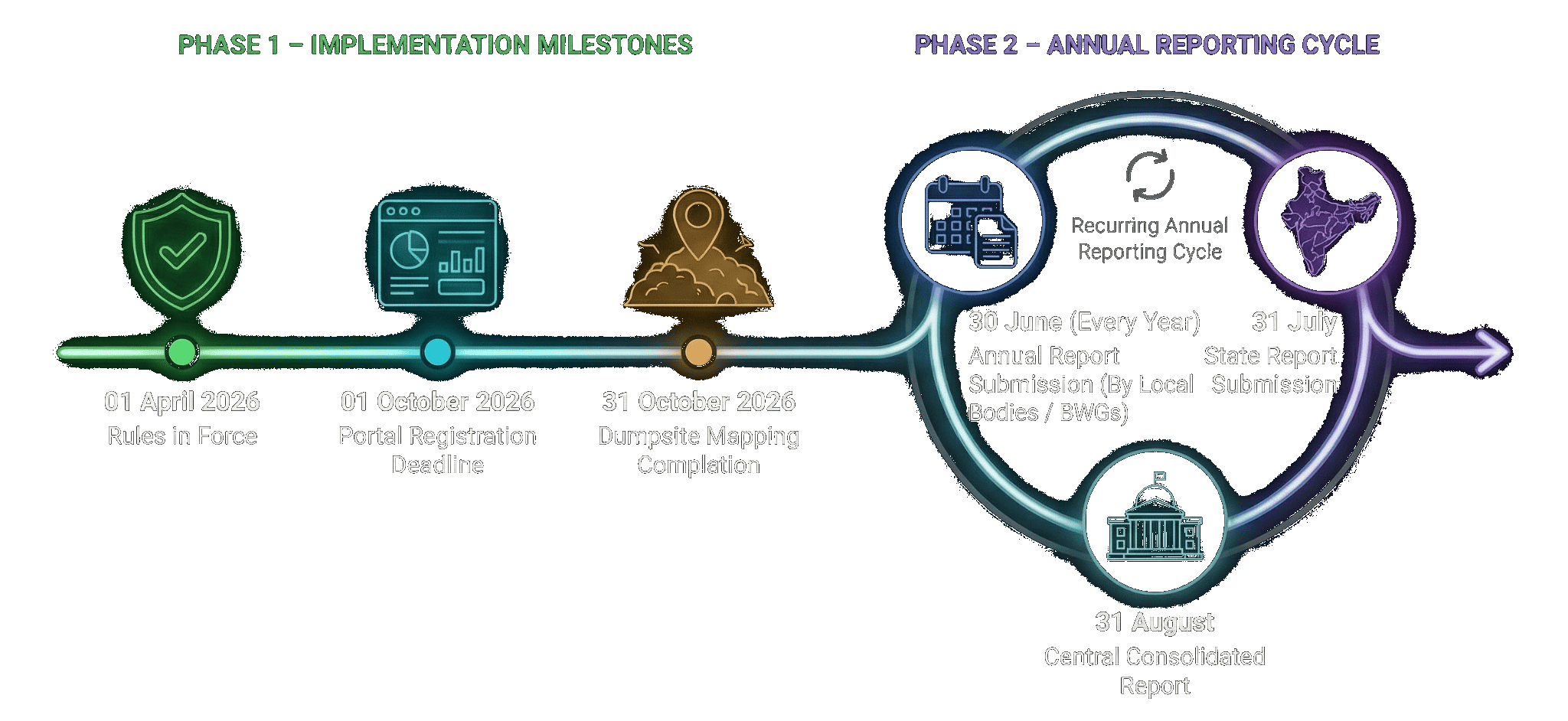
The 2026 Rules officially enter into force, replacing/updating the previous framework.
Deadline for BWGs and obligated entities to complete registration on the Centralized Portal.
All Dumpsites have to be mapped on the Centralized Portal by 31st October 2026.
Deadline for BWGs, Facility Operators, and Local Bodies to submit their annual reports.
Deadline for State-Wise Annual Report submissions.
Deadline for the Central Annual Report submission.
Penalty :
- The environmental compensation will be levied based on the polluter pays principle on those who are not complying with the SWM, 2026 rules.
- The Funds collected will be used for collection, segregation, transportation and treatment or processing of solid waste and disposal.
Exemptions under regulation :
According to Solid Waste Management Rules (2026) , definition of Solid Waste does not include :
- Industrial Waste
- Bio-Medical Waste
- E-Waste
- Battery Waste
- Radioactive Waste
Gazette Notification for SWM Rules dated 27/01/2026 :