


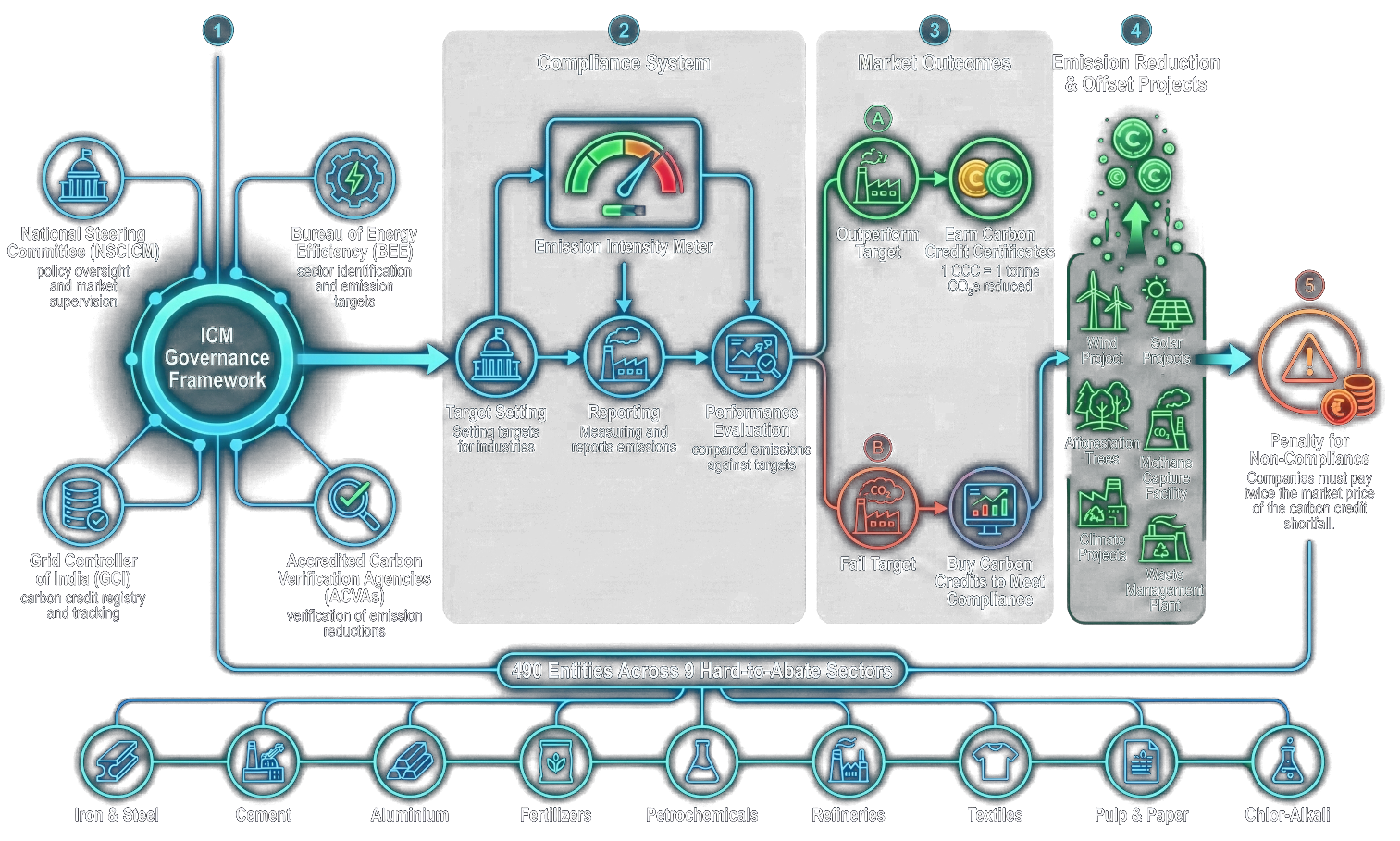
The Indian Carbon Market covers 490 "Obligated Entities" across nine high-emission sectors.
What is a Carbon Credit?
What are Carbon Markets?
Carbon Markets are systems where carbon credits are bought and sold to offset greenhouse gas emissions. Their global foundation was established under the Kyoto Protocol (1997) through the Clean Development Mechanism. Carbon markets operate in two forms:
- Compliance Markets where mandatory emission limits are set by government.
- Voluntary Markets where companies buy credits to meet sustainability or net-zero goals.
What is the Indian Carbon Market (ICM)?
- The Indian Carbon Market (ICM) is a regulatory framework that allows Indian entities to generate, buy, and sell Carbon Credit Certificates (CCCs) based on their greenhouse gas emission performance.
- The Indian Carbon Market will function through both compliance mechanisms and Voluntary (Offset) mechanisms, allowing industries and climate projects to participate in emission reduction efforts.
- The operational framework of the market is defined through the Carbon Credit Trading Scheme (CCTS), 2023, notified by the Government of India on 28 June 2023, in consultation with the Bureau of Energy Efficiency (BEE).
Objectives of the Indian Carbon Market :
- To reduce Greenhouse Gas (GHG) Emissions: Promote the reduction, removal, and avoidance of greenhouse gas emissions by pricing emissions through a carbon credit certificate trading mechanism.
- To promote Energy Efficiency : Encourage industries to adopt cleaner and energy-efficient technologies
- To Decarbonize the Economy: The framework is designed to incentivize and support entities both mandatory and voluntary in their efforts to decarbonize the Indian economy.
How does the Indian Carbon Market work?
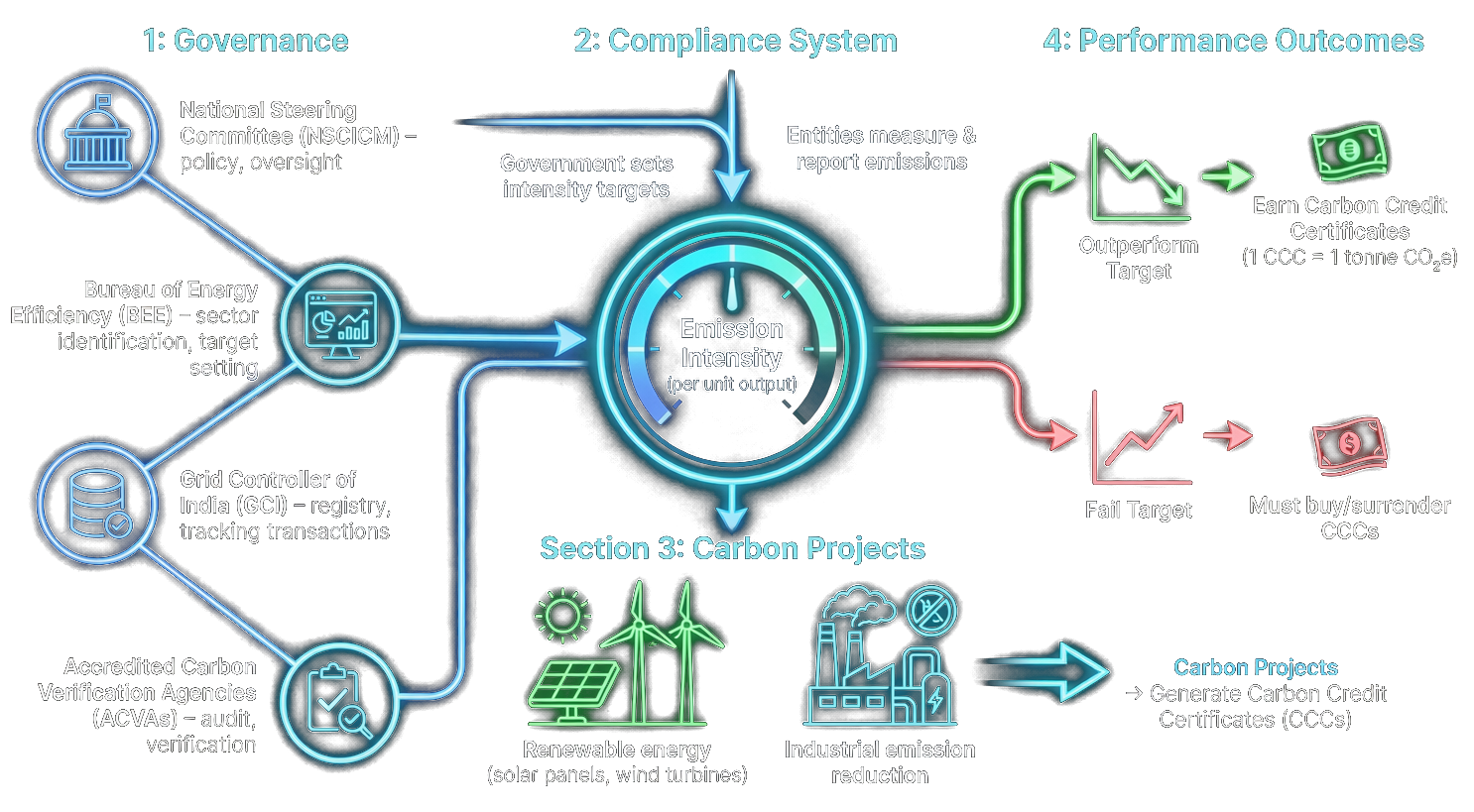
Governance :
- National Steering Committee (NSCICM): The highest authority co-chaired by the Ministry of Power and MoEFCC to oversee policy, recommend rules, and monitor market operations.
- Bureau of Energy Efficiency (BEE): The market administrator responsible for identifying sectors, developing emission trajectories, and setting specific intensity targets.
- Grid Controller of India (GCI): Acts as the meta-registry, managing entity accounts and tracking the issuance and transaction of all certificates.
- Verification (ACVAs): Accredited Carbon Verification Agencies are responsible for the validation and verification of actual emission reductions achieved by entities.
Compliance :
- Target Setting: The Indian government has notified specific intensity targets for each Obligated Entity under Greenhouse Gas Emission Intensity Target, 2026.
- Reporting: Entities measure and report their actual emission intensity.
- Performance Metrics:
- Outperform Target: Entities that reduce their GEI below the assigned benchmark are eligible to earn tradable Carbon Credit Certificates (CCCs), where one certificate equals one tonne of CO2e.
- Fail Target: Entities that exceed their intensity targets must purchase or surrender an equivalent number of certificates from the market to cover their shortfall and meet compliance.
- Invest in Carbon Projects: Participate in approved emission reduction or offset projects to generate Carbon Credit Certificates.
Sectors covered :
As of January 2026, the ICM mandates compliance for 490 entities across nine “hard-to-abate” sectors mentioned in Green House Gases emission intensity targets.
- Iron & Steel
- Cement
- Aluminium
- Fertilizers
- Petrochemicals
- Refineries
- Textiles
- Pulp & Paper
- Chlor-Alkali
Penalty :
According to the GHG Emission Intensity Target Rules (2025), Companies that fail to meet targets must pay a penalty equal to twice the market price of the carbon credit shortfall.
Significance :
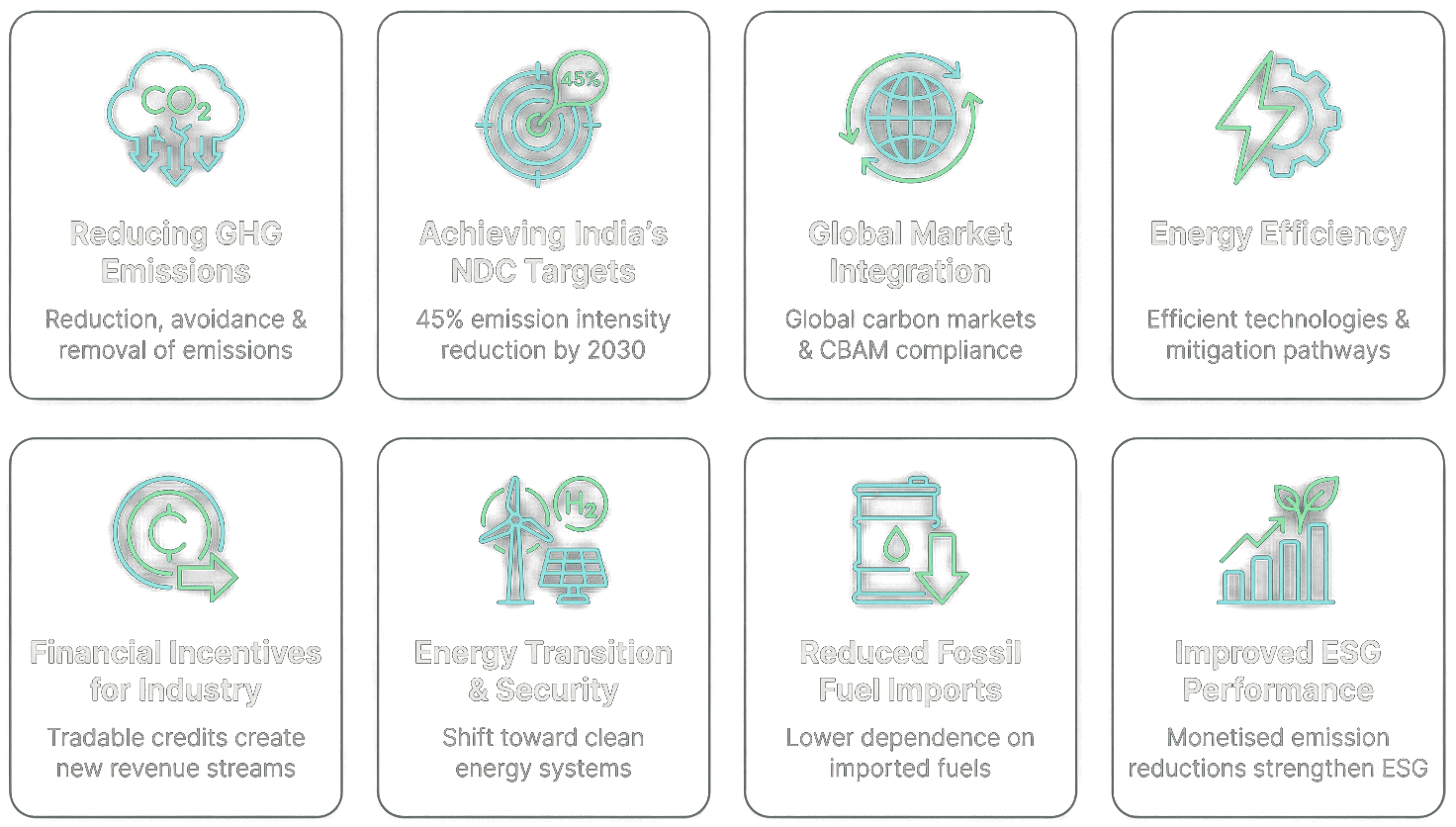
- Reducing Greenhouse Gas (GHG) Emissions : Encourages reduction, avoidance, and removal of greenhouse gas emissions.
Achieving - Nationally Determined Contributions (NDCs): Indian carbon market helps India achieve its updated Nationally Determined Contributions (NDCs), which pledge a 45% reduction in GHG emission intensity of the economy by 2030 from 2005 levels.
- Global Market Integration: Enables participation in global carbon markets and compliance with mechanisms like the EU-Carbon Border Adjustment Mechanism (CBAM).
- Energy Efficiency: By setting emission intensity benchmarks, the market encourages the adoption of energy efficient technologies and mobilizes new mitigation opportunities across private and public sectors.
- Financial Incentives for Industry: Converts emission reductions into tradable Carbon Credit Certificates (CCCs), creating additional revenue streams.
- Energy Transition & Security: Encourages industries to shift toward renewable energy and green hydrogen.
- Less dependency on the import of Fossil Fuels: Reduces dependence on imported fossil fuels.
- Improving ESG performance: The ICM drives ESG performance by monetising emission reductions through tradable certificates, incentivising energy efficiency.
How is the Cost of a Carbon Credit decided?
The price of a Carbon Credit Certificate (CCC) in the ICM is market-discovered based on :
- Demand: Driven by “Obligated Entities” that exceed their emission intensity targets and must purchase credits to comply.
- Supply: Generated by efficient companies that outperform their targets, creating surplus credits for sale.
- Abatement Cost: The actual cost of implementing clean technologies serving as a fundamental price benchmark.
- Penalty Floor: Financial penalties for non-compliance will be structured to ensure that purchasing credits is more economical than paying fines.
Exporters watching the Indian carbon market also face the European carbon border: measured, verified compliance is detailed under CBAM Solutions by GreenSutra.
A Timeline of the Indian Carbon Market :
Renewable Energy Certificates (REC) were introduced, allowing obligated entities to meet renewable purchase obligations by buying credits from renewable energy producers.
The Perform, Achieve and Trade (PAT) scheme was introduced by the Bureau of Energy Efficiency (BEE) to reduce energy consumption in energy-intensive industries through certificate-based trading.
The Energy Conservation (Amendment) Act, 2022 empowered the government to establish a national Carbon Credit Trading Scheme (CCTS).
The Government officially notified the Carbon Credit Trading Scheme, defining the governance structure and appointing BEE as the market administrator.
An amendment added the offset mechanism, allowing non-obligated entities to register emission-reduction projects and generate carbon credits.
The Central Government released the updated Greenhouse Gas Emission Intensity (GEI) Targets for 490 Obligated Entities covering 9 High-emission factors.
