


The World Bank estimates that India could lose up to 5% of its GDP by 2030 due to rising temperatures.
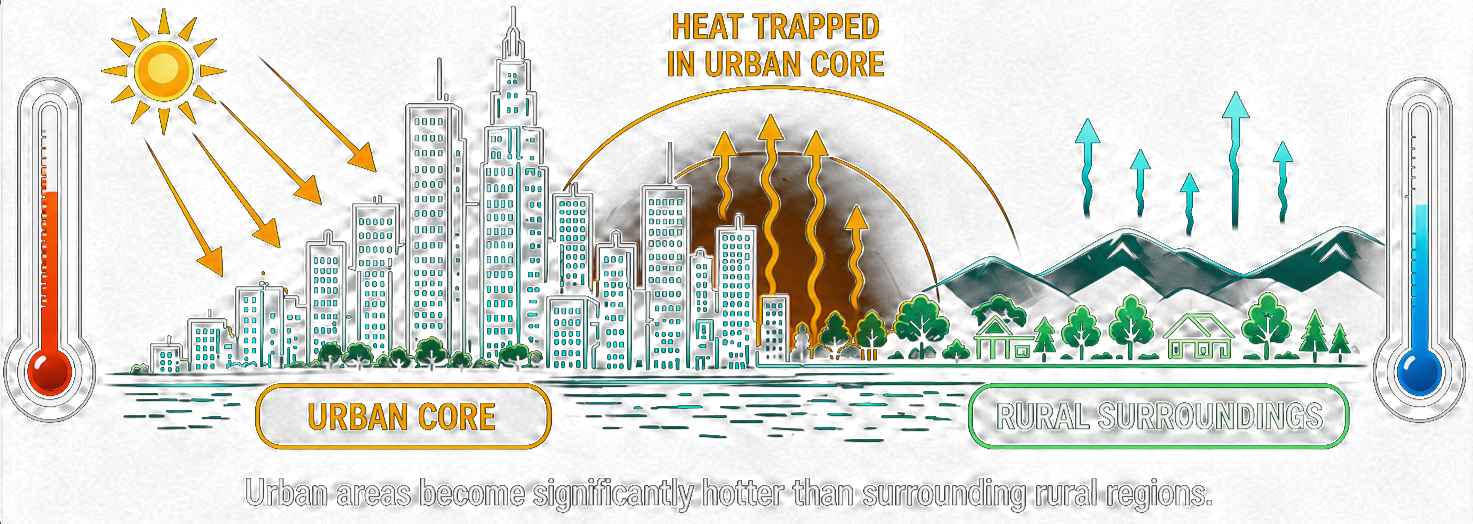
What is the Urban Heat Island Effect ?
The Urban Heat Island (UHI) effect refers to a phenomenon where developed urban areas experience significantly higher temperatures than their surrounding rural or suburban counterparts.
Factors Contributing to the Urban Heat Island (UHI) Effect :
- Heat-Absorbing Materials: Urban environments are dominated by materials like asphalt, steel, cement, brick, and corrugated metal, which are often dark and have a low albedo. These materials absorb all wavelengths of light energy and convert them into heat rather than reflecting them.
- Loss of Green Cover: Urbanisation leads to the depletion of green cover and vegetation, removing the natural cooling mechanism of evapotranspiration, where plants release water vapour to cool the air.
- Urban Morphology and Ventilation: High-density construction and tall buildings create “urban canyons” that trap heat and limit ventilation. A low Sky View Factor (SVF) in these dense areas also prevents radiative heat from dissipating into the atmosphere at night.
- Anthropogenic Waste Heat: Human activities, including the use of air conditioning and vehicles emit significant waste heat into the local environment.
Environmental and Public Health Impacts of the Urban Heat Island (UHI) Effect :
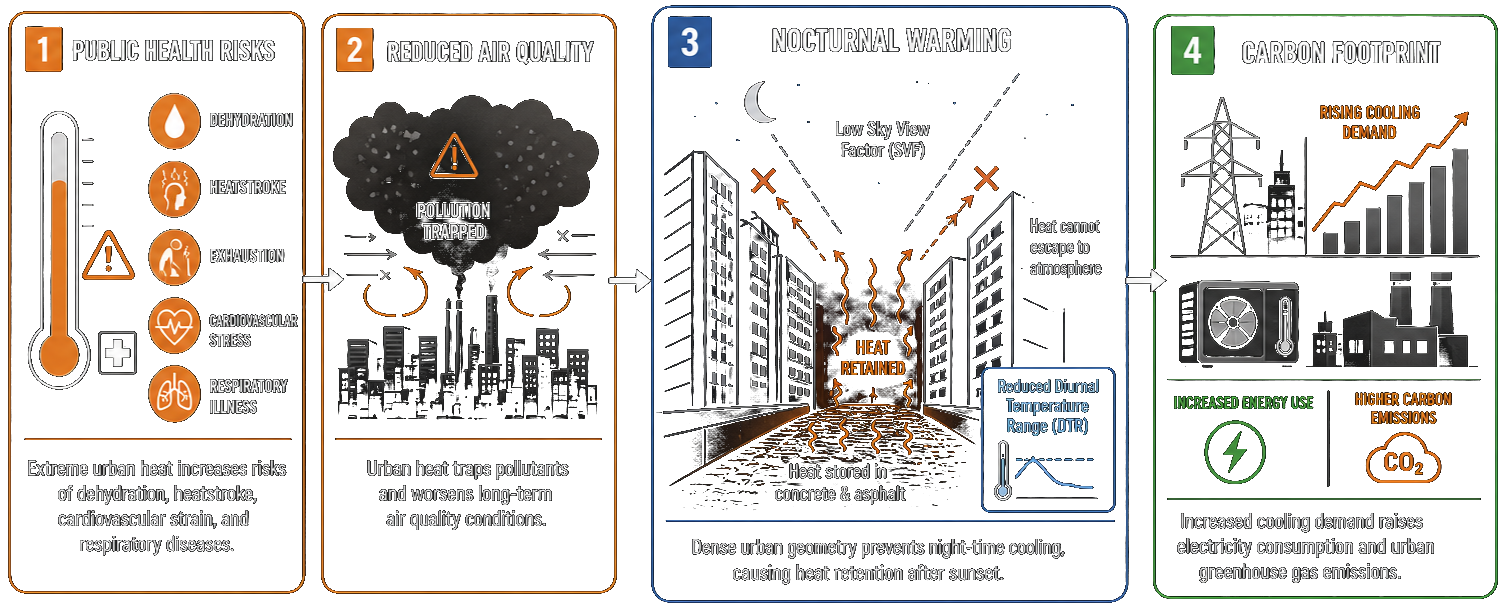
- Public Health Risks: Extreme urban heat is causing dehydration, heatstroke, exhaustion, and increases the risk of cardiovascular and respiratory diseases.
- Reduced Air Quality: The UHI effect traps pollution, worsening air quality and leading to long-term health issues.
- Nocturnal Warming:
- Urban areas suffer from a reduced Diurnal Temperature Range (DTR), meaning minimum temperatures stay dangerously high throughout the night.
- This is caused by a low Sky View Factor (SVF), where tall buildings and narrow “urban canyons” block visibility of the sky and stop radiative heat dissipation. As a result, heat absorbed by concrete and asphalt during the day stays trapped, preventing the nocturnal cooling needed to offset intense daytime temperatures.
- Carbon Footprint: The increased energy consumption required to combat UHI results in a larger carbon footprint and higher greenhouse gas emissions for the city.
- Water Footprint : Rapid urbanization and rising temperatures increase the demand for water, pushing cities toward acute water scarcity and depleting local groundwater resources.
Financial Impact of Urban Heat Island (UHI) Effect in India :
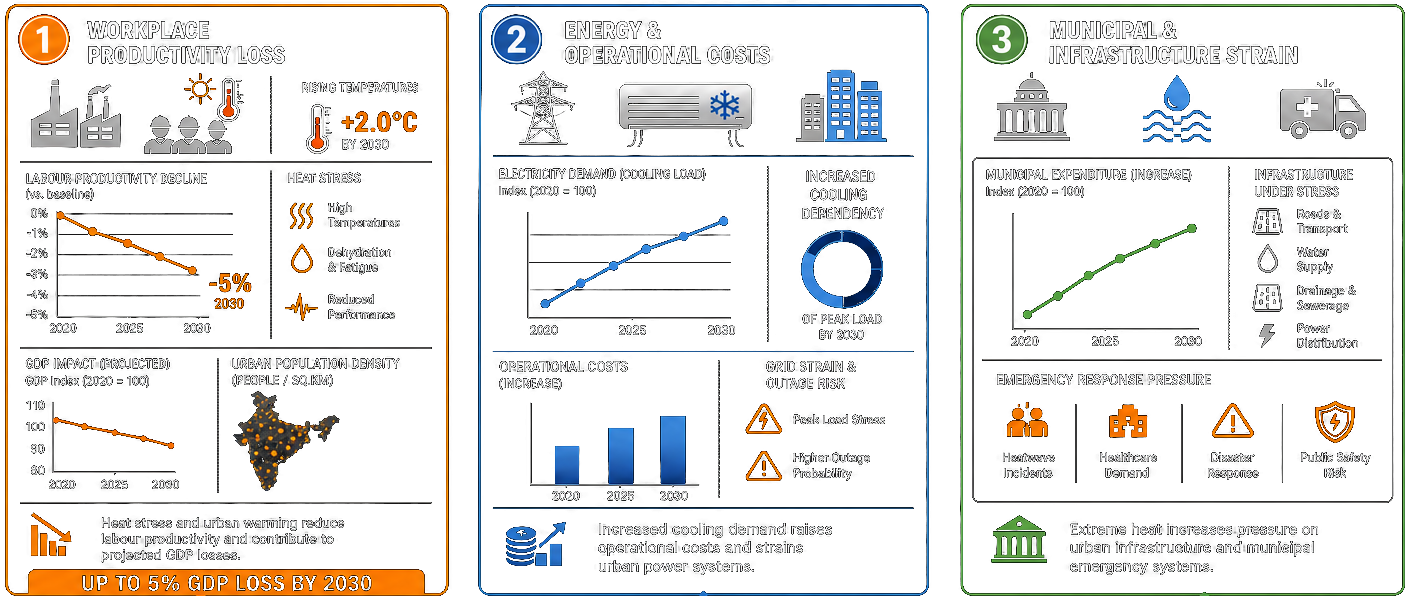
- Workplace Productivity Loss : With more than 31 % of India’s population currently residing in cities, the Urban Heat Island (UHI) effect is severely impacting labour productivity by causing widespread heat-related illnesses and physical exhaustion among workers, leading to a projected national GDP loss of up to 5% by 2030 according to the World Bank.
- Operational and Infrastructure Costs :
- Energy Demand: The UHI effect drives a massive increase in demand for mechanical cooling, raising operational costs for businesses and straining the power grid, which risks outages that disrupt economic activity
- Municipal Strain: Extreme heat events put significant stress on municipal services and infrastructure, requiring higher government expenditure for crisis management and emergency response.
India’s Policy and Mitigation Framework for Urban Heat Island (UHI) Management :
- National Action Plan on Climate Change (NAPCC):
- Launched in 2008 by the Prime Minister’s Council on Climate Change, the NAPCC provides the overarching national framework for addressing climate risks, including heat stress, through eight sectoral missions.
- It helps mitigate the Urban Heat Island (UHI) effect by mainstreaming climate change mitigation and adaptation into urban planning and policy, specifically focusing on building resilience in infrastructure assets and creating additional carbon sinks through expanded forest and tree cover.
- AMRUT Mission :
- The AMRUT scheme (Atal Mission for Rejuvenation and Urban Transformation) was launched on 25th June 2015 (and followed by AMRUT 2.0 in 2021) to build basic infrastructure and ensure water security.
- The mission mitigates the Urban Heat Island (UHI) effect by providing financial support for heat-resilient infrastructure, specifically through the development of urban parks and the rejuvenation of water bodies to provide natural cooling.
- India Cooling Action Plan (ICAP, 2019):
- Launched in March 2019 by the Ministry of Environment, Forest and Climate Change, the India Cooling Action Plan (ICAP) provides a 20-year integrated roadmap to achieve sustainable cooling and thermal comfort for all by 2037-38.
- It helps mitigate the Urban Heat Island (UHI) effect by promoting passive cooling, reflective roofing, and climate-responsive building designs.
- Nagar Van Yojana (Launched 2020):
- Nagar Van Yojana was launched by the Ministry of Environment, Forest and Climate Change in 2020 to develop 1,000 urban forests (Nagar Vans and Nagar Vatikas) across cities.
- The scheme aims to significantly enhance green cover and biodiversity to improve the quality of life for residents mitigating Urban Heat Island (UHI) effect by providing natural cooling, air purification, and increased evapotranspiration through the creation of dense vegetation regions within urban areas.
- National Mission on Sustainable Habitat (NMSH):
- As part of the National Action Plan on Climate Change (NAPCC), NMSH focuses on low-carbon urban growth.
- It mandates heat island mapping for million-plus cities and encourages roof cooling techniques and permeable pavements to reduce surface runoff and heat gain.
- Decentralised Heat Action Plans (HAPs):
- Supported by the National Disaster Management Authority (NDMA), over 250 cities and districts have implemented HAPs.
- These plans use impact-based early warnings from the IMD to trigger local responses, such as shifting outdoor work hours and setting up cooling centres.
