

Indian steel exported to the EU without verified emissions data is assessed at India-specific default values published in Implementing Regulation (EU) 2025/2621: 2.53 tCO2e per tonne for pig iron, 4.28 for hot-rolled flat products and up to 6.50 for stainless flat products, each carrying a 10 percent mark-up in 2026 that rises to 30 percent from 2028.
How the default values are set
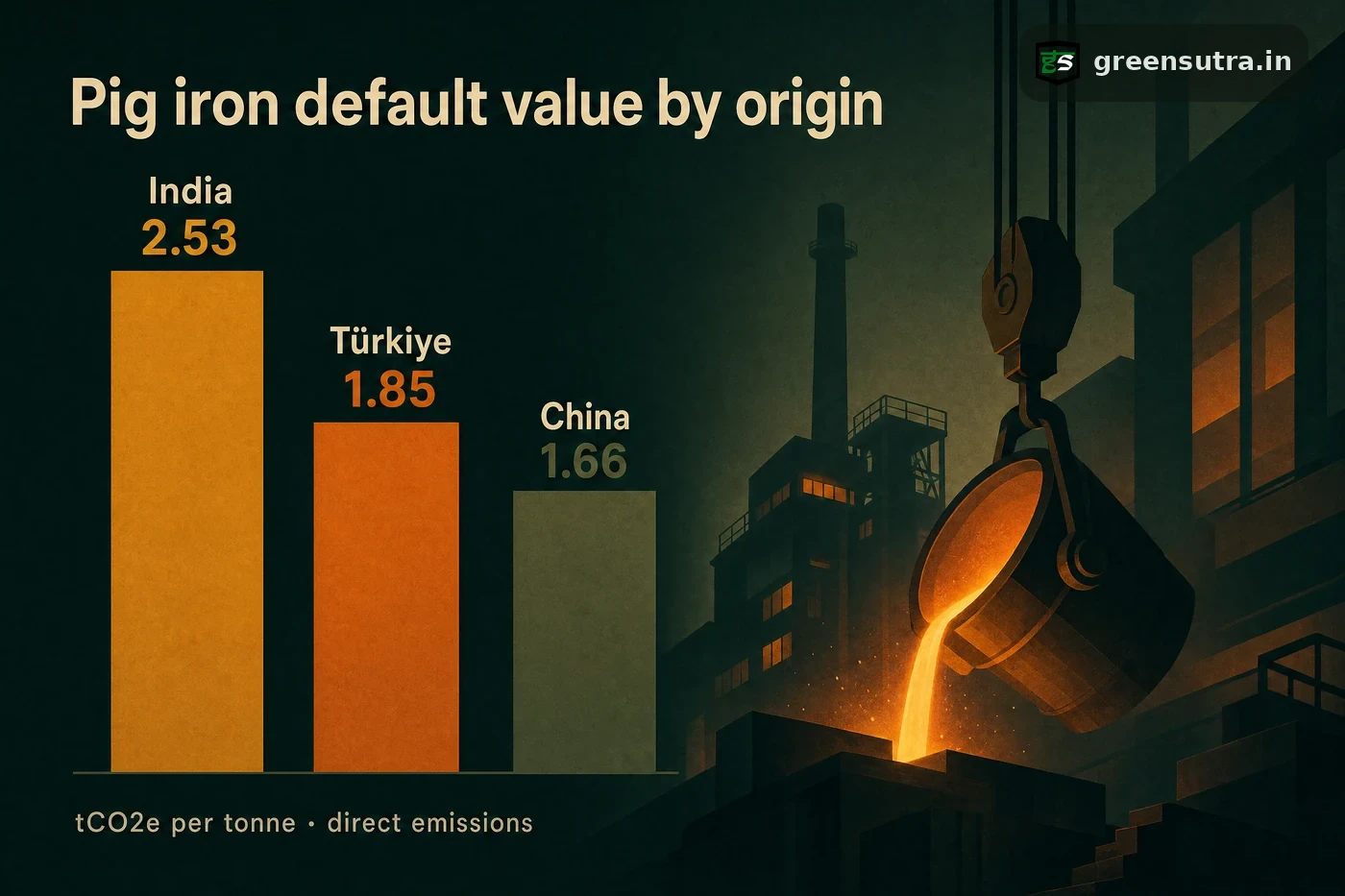
CBAM prices the carbon embedded in goods imported into the European Union. Where an importer declares iron or steel without verified installation data, the European Commission’s default values apply, and two rules shape the number. First, defaults are specific to the country of origin, so the India set differs from every other origin: pig iron carries 2.53 tCO2e per tonne for India against about 1.66 for China and 1.85 for Türkiye, with a 3.48 fallback for origins without a published pig iron value. Second, iron and steel is an Annex II good, so only direct emissions are priced; indirect, electricity related emissions are excluded. Each default then carries a regulatory mark-up of 10 percent in 2026, 20 percent in 2027 and 30 percent from 2028.
India default values for key steel products
| Product | Representative CN | Base default (tCO2e/t) | 2026 with mark-up |
|---|---|---|---|
| Pig iron | 7201 | 2.53 | 2.78 |
| Direct reduced iron (DRI) | 7203 | 4.20 | 4.62 |
| Hot-rolled flat products | 7208 | 4.28 | 4.71 |
| Bars and rods | 7213 · 7214 | 4.27 to 4.32 | 4.70 to 4.75 |
| Stainless flat products | 7219 | 6.49 to 6.50 | 7.14 to 7.15 |
Source: Implementing Regulation (EU) 2025/2621, Annex I. Direct emissions only.
What the defaults mean for an Indian exporter
On the default path the certificate bill scales with the marked up value, the EU ETS price, which averaged EUR 75.36 per tonne of CO2e in the first quarter of 2026, and a payable share that climbs from 2.5 percent in 2026 to 100 percent by 2034. On a single line of 500 tonnes a year of hot-rolled flat steel, the illustrative cost rises from about EUR 4,400 in 2026 to over EUR 200,000 in 2034. Verified actual data usually declares below the marked up default, especially for electric arc furnace production; on the same line it cuts the 2034 bill from about EUR 209,652 to EUR 82,896.
Three steps follow for any exporter on the default path:
- Match every exported product to its CN code in Annex I of Regulation (EU) 2023/956.
- Compare the marked up India default against the installation’s actual production route; CBAM reporting has required actual rather than estimated data since 1 August 2024.
- Estimate the position year by year in the CBAM cost calculator, then take it to a CBAM consultant to prepare installation data for verification by an accredited verifier.
Sources: Implementing Regulation (EU) 2025/2621 · Regulation (EU) 2023/956