EUDR Solutions for Exporters of

EU Deforestation Regulation readiness for Indian exporters of coffee, cocoa, rubber, soya, leather and wood, and the European operators that place those goods on the market. Plot geolocation, deforestation-free evidence after the 31 December 2020 cut-off and the due diligence statement readied as one engagement from Mumbai before the obligations apply from 30 December 2026.

Geolocate · Evidence · FileSeven covered commoditiesIndia benchmarked low risk

Reviewed by Team GreenSutra · Updated 12 June 2026

On recordRegulationRegulation (EU) 2023/1115Covered commoditiesSeven, plus Annex I productsDeforestation-free cut-offAfter 31 December 2020India risk statusLow riskCore dutyDue diligence and geolocationMaximum fine floorAt least 4 percent of turnover
01

From a future obligation to a ready supply chain

For Indian exporters of coffee, cocoa, rubber, soya, leather and wood, and the EU operators who place those goods on the market.

EUDR Solutions by GreenSutra prepare an Indian export supply chain for the EU Deforestation Regulation, Regulation (EU) 2023/1115, before its obligations apply. One accountable engagement maps the commodities, geolocates the plots, assembles deforestation-free evidence and readies the trail so the European operator can file the due diligence statement in the EU information system and pass the reference number down the chain.

WHAT THE REGULATION WILL REQUIRE

The regulation will require that seven relevant commodities and their Annex I derived products reach the European market only when deforestation-free and legally produced. It covers cattle, cocoa, coffee, oil palm, rubber, soya and wood, including derived goods such as leather, chocolate and furniture. The operator must hold plot geolocation and evidence that the land was not subject to deforestation after 31 December 2020, with wood harvested without inducing forest degradation after that date, before placing the goods on the market or exporting them.

WHEN DO THE OBLIGATIONS APPLY

The obligations are not yet applying. As amended by Regulation (EU) 2025/2650, the regulation will apply from 30 December 2026 for medium and large operators and traders, and from 30 June 2027 for micro and small operators and traders established by 31 December 2024.

WHY INDIA SITS IN THE LOW-RISK BAND

India is benchmarked a low-risk country under Implementing Regulation (EU) 2025/1093. An operator sourcing exclusively from India may apply the simplified due diligence of Article 13 and set aside the risk assessment and risk mitigation steps, unless it becomes aware of a non-compliance risk. The information and geolocation duties remain in every case.

WHAT THE ENGAGEMENT DELIVERS

  • Commodity map checking products against the seven covered commodities and the Annex I derived-product list
  • Plot geolocation by latitude and longitude, and polygons where a plot is larger than four hectares for commodities other than cattle
  • Deforestation-free evidence that the land was not deforested after the 31 December 2020 cut-off
  • Traceability records kept so the European buyer can rely on the chain
  • Statement-ready trail so the operator can file the due diligence statement and pass the reference number on
02

EUDR dates and duties at a glance

The application dates after two delays, the covered commodities and the two due diligence tracks.

The regulation has been in force since 29 June 2023 and the deforestation cut-off has never moved: land deforested after 31 December 2020 cannot supply covered goods. What moved twice are the application dates.

EUDR application dates as amended
StageMedium and large operatorsMicro and small operators
Original, Regulation (EU) 2023/111530 December 202430 June 2025
First delay, Regulation (EU) 2024/323430 December 202530 June 2026
Current, Regulation (EU) 2025/265030 December 202630 June 2027
The seven covered commodities and examples of Annex I derived products
CommodityDerived products include
CattleBeef, leather and hides
CocoaCocoa butter, chocolate
CoffeeRoasted and decaffeinated coffee
Oil palmPalm oil, glycerol and derivatives
RubberTyres, tubes, rubber articles
SoyaSoya beans, flour and meal
WoodTimber, furniture, pulp and paper
Standard due diligence compared with the simplified low-risk track
DutyStandard due diligenceSimplified, Article 13, low-risk sourcing
Plot geolocationRequired, six decimal digits, polygons over four hectares.Required identically.
Deforestation-free and legality evidenceRequired against the 31 December 2020 cut-off.Required identically.
Risk assessmentRequired for every supply chain.Set aside unless non-compliance information emerges.
Risk mitigationRequired where risk is found.Set aside unless non-compliance information emerges.
Due diligence statementFiled before first placing on the market.Filed identically.

India is benchmarked low risk under Implementing Regulation (EU) 2025/1093, so exclusively Indian sourcing qualifies for the simplified track, and authorities need check only 1 percent of operators on low-risk origins against 3 percent standard and 9 percent high risk. The information duties in the first two rows never fall away.

03

Commodities covered by the EUDR

The seven relevant commodities, with the derived products each carries and how the obligation attaches.

The EU Deforestation Regulation lists seven relevant commodities and the products derived from them in Annex I. The obligation follows the commodity and its derived products rather than the trade name, so the commodities below act as the guide. Printed Chapter 49 products such as books and newspapers were removed from Annex I by Regulation (EU) 2025/2650.

Coffee

Green and roasted coffee and coffee extracts, a leading Indian export to the European market grown in Karnataka and Kerala.


Annex I commodityRoasted · extracts

Rubber

Natural rubber and derived products including tyres, sheets and latex, sourced from Kerala and the North-East.

Annex I commodityTyres · sheets · latex

Soya

Soya beans and derived products including soya meal and soya oil placed on the European market.

Annex I commoditySoya bean · meal · oil

Cattle

Cattle and derived products including leather and hides; geolocation polygons do not apply to cattle plots.

Annex I commodityLeather · hides

Cocoa

Cocoa beans and derived products including chocolate and cocoa butter listed in Annex I.

Annex I commodityChocolate · cocoa butter

Oil palm

Oil palm fruit and palm oil and its derivatives placed on the European market.

Annex I commodityPalm oil · derivatives

Wood

Wood and derived products including timber, furniture, pulp and paper, with degradation as well as deforestation in scope.

Annex I commodityTimber · furniture · pulp · paper

A precise check of which commodities and derived products a business exports, and in what role toward the European market, is the first step of every EUDR readiness review.

04

How an EUDR engagement runs

From commodity scoping and plot geolocation through deforestation-free evidence and the filed statement to a cleared border.
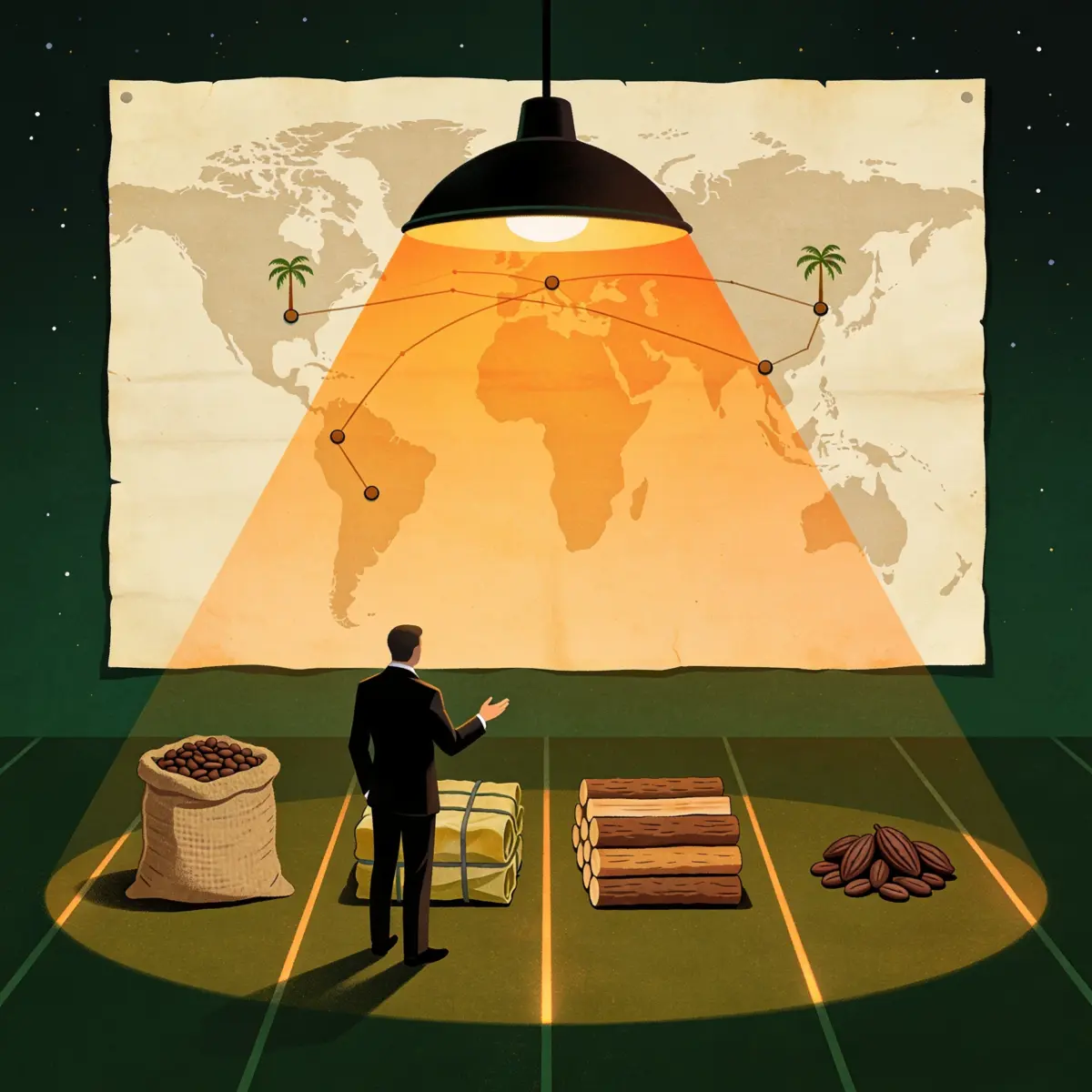
EUDR consultant scoping coffee, rubber and timber export commodities back along the supply chain to their production plots
01

Scope the commodities and supply chains

Products checked against the seven covered commodities and the Annex I derived-product list, the role toward the European market confirmed, and every supply chain back to the production plot identified.

Field officer geolocating a coffee plantation plot by GPS coordinates and a boundary polygon beside the growers at night
02

Geolocate the production plots

Every plot supplying the export located by latitude and longitude to at least six decimal digits, and described as a polygon where the plot is larger than four hectares for commodities other than cattle.

Analyst reviewing satellite forest-cover history and land records against the deforestation-free cut-off with coffee, cocoa and timber samples
03

Assemble deforestation-free evidence and assess risk

Proof that each plot was not deforested after 31 December 2020 assembled from satellite history, land records and supplier declarations, with the simplified due diligence of Article 13 applied where sourcing is exclusively from low-risk India.

Compliance analyst filing an EUDR due diligence statement in the EU information system and receiving a reference number on screen
04

File the due diligence statement

Geolocation, evidence and traceability records compiled so the European operator can file the due diligence statement in the EU information system and obtain the reference number passed down the chain.

Coffee and rubber consignments clearing the European border at a night port while an officer checks the due diligence reference number
05

Clear the border and keep watch

Once the obligations apply, the goods clear the European border with the reference number demonstrating compliance, and the geolocation and evidence are kept current for every later consignment.

05

How EUDR due diligence flows from origin plot to EU market

A commodity from a geolocated plot clears due diligence, the statement is filed in the EU information system, and the goods enter the market.

How EUDR due diligence flows from a surveyed plot to the EU marketTechnical surveyor sheet of the EU Deforestation Regulation due diligence mechanism, drawn as a plot-to-port cross section. A relevant commodity is grown on a geolocated origin plot, recorded as polygons of the plot of land with vertex survey ticks and the latitude and longitude of each corner. The seven relevant commodities and their derived products are cattle, cocoa, coffee, oil palm, rubber, soya and wood, including leather and furniture. The operator builds an evidence bench from satellite forest-cover imagery and land records, checks production against the deforestation-free cut off, and assesses the country risk benchmark, which classifies India as low risk under Regulation (EU) 2025/1093. The operator then submits a due diligence statement at a filing desk into the EU Information System, receives a reference number that is recorded in the register, and the cleared consignment crosses the border into the European Union market once customs verify the statement.1122334455667788AABBCCDDEEFFREGULATIONEU 2023/1115AMENDED 2025/2650EU INFORMATIONSYSTEMORIGIN PLOTGEOLOCATED PRODUCTION01SUPPLY CHAINCOMMODITY AND DERIVED02DUE DILIGENCEEVIDENCE · RISK BENCH03DDS FILEDEU INFORMATION SYSTEM04EU MARKETBORDER CLEARED05SURVEY INSET · PLANNLATITUDE · LONGITUDEPLOT TO PORT SECTION · NTSORIGIN · CHAIN OF CUSTODYRELEVANT · DERIVEDSEVEN COMMODITIESLEATHER · FURNITURECONSIGNMENT TO QUAYSAT IMAGELAND RECORDINDIA LOW RISKGEOLOCATION · LEGALITYBGEOLOCATIONLEGAL PRODUCTIONRISK MITIGATEDDETAIL B · NTSDUE DILIGENCE STATEMENTEU INFORMATION SYSTEMDDS REFERENCEREFERENCE RECORDEDTHIRD COUNTRYEUROPEAN UNIONCLEARED CONSIGNMENTCOLOUR KEYPLOTS AND LANDVERIFICATIONCOMMODITIESRISK FLAGFILINGDRAWINGEUDR · SURVEYOR SHEETSTATUSDWG NOGS·EUDR·02REVBDATE2026·06
01Origin plot

A relevant commodity is grown on a geolocated production plot, recorded by latitude and longitude and, where the plot is larger than four hectares for commodities other than cattle, by a polygon of the plot perimeter.

02Supply chain

The commodity and its Annex I derived products travel the supply chain from the Indian producer toward the European operator that will place them on the market or export them.

03Due diligence

The operator collects the Article 9 information and, where sourcing is not from a low-risk country, assesses and mitigates the risk that the goods are not deforestation-free or not legally produced.

04DDS filed

The operator first placing on the market or exporting files a due diligence statement in the EU information system and receives a reference number; downstream operators pass that reference number on.

05EU market

Once the statement is filed, the goods clear the European border and enter the EU market, with the reference number demonstrating compliance down the chain.

A relevant commodity grown on a geolocated origin plot travels the supply chain to the operator placing it on the EU market or exporting it. That operator files a due diligence statement in the EU information system and obtains a reference number, which downstream operators pass on, before the goods clear the border. Sourcing exclusively from low-risk India sets the Article 13 risk steps aside.

06

EUDR exposure self-check

Three answers map an export trade onto the EU Deforestation Regulation.

Three questions place an export trade against the EU Deforestation Regulation: the commodities or derived products involved, who places the goods on the European market, and the size of the operator that does. The result states what the regulation will require and from when.

Three questions decide EUDR exposure: which relevant commodities or derived products the business exports to the European market, who places the goods on the market, and the size of that operator. An EUDR readiness review works through all three with the supply chain on the table.

Request an EUDR readiness review

Answers stay in this browser. Nothing is sent until a contact channel is opened.

Due diligence runs from the geolocated origin plot to the statement filed in the EU information system, and a readiness review turns that path into a geolocated, evidenced, ready supply chain before the obligations apply.

Request an EUDR readiness review
07

Benefits of EUDR solutions

What an EUDR-ready supply chain earns an exporter and its European operator before the obligations apply.

B·01

Market access protected

Plot geolocation and deforestation-free evidence ready ahead of the application dates keep covered commodities moving into the European market when the obligations apply.

B·02

Traceability in place

Every plot located and documented, so the European operator can file an accurate due diligence statement and pass the reference number down the chain.

B·03

Preferred supplier status

A ready trail of geolocation and evidence positions the Indian exporter as a low-friction supplier to European operators sourcing under the regulation.

B·04

Low-risk advantage

India benchmarked low risk lets the European operator apply simplified due diligence, an advantage that holds while the information and geolocation duties are met cleanly.

Geolocated coffee, rubber and timber plots feeding a due diligence statement that clears Indian export goods into the European market
Readiness that protects market access
08

Why GreenSutra leads EUDR consulting

The reasons behind the reputation.

R·01

Certified expertise

Each engagement led by a certified specialist with proven experience across deforestation due diligence and supply-chain traceability.

R·02

EU and India regulatory fluency

Working knowledge of the EU Deforestation Regulation as amended alongside Indian export realities, so guidance fits both sides of the trade.

R·03

Geolocation discipline

Plot coordinates and polygons captured to the standard the regulation sets, including the cattle carve-out, so the data stands up at the European border.

R·04

End to end delivery

Commodity mapping, geolocation, deforestation-free evidence, traceability and statement readiness handled as one accountable engagement, or any stage standalone.

R·05

Mumbai based, serving worldwide

EUDR readiness delivered to exporters and their European operators worldwide from a Mumbai base.

09

Built for every covered commodity

The same geolocation and evidence discipline, tuned to the commodity and the operators it supplies.

01

Coffee and cocoa exporters

Plantation plots geolocated and deforestation-free evidence assembled so European operators can file the statement.

02

Rubber and oil palm suppliers

Smallholder and estate plots mapped to coordinates and polygons, with traceability kept for the European buyer.

03

Soya and leather producers

Soya and cattle-derived goods evidenced as deforestation-free, with the cattle polygon carve-out applied correctly.

04

EU operators and traders

Operators and traders sourcing from India obtain ready geolocation and evidence to file accurate due diligence statements.

Every covered commodity carries the same geolocation and evidence discipline, tuned to the exporter and the European operators it supplies.

Request an EUDR readiness review
10

EUDR questions, answered

Q·01What are EUDR solutions?
EUDR solutions prepare a business for the EU Deforestation Regulation, Regulation (EU) 2023/1115, which will require covered commodities to be deforestation-free and legally produced before they reach the European market. The work covers mapping products against the seven covered commodities, geolocating every production plot, assembling evidence that the land was not deforested after 31 December 2020, and readying the trail so the European operator can file the due diligence statement in the EU information system. The aim is an export supply chain that is ready before the obligations apply.
Q·02When does the EUDR start applying after the latest delay?
Under Regulation (EU) 2025/2650, published on 23 December 2025, the obligations will apply from 30 December 2026 for medium and large operators and traders, and from 30 June 2027 for micro and small operators and traders established by 31 December 2024. The earlier 30 December 2025 and 30 June 2026 dates set by Regulation (EU) 2024/3234 are superseded, and the original 30 December 2024 date never took effect. The regulation is not yet applying, so the period now is a preparation window.
Q·03Which commodities does the EUDR cover?
The regulation covers seven relevant commodities: cattle, cocoa, coffee, oil palm, rubber, soya and wood, together with the products derived from them listed in Annex I, such as leather, chocolate, furniture, soya meal and palm oil derivatives. Printed products of Chapter 49 of the Combined Nomenclature, such as books and newspapers, were removed from Annex I by Regulation (EU) 2025/2650 and are no longer in scope.
Q·04Is India high risk or low risk under the EUDR?
India is classified a low-risk country under Commission Implementing Regulation (EU) 2025/1093 of 22 May 2025. An operator sourcing exclusively from a low-risk country may apply the simplified due diligence of Article 13, which sets aside the risk assessment and risk mitigation steps unless the operator becomes aware of information pointing to a risk of non-compliance. Only four countries are classified high risk, and India is not among them, so the low-risk benchmark is a genuine advantage for Indian exporters.
Q·05What is the deforestation-free cut-off date?
A commodity must be produced on land that was not subject to deforestation after 31 December 2020, and wood must be harvested without inducing forest degradation after that date. The cut-off is a fixed baseline and was not changed by the 2025 amendment, so plots that were forest after that date and cleared since cannot supply covered commodities to the European market once the obligations apply.
Q·06What geolocation data does the EUDR require?
Due diligence requires the geolocation of every plot of land where the commodity was produced, given as latitude and longitude using at least six decimal digits. For plots of more than four hectares used to produce relevant commodities other than cattle, the geolocation must be provided as polygons describing the plot perimeter. Cattle plots are exempt from the polygon requirement, which is a point the data capture has to get right.
Q·07Do Indian exporters file the due diligence statement themselves?
The due diligence statement is filed in the EU information system by the operator that first places the goods on the market or exports them, which is usually the European-side operator. An Indian supplier provides the plot geolocation, the deforestation-free evidence and the traceability records that the operator needs. Where the exporter places the goods on the market through its own European entity, that entity is the operator and files the statement itself.
Q·08Does every business in the chain file a separate statement?
No. As amended by Regulation (EU) 2025/2650, the full due diligence statement obligation falls on the operator carrying out the first placing on the market or export. A downstream operator registers in the information system and passes on the reference number issued for that statement rather than filing a fresh one. A micro or small primary operator uses a one-time simplified declaration and receives a declaration identifier sufficient for traceability.
Q·09What can the fines be for breaking the EUDR?
Under Article 25 the maximum fine must be set at least at 4 percent of the operator or trader total annual Union-wide turnover in the year before the fining decision, and each EU Member State sets the actual level and may go higher. Penalties also include confiscation of the relevant products and of the revenues gained, temporary exclusion of up to 12 months from public procurement and public funding, and, for serious or repeated infringements, a temporary ban on placing the products on the market or exporting them.
Q·10Is the low-risk status enough to skip due diligence?
No. India being low risk lets the European operator apply the simplified due diligence of Article 13, which sets aside the risk assessment and risk mitigation steps, but the information and geolocation duties remain in every case. Plot coordinates, polygons for plots over four hectares other than cattle, and evidence that the land was not deforested after 31 December 2020 are still required, and the simplification falls away if the operator becomes aware of a non-compliance risk.
Q·11How many EUDR checks do authorities run on low-risk sourcing?
Member State authorities must check at least 9 percent of operators placing products from high-risk countries, 3 percent for standard-risk countries and 1 percent for low-risk countries, counted per commodity under Article 16. Sourcing from India therefore sits in the lightest inspection tier, provided the geolocation and evidence package behind each due diligence statement holds up when a check does come.
Q·12Does meeting the EUDR also cover other EU import rules?
No. The EU Deforestation Regulation is one of several European frameworks an Indian exporter may face, separate from the Carbon Border Adjustment Mechanism and other EU rules. A business serving the European market may carry more than one obligation at once, and meeting the EUDR satisfies only the deforestation due diligence requirement. Where several frameworks apply, planning them together keeps each obligation from being missed.
13

Request an EUDR readiness review

A short conversation about the commodities exported, the plots that supply them and the European operators involved turns into a tailored EUDR plan. Schedule a call directly or send a written brief.

01Schedule a call

Pick the service and a slot; a practitioner takes the call.

02Write to us
Contact Us
EUDR geolocated, evidenced and ready before the obligations applyRequest an EUDR readiness review

Check your EUDR readiness

Answer a few questions about your commodities, suppliers and geolocation data — our team maps your due-diligence obligations and returns a tailored Scope of Work.

Start your EUDR discovery →