

Sustainability Training for India
Corporate sustainability training that moves teams from passive awareness to empowered action. A catalogue of instructor-led and blended modules across ESG, CBAM, carbon, water, solar, BRSR, EPR and energy, each anchored to a recognised standard and built around the role and the regulation a team actually faces, delivered as one accountable engagement from Mumbai across India.
Reviewed by Team GreenSutra · Updated 10 June 2026
From passive awareness to empowered action
For the finance, operations, supply chain and sustainability teams who carry the obligations.
Sustainability training is the work of turning a policy on a wall into a decision a team makes every day. Sustainability has moved from a corporate initiative into the operating context of every department, so the people in finance, operations, procurement and the plant need to understand how Environmental, Social and Governance principles shape the choices in front of them.
The pressure is concrete. The top 1000 listed companies report under SEBI BRSR, exporters of covered goods face the CBAM definitive phase from 1 January 2026, supply chains carry Extended Producer Responsibility and Scope 3 carbon questions, and water-stressed operations carry a neutrality agenda. Yet the demand for green skills is rising faster than the supply of people who hold them.
Sustainable Trainings by GreenSutra close that gap with a catalogue of modules, each anchored to a recognised standard: ESG and BRSR to the disclosure frameworks, carbon to the GHG Protocol and ISO 14064, CBAM to Regulation (EU) 2023/956, water to the NITI Aayog framework, and solar and energy to the Ministry and the Bureau of Energy Efficiency. Every module is built around the role and the regulation a team actually faces.
An engagement runs from a needs assessment through a sequenced curriculum to delivery, assessment and a train-the-trainer hand-off, so the capability stays inside the organisation. Based in Mumbai and delivering across India, GreenSutra has run training across solar, ESG, CBAM and water programmes for teams in many states, with the detailed reach available on request.
The training catalogue
Eight modules, each anchored to a recognised standard and built around a role.
ESG fundamentals
The Environmental, Social and Governance framework, materiality, disclosure frameworks and the key performance indicators a team reports against.
View →M·02CBAM readiness
The six covered sectors, authorised declarant status, embedded-emissions reporting and certificate obligations under the definitive phase.
View →M·03Carbon footprint
Scope 1, 2 and 3 inventories on the GHG Protocol and ISO 14064, verification readiness and science-based target setting.
View →M·04BRSR reporting
The BRSR and BRSR Core framework for the top 1000 listed companies, the core attributes and assurance readiness.
View →M·05Solar and energy
Solar feasibility, Scope 2 reduction and the energy management discipline behind the Bureau of Energy Efficiency certifications.
View →M·06EPR and procurement
Extended Producer Responsibility across plastic, e-waste and batteries, and sustainable procurement across the supply chain.
View →M·07Water neutrality
The water footprint, baseline development, physical and regulatory risk and the neutrality strategies of reduce, reuse and offset.
View →M·08Energy conservation
Systematic energy audits, the thermal and electrical systems, and preparation for the energy manager and auditor certification.
View →The catalogue is modular, so a pathway is assembled from the modules a team needs rather than bought as a fixed course, and a needs assessment sets the sequence.
WhatsAppRequest a training plan →How a Sustainable Training engagement runs
From a needs assessment to a certified, self-sustaining team.

Needs assessment
The current maturity audited, the roles and obligations mapped, and the skill gaps and learning objectives set against the regulations the organisation faces.

Curriculum design
A sequenced learning pathway assembled from the module catalogue, tuned to the function and the regulation, with assessment gates and a train-the-trainer route where internal capacity is the goal.

Delivery
Instructor-led workshops, blended e-learning and cohort sessions delivered in house or online, grounded in Indian supply-chain, BRSR and CBAM case material rather than generic theory.

Assessment and certification
Competency checks against the learning objectives, certificates of completion, and preparation for external credentials where a module aligns to a GRI, BEE or NISM syllabus.

Train the trainer
Internal champions equipped to run refresher sessions, so the capability stays inside the organisation and the learning continues after the engagement closes.
How a training pathway is built and delivered
A needs assessment opens onto a sequenced curriculum, delivered, assessed and handed to internal trainers.
Roles, obligations and skill gaps are mapped against the regulations the organisation faces, from BRSR and CBAM to carbon, water and energy.
A learning pathway is sequenced from the module catalogue, tuned to the function and the regulation, with assessment gates set along the way.
Instructor-led workshops, blended e-learning and cohort sessions are delivered in house or online, grounded in Indian case material.
Competency is checked against the learning objectives, certificates of completion are issued, and external credential preparation is offered where modules align.
Internal champions are equipped to run refresher sessions, so the capability stays in house and the learning continues.
A needs assessment maps the roles, obligations and skill gaps, a curriculum is sequenced from the module catalogue, delivery runs through instructor-led and blended sessions grounded in Indian case material, competency is assessed and certified, and a train-the-trainer hand-off keeps the capability inside the organisation.
Training pathway selector
Two answers point to the module track and the depth that fit a team.
Two questions place a team against the training catalogue: the priority topic in front of it, and the level it starts from. The result names the module track to begin with and how to sequence the depth.
- 01Priority
- 02Level
- ··Result
Two questions decide a training pathway: the priority topic in front of the team, from ESG and BRSR to CBAM, carbon, water, solar and EPR, and the level it starts from. A needs assessment turns both into a sequenced curriculum from the module catalogue.
Request a training plan →- Needs assessmentAt the start of the engagement
- DeliverySequenced across the cohort
- RefresherRun by internal trainers
The ESG and BRSR track fits
The priority is disclosure, so the pathway opens with ESG fundamentals, the framework, materiality and the key performance indicators, and runs into BRSR reporting for the top 1000 listed companies, the core attributes and assurance readiness. A carbon footprint module sits naturally alongside, since the emissions numbers feed the report.
The CBAM readiness track fits
The priority is the export border, so the pathway opens with CBAM readiness, the six covered sectors, authorised declarant status, embedded-emissions reporting and the certificate obligations of the definitive phase from 1 January 2026. A carbon footprint module supports it, since the embedded emissions are a Scope 1 and 2 calculation at heart.
The carbon and net zero track fits
The priority is the carbon inventory, so the pathway opens with the carbon footprint module on the GHG Protocol and ISO 14064, Scope 1, 2 and 3, verification readiness and science-based target setting. It carries into BRSR or CBAM depending on whether the driver is disclosure or the export border.
The water neutrality track fits
The priority is water, so the pathway opens with the water neutrality module, the water footprint, baseline development, the physical and regulatory risk and the neutrality strategies of reduce, reuse and offset, drawing on the NITI Aayog framework, ISO 46001 and GRI 303. An energy module pairs with it for water-stressed manufacturing.
The solar and energy track fits
The priority is energy, so the pathway opens with the solar and energy module, feasibility, the Scope 2 reduction and the energy management discipline, and runs into the energy conservation module and its preparation for the Bureau of Energy Efficiency certifications. A carbon module quantifies the reduction the energy work delivers.
The EPR and procurement track fits
The priority is the supply chain, so the pathway opens with the EPR and procurement module, Extended Producer Responsibility across plastic, e-waste and batteries, and sustainable procurement across suppliers. A Scope 3 carbon module supports it, since supplier emissions are where most of the footprint sits.
A short needs assessment sets the pathway
The priority is still being mapped, so the strongest pathway cannot be fixed from the answers alone. A needs assessment maps the roles, the obligations and the skill gaps, and sequences the module catalogue into a pathway tuned to the function and the regulation the team faces.
Starting from awareness, the pathway opens with the fundamentals of the chosen track and builds the depth in sequence, so the team is grounded before the advanced material.
With basic awareness in place, the pathway moves quickly through the fundamentals into the working material, the calculations, the framework and the reporting the role needs.
With reporting already in place, the pathway focuses on the gaps, the assurance readiness and the advanced material, rather than repeating the basics.
Ready for certification, the pathway is built around external credential preparation where the module aligns to a GRI, BEE or NISM syllabus, alongside a train-the-trainer route to keep the capability in house.
Answers stay in this browser. Nothing is sent until a contact channel is opened.
A pathway runs from a needs assessment through a sequenced curriculum to delivery, assessment and a train-the-trainer hand-off that keeps the capability in house.
WhatsAppRequest a training plan →Benefits of sustainability training
What a standards-anchored, role-built training programme earns an organisation.
Compliance capability
Teams equipped to meet BRSR, CBAM, EPR and carbon obligations from the inside, so reporting and readiness rest on understanding rather than outsourcing.
Engagement and retention
Staff who see their role in the sustainability agenda are more engaged, and the capability built stays with the organisation.
Standards alignment
Every module anchored to a recognised standard, from the GHG Protocol and ISO 14064 to BRSR, CBAM and the Bureau of Energy Efficiency syllabi.
Self-sustaining
A train-the-trainer hand-off and certificates of completion that keep the learning running after the engagement closes.
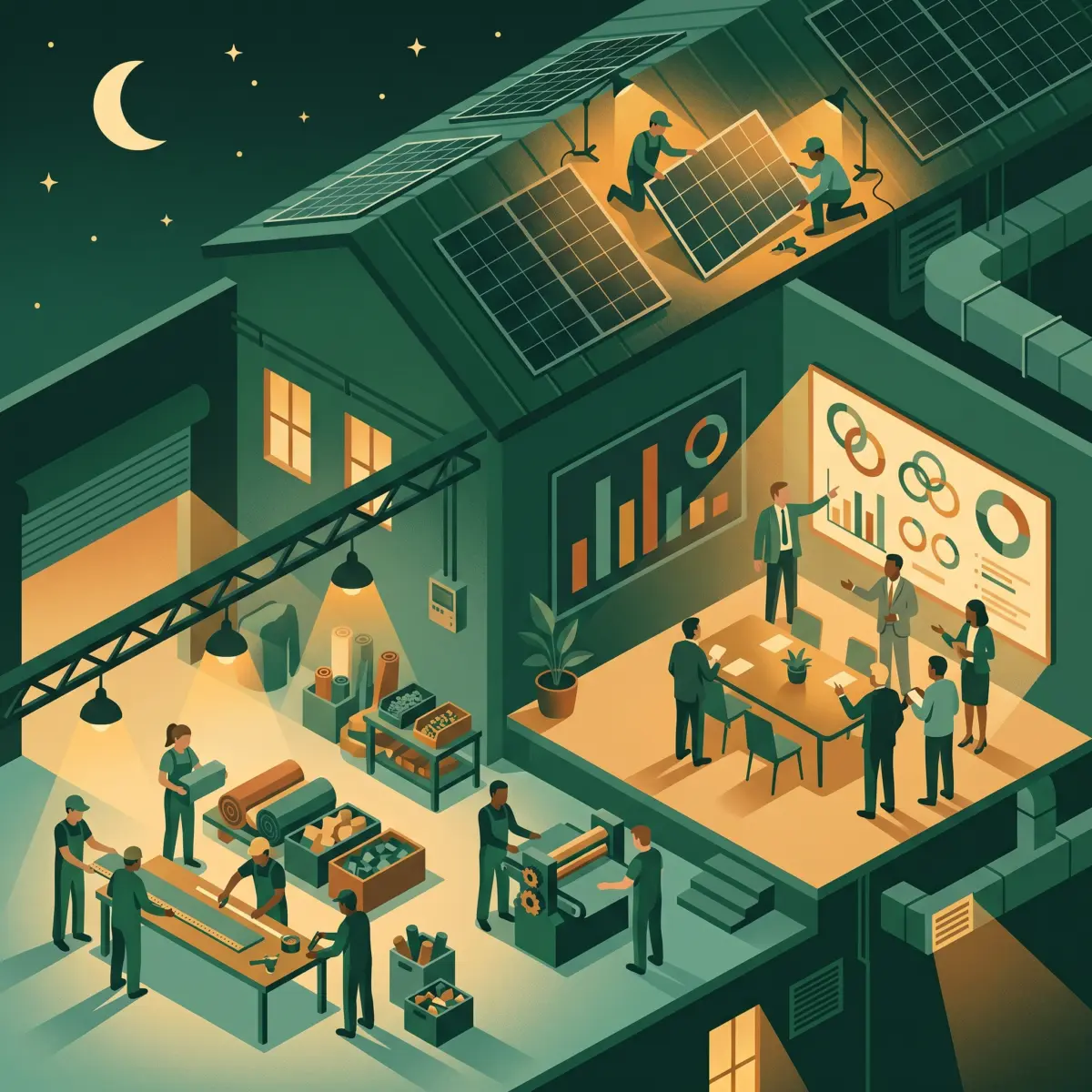
Why GreenSutra leads sustainability training
The reasons behind the reputation.
Practitioner-led
Modules taught by specialists who run CBAM, BRSR, carbon and solar engagements, so the training carries working practice rather than slides.
Indian case material
Curricula grounded in Indian BRSR timelines, CPCB rules and supply-chain cases, not a generic Western ESG syllabus.
Modular pathways
A catalogue assembled into a pathway tuned to the role and the regulation, from a fast compliance track to a deep mastery route.
Train the trainer
Internal champions equipped to deliver refreshers, so the capability scales and stays in house.
Multi-state reach
Training delivered across solar, ESG, CBAM and water programmes for teams in many states, with detailed reach available on request.
Built for the teams who carry the obligations
The same assess, design and deliver discipline, tuned to the function and the regulation.
Manufacturing
High Scope 1 and 2 emissions, water intensity and CBAM goods, supported with carbon, water, energy and CBAM modules.
Supply chain and exports
CBAM declarants and Scope 3 reporting, supported with CBAM, carbon and EPR and procurement modules.
Listed companies
The top 1000 under BRSR Core, supported with ESG, BRSR and carbon modules and assurance-readiness preparation.
Real estate and facilities
Energy and water-intensive operations, supported with solar, energy conservation and water neutrality modules.
Every sector carries its own obligations, and the module mix shifts to match, from CBAM for exporters to BRSR for listed companies and water for manufacturing.
WhatsAppRequest a training plan →Sustainability training questions, answered
Q·01What is sustainability training?
Q·02Which training modules are available?
Q·03What standards do the modules anchor to?
Q·04Who should attend sustainability training?
Q·05How is the training delivered?
Q·06Is the training customised to the organisation?
Q·07Does the training lead to a certification?
Q·08What is the CBAM training module?
Q·09What is the BRSR training module?
Q·10Can training build internal capability rather than ongoing dependence?
Q·11How many people has GreenSutra trained?
Q·12Where does GreenSutra deliver training?
Primary sources
Every standard named on this page traces to one of these references.
Asked at the Expert's Corner
Real sustainability and reporting questions from the community, answered by the GreenSutra team.
What is ESRS?
The European Sustainability Reporting Standards are referred to as ESRS. Organizations that are subject to the Corporate Sustainbility Reporting Directive have to report according…
Answered by the GreenSutra team→Q · 02Sustainability4,317 viewsWhat is CSRD?
CSRD stands for Corporate Sustainability Reporting Directive. Corporate Sustainability Reporting Directive is a regulatory framework introduced by the the European Union aimed at improving…
Answered by the GreenSutra team→Q · 03Sustainability4,038 viewsWhat is GCP?
GCP stands for the Green Credit Programme, India's market based mechanism for rewarding voluntary environmental action. Notified under the Green Credit Rules, 2023, it…
Answered by the GreenSutra team→Q · 04Sustainability3,414 viewsWhen do the Ecomark Rules 2024 come in force?
The Ministry of Environment, Forest and Climate Change (MoEFCC) on 26th Septmeber 2024 notified the Ecomark Rules 2024. The Ecomark Rules, 2024 came into force from 1st October 2024, the…
Answered by the GreenSutra team→Q · 05Sustainability3,410 viewsWhat are the conditions for grant of Ecomark?
Under the Ecomark Rules 2024, an Ecomark may be granted to product(s) if they adhere or meet specific sustainability or environmental criterias such as…
Answered by the GreenSutra team→Q · 06Sustainability3,407 viewsWhat is Greenwashing?
Greenwashing may be referred to as any practice or tatic that misrepresents, misleads, conceals by means of exaggerating, making vague, false or unsubstaintiated environmental…
Answered by the GreenSutra team→Q · 07Sustainability3,392 viewsWhat is the procedure for grant of Ecomark?
The Ecomark Rules 2024 have come into force from 1st October 2024. Products that meet specific sustainability or environmental criteras may be granted an…
Answered by the GreenSutra team→Q · 08CBAM3,138 viewsWhat are the salient features of the Green Steel Taxonomy of India?
As per definitation, Green Steel shall be expressed as percentage of greenness of steel which is produced from the steel plant having emissions intensity…
Answered by the GreenSutra team→Request a training plan
A short conversation about the team, its roles and the obligations it faces turns into a sequenced training pathway from the module catalogue. Schedule a call, send a written brief, or reach the training desk directly; a practitioner takes it from there.
Pick the service and a slot; a practitioner takes the call.
Field notes and stories
Reading on ESG, carbon and disclosure from the GreenSutra journal.
Maintained by GreenSutra · Last reviewed June 2026