

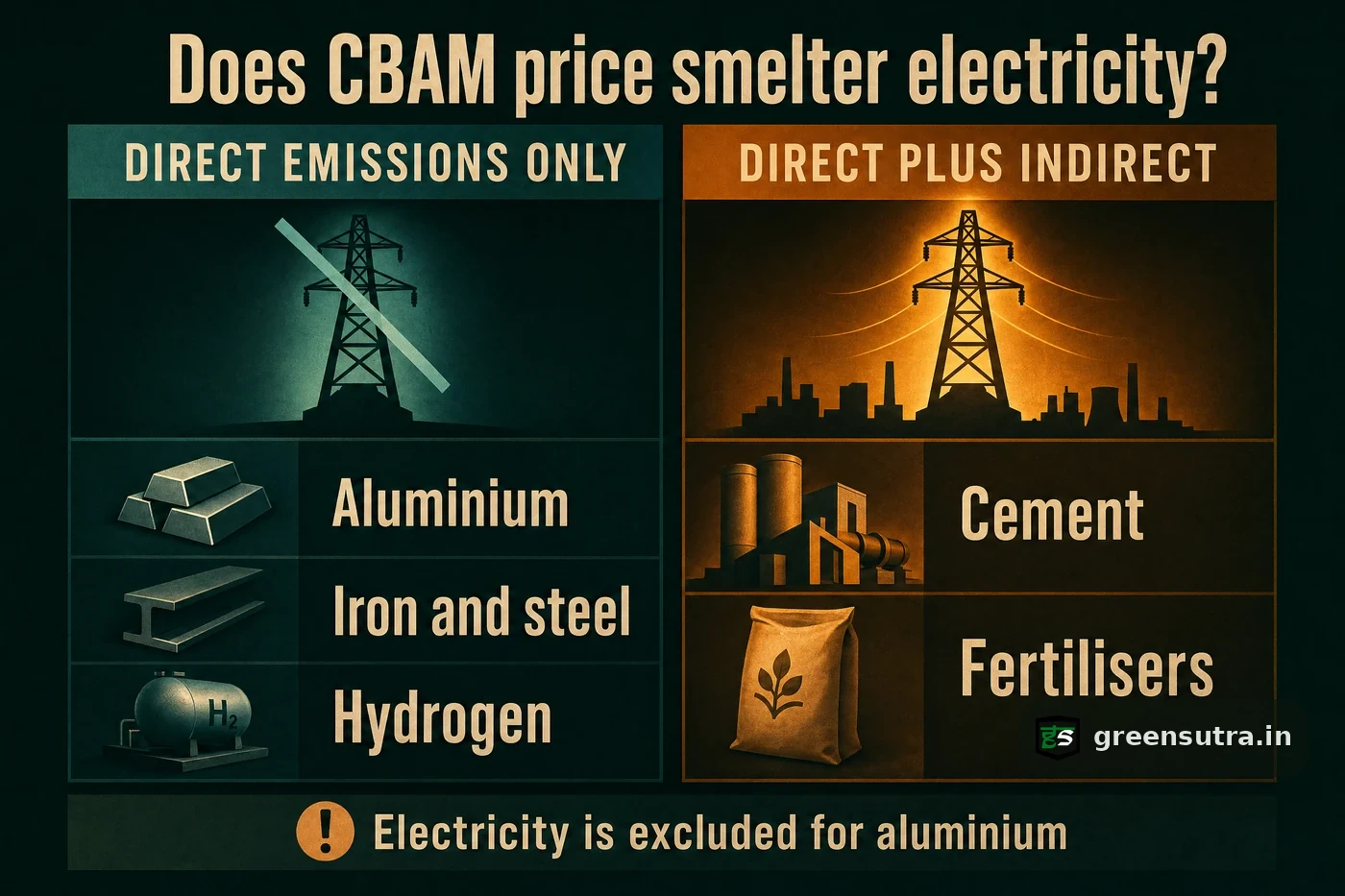
No, not under the current scope. Aluminium is an Annex II good under Regulation (EU) 2023/956, so CBAM certificates cover direct embedded emissions only; the electricity purchased to run a smelter is excluded even though smelting is highly power intensive. Cement and fertilisers count direct plus indirect emissions; aluminium, iron and steel and hydrogen do not.
Why the grid behind a smelter is not priced
Aluminium (CN 7601 to 7616) is listed in Annex II of Regulation (EU) 2023/956, and Annex II restricts the certificate obligation for the whole group to direct embedded emissions. Smelting runs on electrolysis, among the most electricity intensive processes, yet purchased power counts as an indirect emission, and indirect emissions are excluded for aluminium. A smelter on a coal heavy grid therefore surrenders no more certificates than an identical smelter on hydropower; the grid mix would begin to matter only if the scope were extended to indirect emissions. Iron and steel and hydrogen sit under the same direct only rule, examined for steel in the steel indirect emissions answer, while cement and fertilisers pay on both.
| Covered group | Basis of the certificate obligation |
|---|---|
| Aluminium | Direct emissions only |
| Iron and steel | Direct emissions only |
| Hydrogen | Direct emissions only |
| Cement | Direct plus indirect emissions |
| Fertilisers | Direct plus indirect emissions |
What CBAM does price at an aluminium installation
The certificate obligation covers the direct emissions released at the producing installation, declared through verified data or, failing that, country of origin defaults. Two factors dominate that number. First, primary metal smelted from ore carries far more embedded carbon than recycled, scrap based metal, so the raw material route sets the exposure before any power contract does. Second, direct intensity varies sharply by origin: estimates from the Hasanbeigi / ORF 2025 dataset put Norway at 1.53, the EU at 1.65, India at 1.75 and China at 2.28 tCO2e per tonne, leaving Chinese metal the most exposed major origin per tonne under direct only accounting. On the default path, India’s unwrought aluminium (CN 7601) value is 1.87 tCO2e per tonne, 2.06 with the 10 percent 2026 mark up, detailed in the Indian aluminium default values answer.
What the exclusion changes in practice
The exclusion narrows the compliance question to the installation’s own emissions, and those still need evidence. Actual rather than estimated data has been mandatory since 1 August 2024, and the figures feed the first annual declaration, due 30 September 2027 for 2026 imports. Purchased electricity adds no certificates under the current scope. The wider regime is walked through in the CBAM guide. Quantifying an installation’s direct emissions, separating primary from scrap based flows and preparing data an accredited verifier will accept is the work GreenSutra delivers as a CBAM consultant through the CBAM solutions service.
Sources: Regulation (EU) 2023/956 · Implementing Regulation (EU) 2025/2621 · European Commission CBAM