


Norway supplied the most aluminium to the EU in 2024 at EUR 4.4 billion, ahead of China, Türkiye, Iceland and Switzerland, out of roughly EUR 29.5 billion in imports. Norway, Iceland and Switzerland are exempt under Annex III, so CBAM pricing falls chiefly on China, Türkiye and the Gulf, with India a mid-tier supplier.
The EU aluminium import map for 2024
The EU imported about EUR 29.5 billion of aluminium and aluminium articles (HS 76) in 2024, according to Eurostat trade data. Norway leads by a clear margin, yet the raw ranking misleads for CBAM purposes because the mechanism does not price every origin.
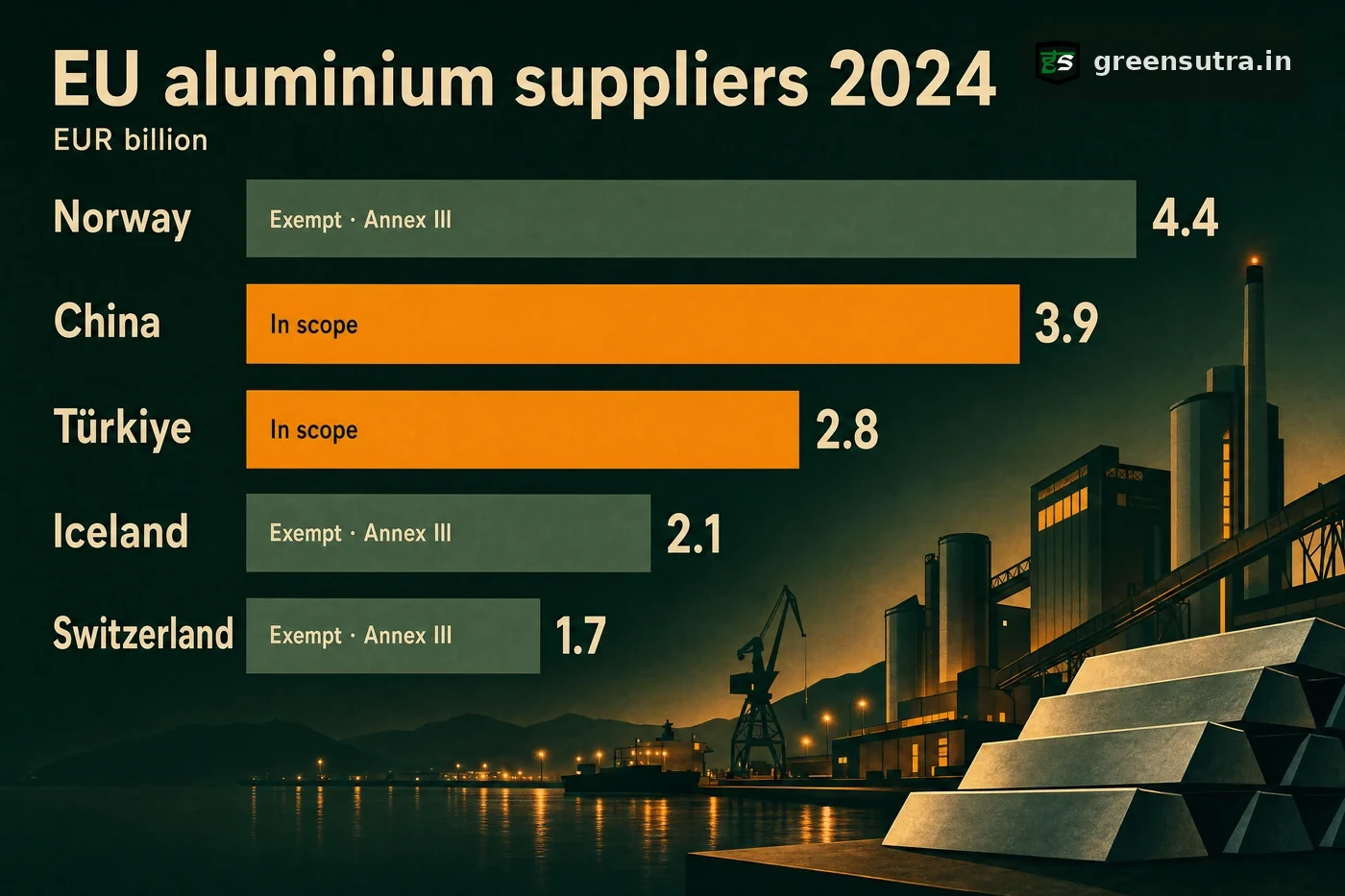
| Supplier | 2024 imports | Share | CBAM status |
|---|---|---|---|
| Norway | EUR 4.4bn | 15% | Exempt (Annex III) |
| China | EUR 3.9bn | 13.1% | In scope |
| Türkiye | EUR 2.8bn | 9.4% | In scope |
| Iceland | EUR 2.1bn | 7.3% | Exempt (Annex III) |
| Switzerland | EUR 1.7bn | 5.8% | Exempt (Annex III) |
| India | about EUR 1bn | about 3% | In scope, mid-tier |
Source: Eurostat, reference year 2024. Gulf suppliers such as the UAE and Bahrain also ship material volumes into the EU and sit fully in scope.
The exemption twist that reorders the list
Norway, Iceland and Switzerland fall outside CBAM under Annex III of Regulation (EU) 2023/956, because each participates in the EU ETS or an emissions trading system linked to it. Their metal enters the EU with no CBAM obligation at all, whatever its emissions profile; the sibling answer on why Norwegian and Icelandic aluminium is exempt covers the legal basis. Strip the exempt origins out and the priced field narrows to China, Türkiye and the Gulf, with India sitting mid-tier. Exposure per tonne also differs sharply: Hasanbeigi / ORF 2025 estimates put China at 2.28 tCO2e per tonne of direct emissions, the highest of the major supply routes, against an estimated 1.75 for India and 1.53 for exempt Norway. The largest priced volume therefore also carries the heaviest per-tonne carbon.
What the map means for buyers and exporters
Origin now sets the carbon bill as much as the invoice does. Aluminium is an Annex II good, so the definitive regime that began on 1 January 2026 prices direct embedded emissions only, with the payable share climbing from 2.5 percent in 2026 to 100 percent by 2034. Importers weighing Chinese, Turkish or Indian metal can compare origins in the CBAM cost calculator; the India-specific figures sit in the sibling answer on default values for Indian aluminium. Exporters competing against exempt Norwegian metal can engage a CBAM solutions consulting service to prepare verified installation data, with verification performed by an accredited verifier.
Sources: Regulation (EU) 2023/956 · European Commission, Carbon Border Adjustment Mechanism