


Carbon neutral and net zero are not the same commitment. Carbon neutral means emissions over a defined boundary are balanced by an equivalent quantity offset or removed, and can rely substantially on offsets. Net zero is more demanding: emissions are reduced across Scope 1, Scope 2 and Scope 3 as far as possible, then only residual emissions are neutralised by removals.
The core distinction
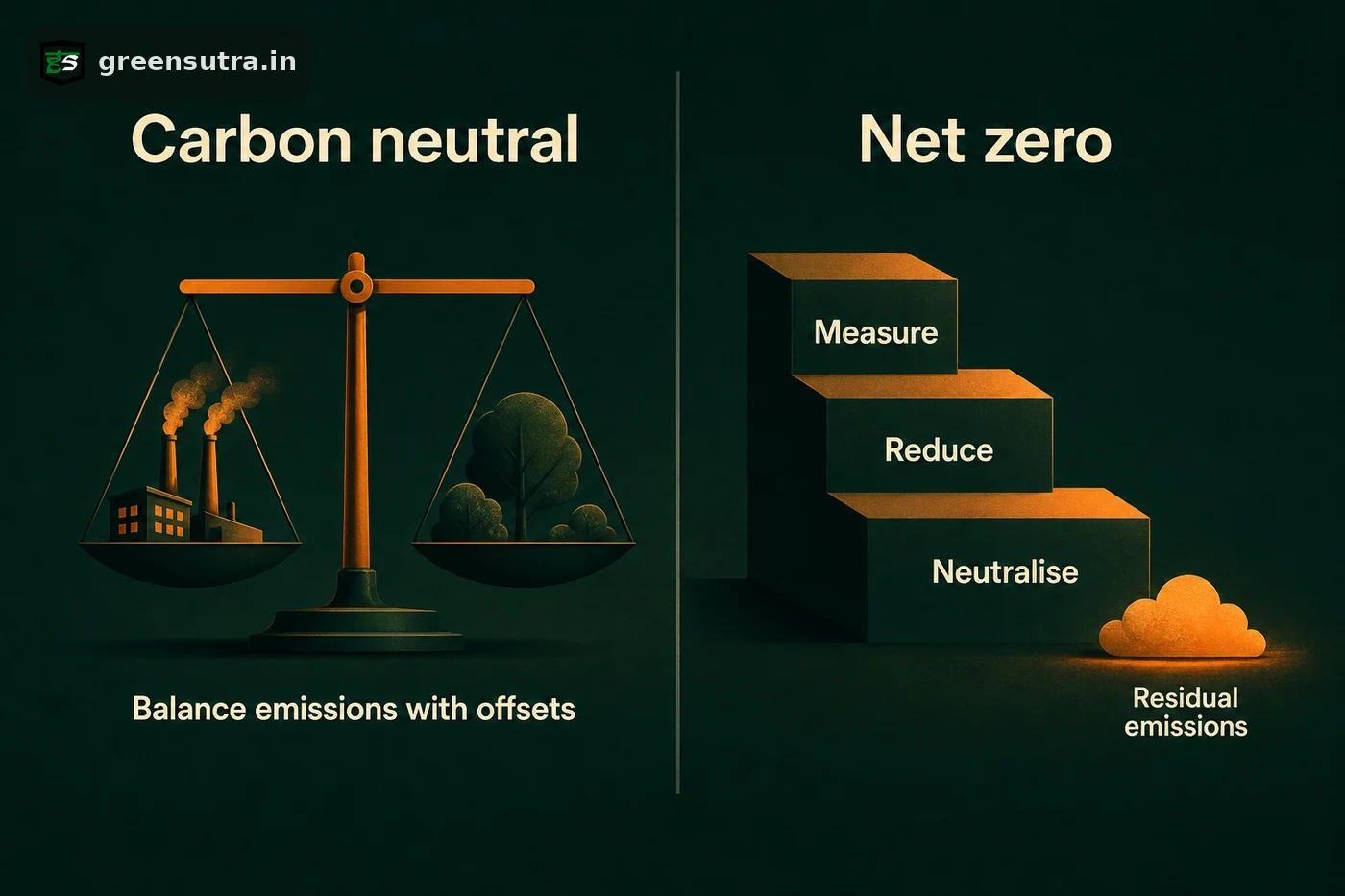
Carbon neutral and net zero are often used interchangeably, yet they are not the same commitment. Carbon neutral balances emissions with offsets, while net zero demands deep reduction first and neutralises only what remains.
| Commitment | What it means | Emphasis |
|---|---|---|
| Carbon neutral | Emissions over a defined boundary are balanced by an equivalent quantity offset or removed. | Balancing emissions, often with offsets, for a stated scope or product. |
| Net zero | Emissions are reduced across Scope 1, Scope 2 and Scope 3 as far as possible, with only residual emissions neutralised by removals. | Deep reduction first, in line with a science based trajectory, then removal of what is left. |
The practical difference is depth. A carbon neutral claim can be made largely by offsetting against a stated boundary. A net zero commitment requires emissions to fall across the value chain first, along a science based trajectory, leaving only the residual emissions that cannot be eliminated to be neutralised through removals.
Reduce first, then neutralise
A net zero commitment follows a decarbonisation roadmap, sometimes called a net zero roadmap, that sequences the work in three moves.
- Measure. Build the baseline inventory across Scope 1, Scope 2 and Scope 3.
- Reduce. Cut emissions across the value chain as far as practicable.
- Neutralise. Neutralise only the residual emissions that remain.
Reduction comes before removals, and that ordering is what separates a net zero pathway from a neutrality claim that rests mainly on offsets.
Where the footprint fits
Both commitments begin from a measured greenhouse gas inventory. The carbon footprint solutions service identifies emission sources, estimates the inventory to the GHG Protocol, GRI and ISO 14064, curates reduction recommendations and arranges offsets through afforestation, verified credits and renewable energy projects, reporting progress along the way. The carbon footprint guide sets out the standards and scopes in full, and a carbon footprint discovery session scopes the boundary and the data gap.
Independent verification to ISO 14064-3 is a separate step, performed by a qualified body that did not prepare the inventory. It is not part of the consulting engagement, and no consultant certifies, issues or guarantees carbon neutral or net zero status for an organisation.
Sources: GHG Protocol Corporate Standard · ISO 14064-1 · ISO 14064-3