


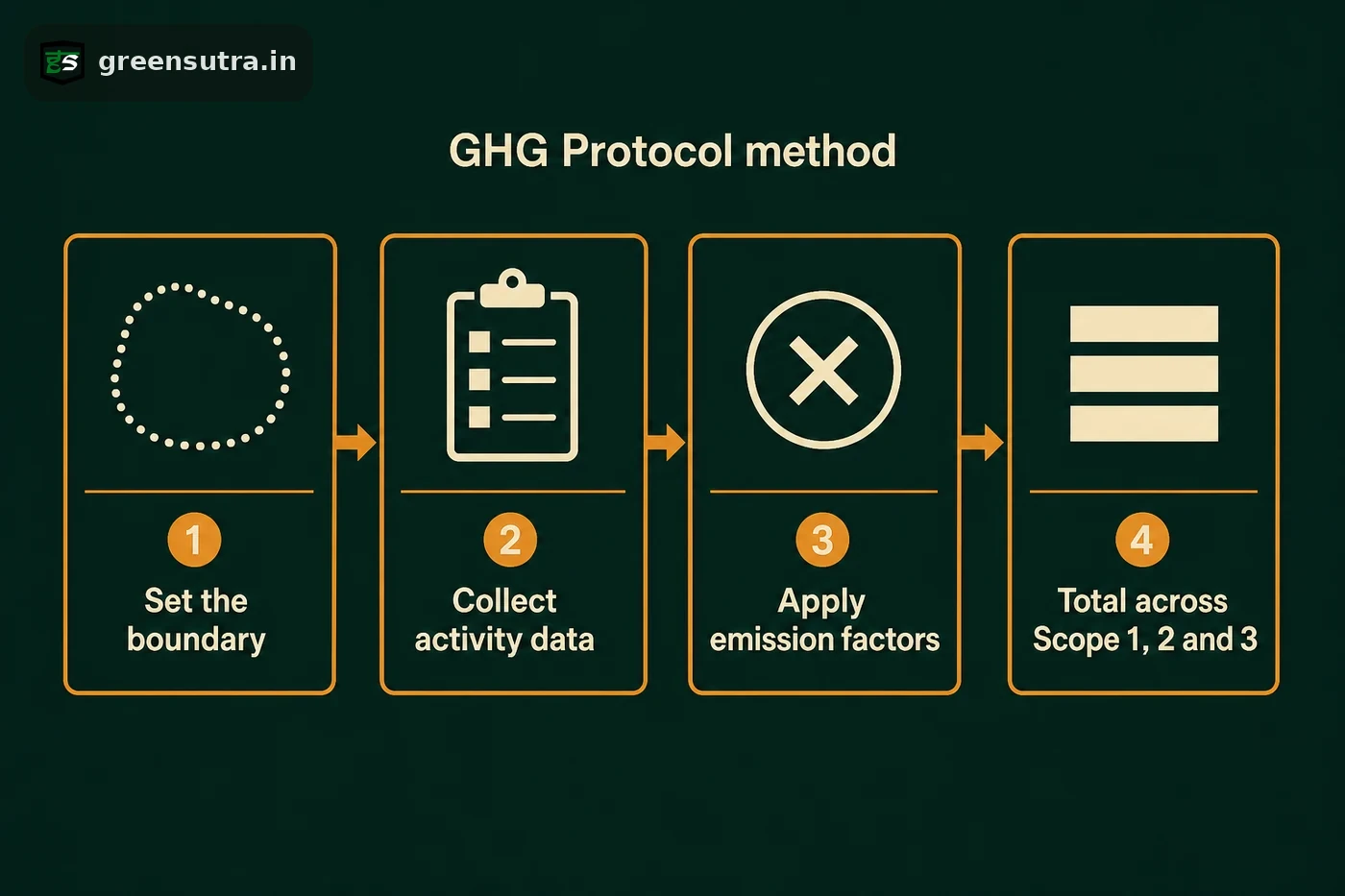
A company carbon footprint is calculated in a defined GHG Protocol sequence: set the organisational and operational boundary, identify Scope 1, Scope 2 and Scope 3 sources, collect activity data, multiply each activity by an emission factor to convert it to carbon dioxide equivalent, then total, review and report the inventory to ISO 14064.
The GHG Protocol calculation sequence
A company carbon footprint is built in a defined sequence under the Greenhouse Gas Protocol and expressed in tonnes of carbon dioxide equivalent. A carbon footprint consulting engagement works through the following steps.
1. Set the boundary. The organisational and operational boundary decides which sites and which scopes are included. 2. Identify the emission sources. Direct, energy and value chain sources are mapped across Scope 1, Scope 2 and Scope 3. 3. Collect activity data. Fuel use, purchased electricity, business travel, waste and purchased goods are gathered across operations. 4. Apply emission factors and total. Each activity is multiplied by an appropriate emission factor to convert it into carbon dioxide equivalent, and the results are summed across Scope 1, Scope 2 and Scope 3 into one inventory. 5. Review, report and verify. The inventory is reviewed and reported to the GHG Protocol, GRI and ISO 14064, and may be independently verified to ISO 14064-3.
Which sources fall into each scope
Identifying sources correctly is what makes the totals defensible. Each scope captures a different part of the emissions picture.
| Scope | Category | What it covers |
|---|---|---|
| Scope 1 | Direct | Owned and controlled sources: fuel burned on site, company vehicles, process and fugitive releases. |
| Scope 2 | Energy | Indirect emissions from purchased electricity, steam, heat and cooling generated off site. |
| Scope 3 | Value chain | Upstream and downstream sources: purchased goods, inbound transport, business travel, waste, distribution and use of sold products. |
Reporting and independent verification
All scopes consolidate into a single GHG inventory in tonnes of carbon dioxide equivalent, which becomes the baseline for reduction planning. Independent verification is a separate step: a qualified body that did not prepare the inventory checks it against a recognised standard to ISO 14064-3. The carbon footprint guide sets out the full checklist, and a carbon footprint discovery session scopes the boundary and data before measurement begins.
Sources: GHG Protocol Corporate Standard · ISO 14064-1 · ISO 14064-3