


Overseas buyers ask Indian exporters for verified ESG data because their own sustainability disclosure and supply chain commitments depend on the numbers suppliers return. Large customers request completion of platform questionnaires such as EcoVadis, or disclosure through CDP, then score the trusted data into procurement and financing decisions, so adjectives will not suffice.
A buyer’s own disclosure depends on the supplier’s numbers
A buyer wants evidence it can trust, not adjectives, because its own sustainability disclosure and supply chain commitments depend on the data its suppliers return. A supplier claim without a documented number, name or date cannot be carried into a customer’s report, so overseas buyers increasingly convert an ESG expectation into a request for verified data rather than a statement of intent.
How buyers collect and score the data
Large customers rarely ask in prose. The request is routed through a standard platform, and the returned data is scored and fed into procurement and financing decisions.
| Route | What the buyer asks for | Who scores it |
|---|---|---|
| EcoVadis | A completed platform questionnaire on ESG performance | EcoVadis, an independent platform |
| CDP | Disclosure of environmental data through the CDP system | CDP, an independent platform |
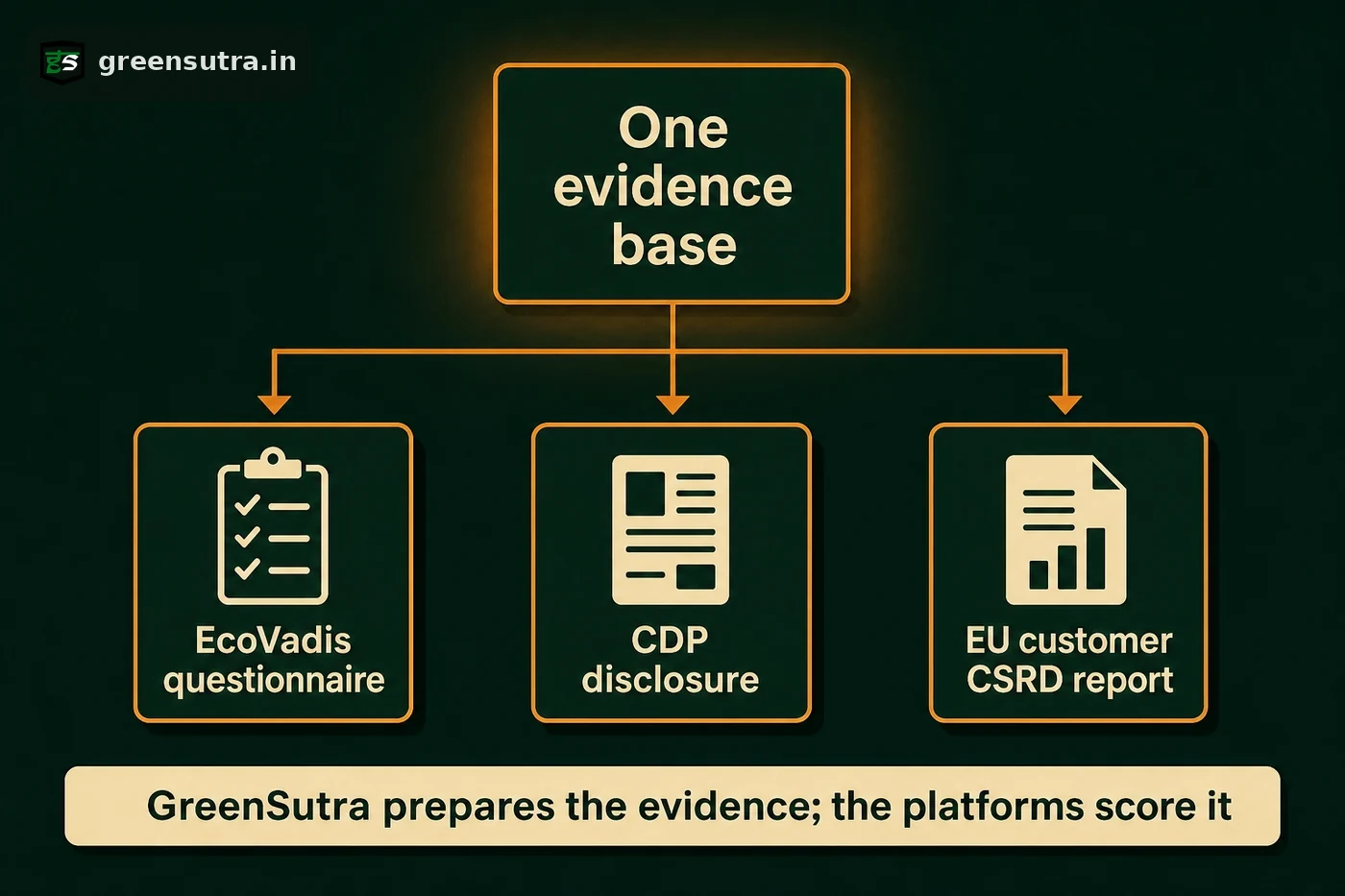
The assessment and any medal stay with the platform; GreenSutra never scores the data or awards a medal. The engagement assembles the underlying evidence once, covering emissions, energy, water, workforce, safety and governance metrics, structures it to survive scrutiny, and maps it to the format each questionnaire requests, so the supplier responds from data already collected rather than assembling answers under deadline. The ESG Reporting Guide sets out that single evidence base.
The CSRD value chain pull reaches suppliers early
European demand carries a regulatory driver behind it. The EU Corporate Sustainability Reporting Directive, Directive (EU) 2022/2464, can reach an Indian company through its EU operations, and even a supplier below any direct threshold feels the pull. An EU customer captured by the directive often asks its Indian suppliers for the same environmental, social and governance data to complete its own disclosure. Reporting by non EU groups is expected to begin around financial year 2028, subject to transposition and further simplification, so a documented assessment and an assurance ready data file matter ahead of any direct obligation. GreenSutra prepares that evidence base and readies it for independent verification, while the actual verification and assurance are performed by independent third parties. An ESG discovery brief scopes the gap, and the ESG Solutions service sets out the engagement.
Sources: Directive (EU) 2022/2464 (CSRD) · EcoVadis · CDP