


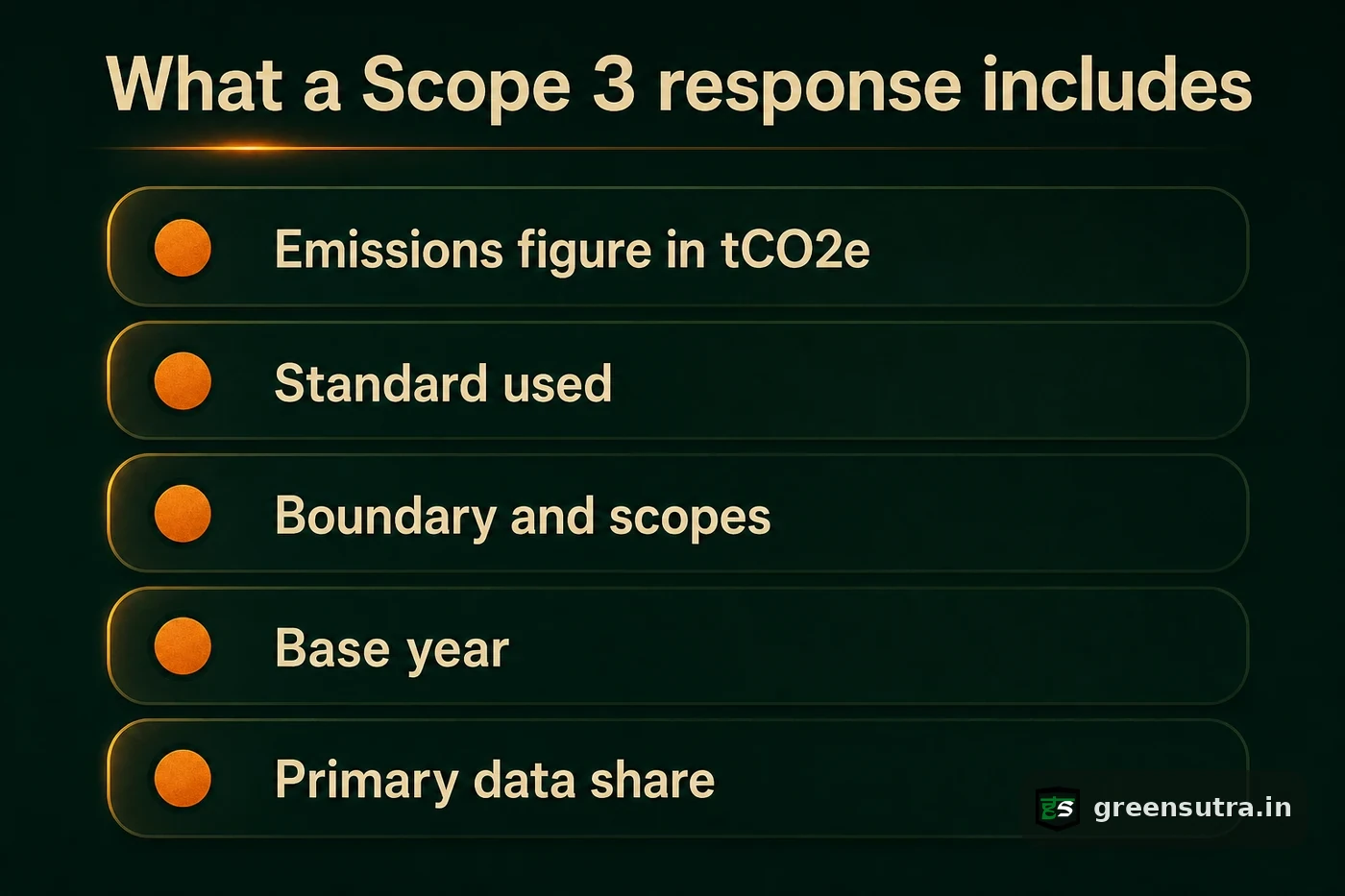
A scope 3 data request from a customer is best answered with an emissions figure and its methodology attached, giving an organisation or product level footprint in tonnes of CO2e, the standard used, boundary, scopes, base year, and how much rests on primary supplier data.
What a buyer’s request should receive
A scope 3 data request from a customer feeds that customer’s own Scope 3 inventory, so the response is strongest when it pairs an emissions figure with the methodology behind it rather than a bare number. Useful content includes an organisation level or product level footprint expressed in tonnes of carbon dioxide equivalent, the accounting standard used, the boundary and scopes covered, the base year, and a statement of how much of the figure rests on primary activity data rather than secondary emission factors. A documented carbon footprint consulting inventory holds all of this in one place, so most requests are answered from existing records.
Organisation level versus product level
Which footprint to send depends on what the buyer is measuring. A supplier’s own operations map to an organisation level number, while a specific purchased item maps to a product level number.
| Footprint type | Aligns with | Best for |
|---|---|---|
| Organisation level | GHG Protocol Corporate Standard and ISO 14064-1 | Corporate supplier emissions across sites |
| Product level | Life cycle assessment under ISO 14067 | A specific good the buyer purchases |
Under the GHG Protocol Corporate Value Chain (Scope 3) Standard, Scope 3 splits into fifteen categories, upstream categories one to eight and downstream categories nine to fifteen, with purchased goods and services as category one. A buyer usually places a supplier inside its own category one, which is why primary supplier data is prized over spend based estimates. A screening exercise that estimates each category from spend or activity proxies locates where value chain emissions concentrate, and the material categories are then reworked with primary data collected from suppliers, which the GHG Protocol treats as the higher quality basis.
One inventory, many requests
The same Scope 1, Scope 2 and Scope 3 data set that answers a buyer request also feeds CBAM embedded emissions reporting for covered goods and wider ESG disclosure, so one accounting exercise serves several requests. Where the inventory has been independently checked, noting verification to ISO 14064-3 raises credibility; that assurance is performed by an accredited third party body that did not prepare the inventory, not by the consultant. A short scoping conversation sizes the inventory work.
Sources: GHG Protocol Corporate Standard · GHG Protocol Scope 3 Standard · ISO 14067 · ISO 14064-3