


A corporate vs product carbon footprint distinction turns on scope: a corporate carbon footprint is an organisation-level inventory across Scope 1, Scope 2 and Scope 3 to the GHG Protocol Corporate Standard, whereas a product carbon footprint measures one product per functional or declared unit across its life cycle under ISO 14067.
What each footprint measures
The difference between a corporate and a product carbon footprint is one of scale and standard. A corporate carbon footprint is an organisation-level greenhouse gas inventory prepared to the GHG Protocol Corporate Standard, categorising emissions across Scope 1, Scope 2 and Scope 3 and reporting the whole organisation in tonnes of carbon dioxide equivalent. A product carbon footprint is a product-level figure prepared to ISO 14067:2018, expressed per functional or declared unit of one product across its life cycle. The GHG Protocol Product Standard states that the product standard complements, and does not replace, the Corporate Standard. Practical carbon footprint consulting often runs both, since the same activity data can feed several disclosure needs at once.
Corporate vs product carbon footprint at a glance
The two footprints answer different questions and rest on different standards, as the table below sets out.
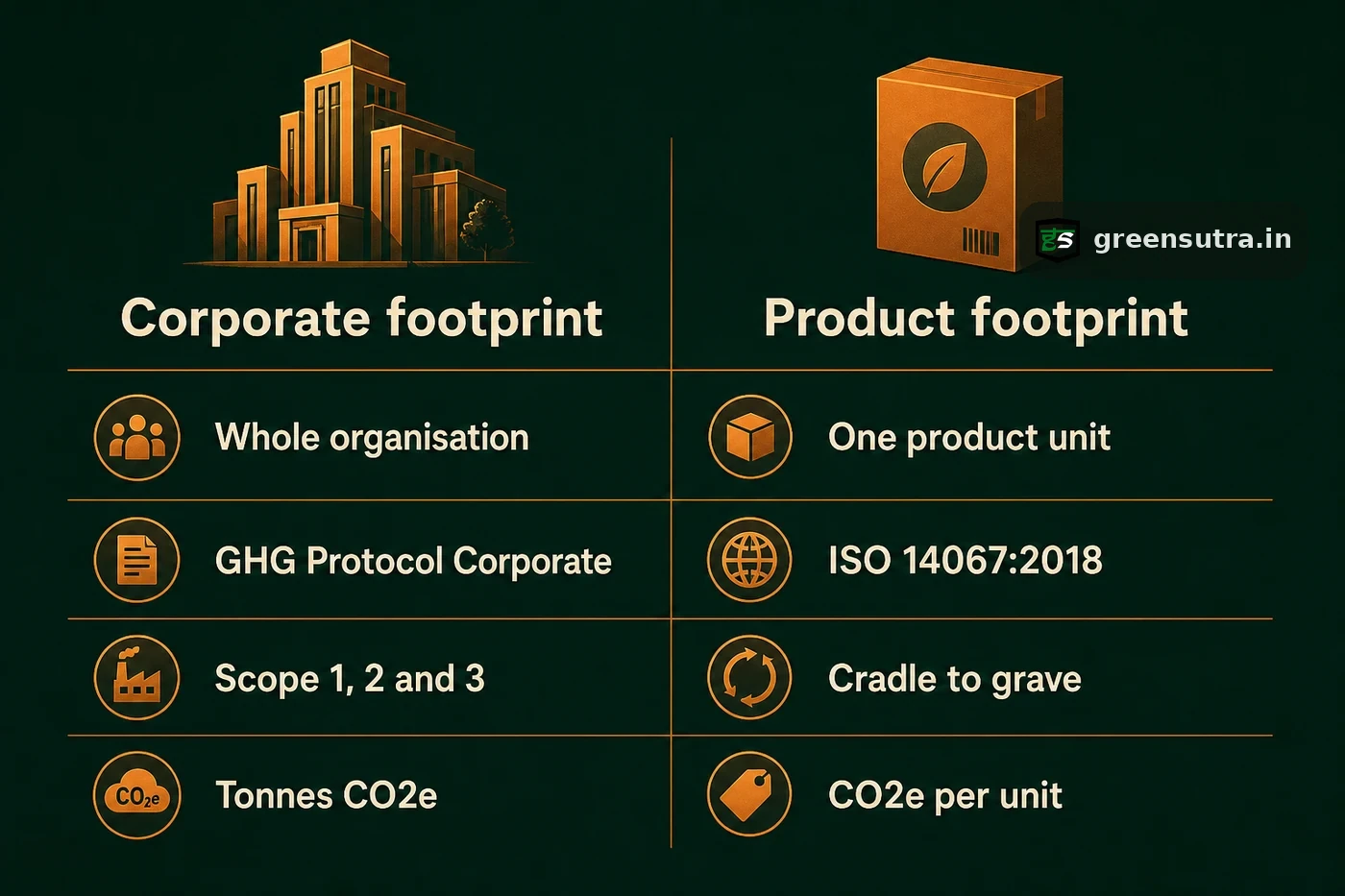
| Dimension | Corporate carbon footprint | Product carbon footprint |
|---|---|---|
| Unit of analysis | The whole organisation | One product, per functional or declared unit |
| Primary standard | GHG Protocol Corporate Standard | ISO 14067:2018 |
| Boundary | Scope 1, Scope 2 and Scope 3 | Product life cycle, cradle to grave or cradle to gate |
| Method basis | Corporate accounting and reporting | Life cycle assessment (ISO 14040 and ISO 14044) |
| Result | Organisation emissions in tonnes of CO2e | Emissions per unit of product in CO2e |
| Independent check | Verification to ISO 14064-3 | Critical review (ISO 14071) or ISO 14064-3 |
Standards, method and verification
Method basis differs as well. The corporate inventory follows corporate accounting and reporting rules, while the product footprint follows the life cycle assessment sequence of ISO 14040 and ISO 14044, applied to a single climate-change indicator:
- Define goal and scope, fixing the functional or declared unit and the system boundary.
- Compile the life cycle inventory of activity data and emissions across the value chain.
- Convert the inventory to carbon dioxide equivalent using global warming potential.
- Interpret the result.
Verification also diverges. A corporate inventory may be independently verified to ISO 14064-3 by a competent body that did not prepare it. A product carbon footprint uses an optional critical review under ISO 14071, or independent verification to ISO 14064-3 where a customer requires it. A footprint gains credibility when reviewed or verified by an independent competent third party against a named standard, with a documented unit, system boundary and data sources. GreenSutra prepares the inventory and the footprint; any independent verification or assurance is carried out by a separate accredited third party. Further detail on scopes, standards and reduction planning sits in the carbon footprint guide.
Sources: GHG Protocol Corporate Standard · ISO 14067:2018 · GHG Protocol Product Standard · ISO 14064-3