


A functional unit in LCA is the quantified description of the function a product performs, the shared reference against which every input, output and impact is normalised across the four ISO 14040 phases, so that two products may be compared only where they deliver that same function.
What a functional unit measures
A functional unit is the quantified description of a product’s function, set during goal and scope definition, the first of the four ISO 14040 phases. It fixes what the study includes and the basis on which results compare. Its role in life cycle assessment is to hold the assessment together, so that every input, output and impact stays comparable. The same reference runs through all four phases:
- Goal and scope definition: the functional unit and system boundary are set, fixing what the study includes.
- Life cycle inventory: material, energy and emission flows are compiled and referenced to the functional unit.
- Life cycle impact assessment: the inventory is converted into impacts expressed per functional unit.
- Interpretation: hotspots and sensitivity are tested against that same reference.
Why the same functional unit matters for comparison
A comparison between two products holds only where both deliver the same function expressed through the same functional unit, a requirement of ISO 14044. A litre of one product and a kilogram of another cannot be compared directly; the coverage area, service life or performance that define the function can. Where the stated function differs, the results are not comparable, which is why goal and scope definition fixes the functional unit before any data is collected.
Functional unit against declared unit
For EPDs of construction products, EN 15804:2012+A2:2019 also defines a declared unit. The two references differ in what they measure and when each applies.
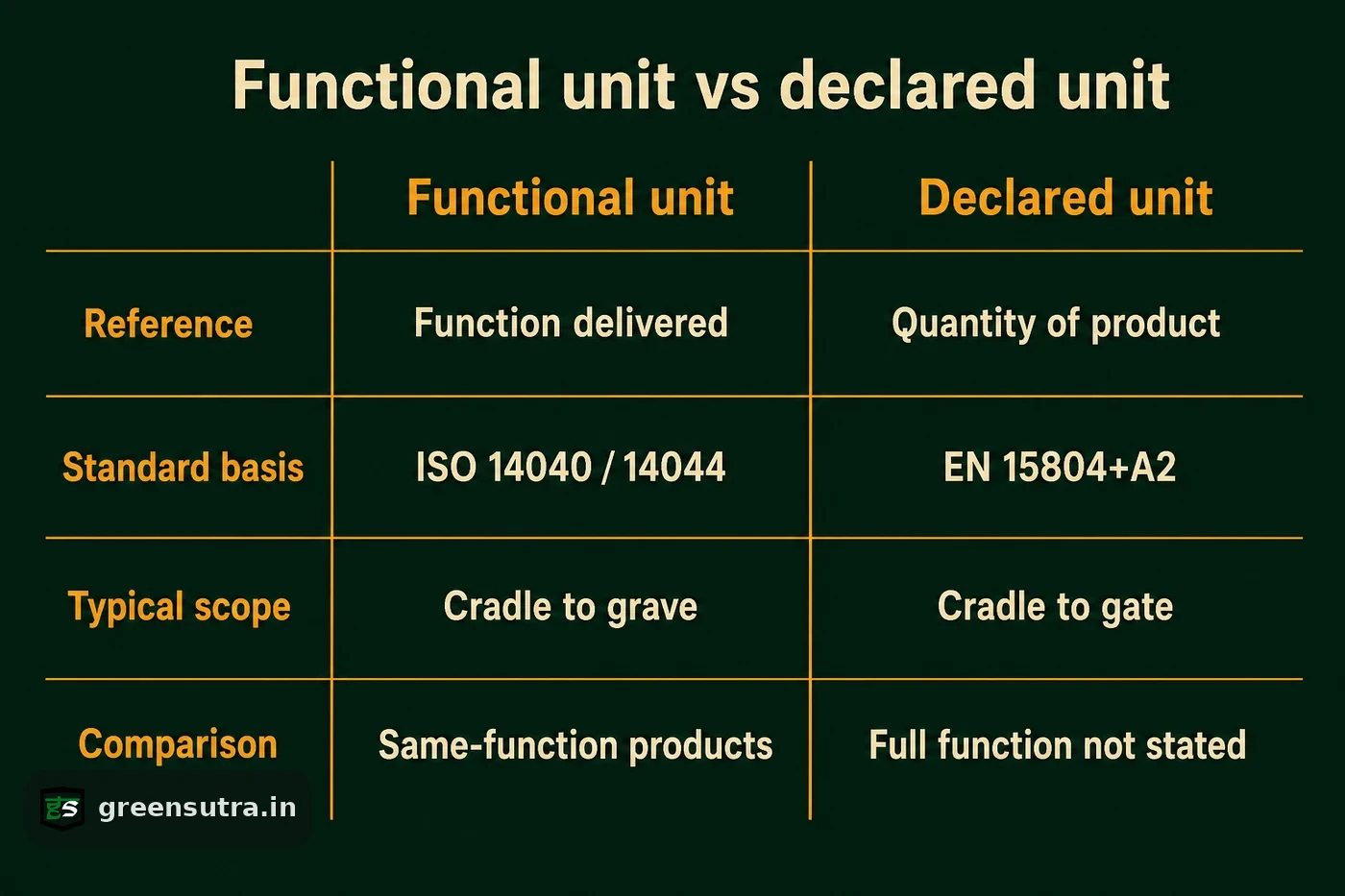
| Aspect | Functional unit | Declared unit |
|---|---|---|
| Reference | The function a product delivers | A quantity of product, for example 1 kg or 1 m3 |
| Standard basis | ISO 14040 and ISO 14044 | EN 15804:2012+A2:2019 |
| Typical scope | Full cradle to grave | Cradle to gate, modules A1 to A3 |
| Comparison | Supports comparison of same-function products | Used where the full-life function is not stated |
The declared unit in EPDs
A declared unit is a quantity of product, for example a mass in kilograms or a volume in cubic metres, used as the reference where the function across the full life cycle is not stated. It is used typically for cradle-to-gate declarations covering modules A1 to A3, whereas a full cradle-to-grave declaration is based on a functional unit. An Environmental Product Declaration is a Type III declaration under ISO 14025, verified against Product Category Rules by an independent third party through a programme operator, not by the consultant preparing the study. Further detail on scoping a study sits in the LCA guide.
Sources: ISO 14040 · ISO 14044 · EN 15804:2012+A2:2019