


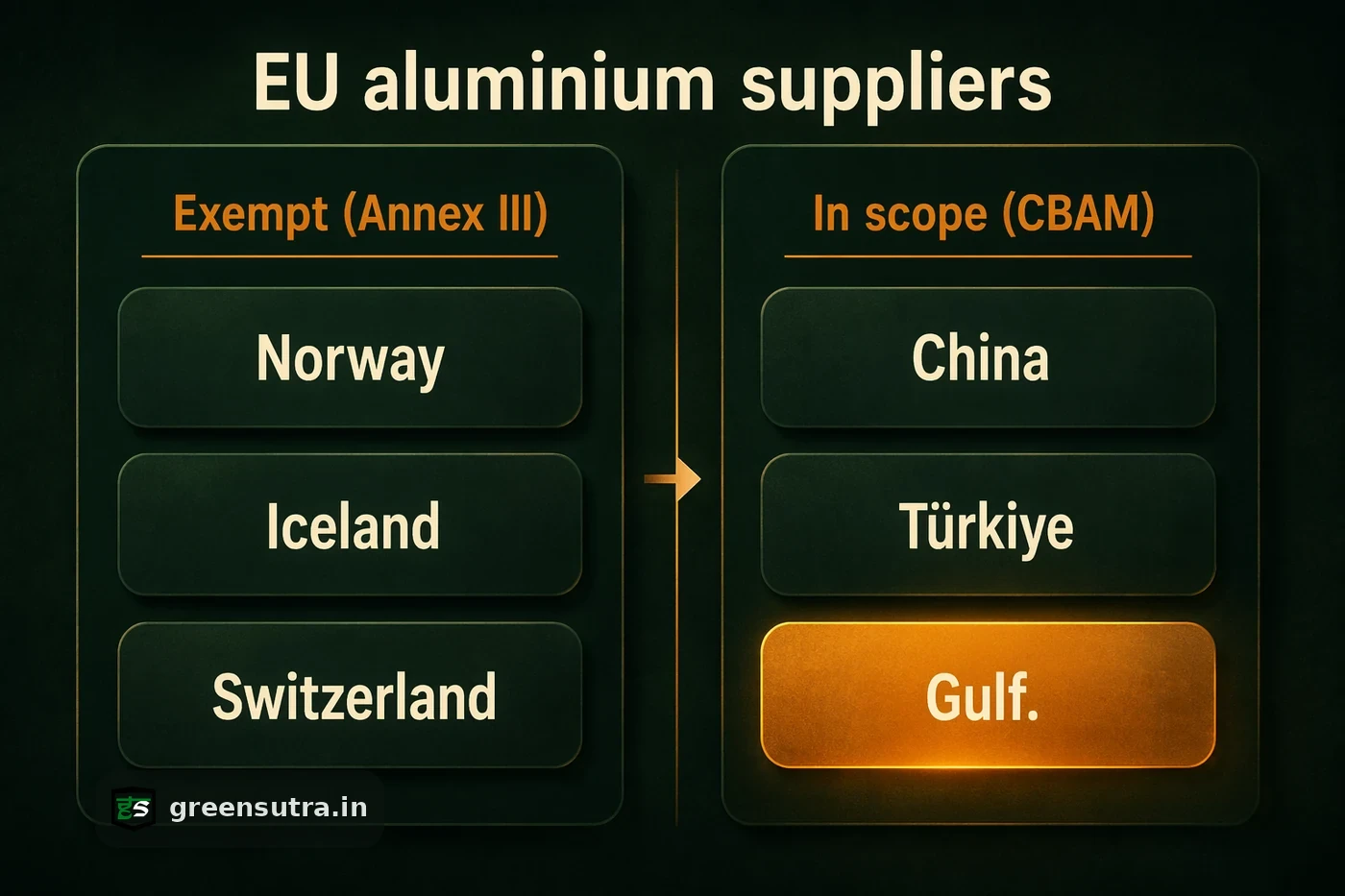
Gulf aluminium moves to the front of the covered supplier list once Norway, Iceland and Switzerland are set aside as exempt under Annex III. Its direct emission intensity is estimated at 1.60 to 1.65 tonnes of CO2e per tonne, an estimate rather than a published country default, so verified installation data is decisive.
Where Gulf aluminium sits once exempt origins are removed
The EU imported about EUR 29.5 billion of aluminium in 2024. Norway, China, Türkiye, Iceland and Switzerland lead the partner list, yet Norway, Iceland and Switzerland fall outside CBAM under Annex III of Regulation (EU) 2023/956, through the EEA or a linked emissions-trading system, whatever their emissions. In-scope repricing therefore concentrates on the suppliers that follow, led by China, Türkiye and the Gulf. Gulf smelters rise up the ranking of covered origins for that reason, not because their metal is unusually carbon-heavy.
Direct intensity is an estimate, not a default
Estimated direct emission intensity by origin, in tonnes of CO2e per tonne of aluminium:
| Origin | Estimated direct intensity |
|---|---|
| Norway | 1.53 |
| Iceland | 1.59 |
| Gulf | 1.60 to 1.65 |
| EU | 1.65 |
| India | 1.75 |
| China | 2.28 |
These are estimates, not published country default values, and no per-tonne CBAM default exists for any Gulf state. Aluminium is an Annex II good, so several features of the regime decide the real number:
- Only direct embedded emissions count, and grid electricity is excluded from the certificate obligation.
- Smelting is power-intensive, so the figure follows the smelter’s own power route, a hydro or gas-fed line declaring very differently from one on a coal grid.
- Primary metal smelted from ore carries far more embedded carbon than recycled, scrap-based metal, so feed mix matters too.
From estimate to declared figure
With no Gulf default published, a producer lacking verified data falls back to marked-up default values, applied at plus 10 percent in 2026 and rising to plus 30 percent from 2028. Verified installation data usually replaces that conservative default with a lower real figure. A workable sequence:
1. Confirm the CN code, since aluminium spans unwrought metal through bars, profiles, wire, sheet and finished articles. 2. Measure direct emissions at the smelter on a calculation-based or measurement-based approach. 3. Have that data confirmed by an accredited verifier before it reaches the EU importer.
The de-minimis of 50 tonnes per importer each year sits below most commercial consignments, so the bulk of Gulf aluminium trade is covered. CBAM advisory covers declarant status, embedded-emissions calculation and certificate exposure across covered origins, and the CBAM guide sets out the evidence an EU importer expects.
Sources: Regulation (EU) 2023/956 · Eurostat · European Commission CBAM