


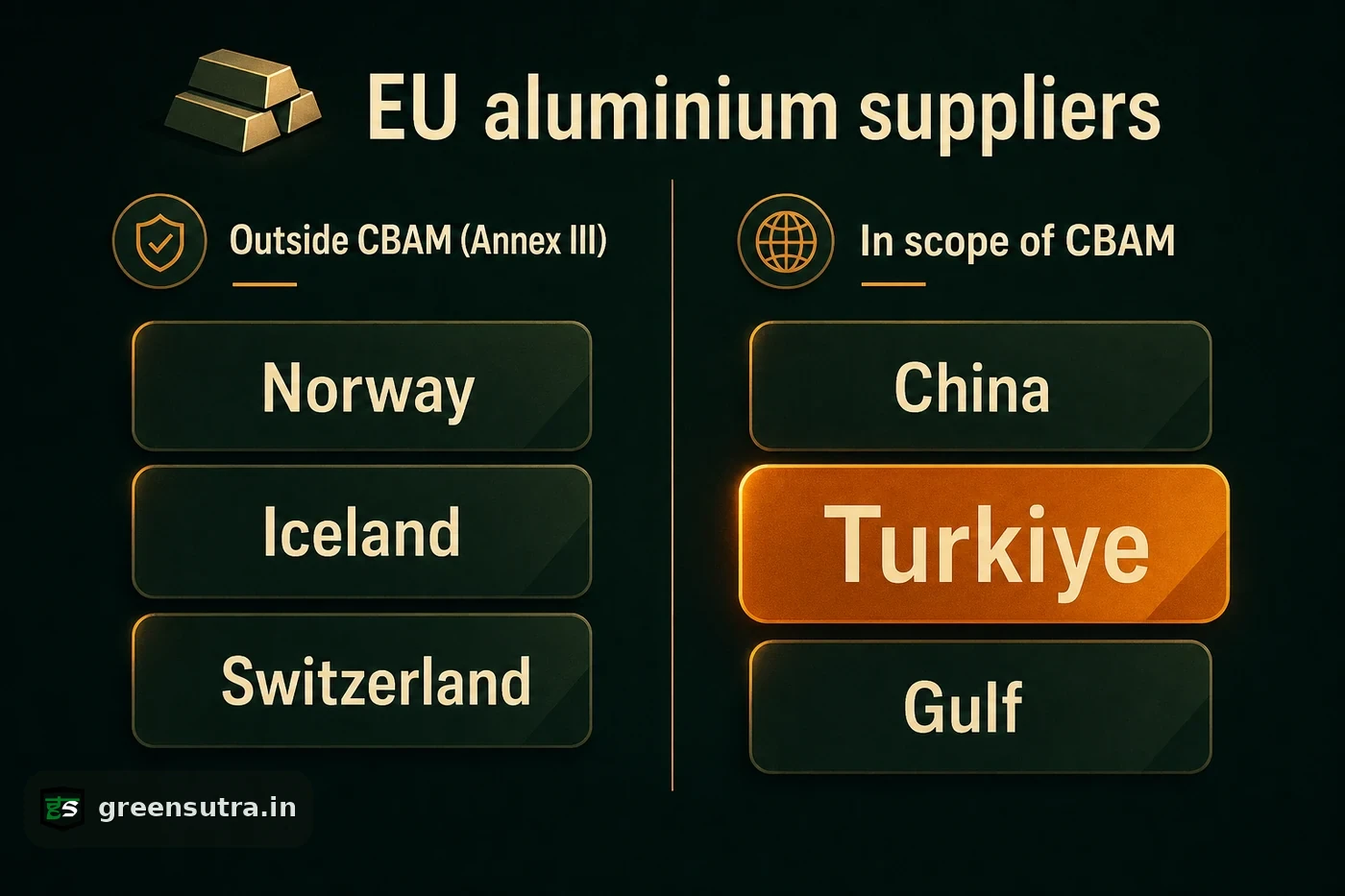
Türkiye supplies about EUR 2.8 billion of the EU’s aluminium imports, ranking third among partners. Because Norway, Iceland and Switzerland sit outside CBAM under Annex III, Türkiye becomes one of the leading in-scope aluminium origins once those Annex III suppliers are set aside, with each smelter’s charge set by verified direct emissions.
CBAM reaches Turkish aluminium because Türkiye ranks among the EU’s largest suppliers that fall inside the mechanism. The EU imported about EUR 29.5 billion of aluminium in 2024, with Türkiye among its largest suppliers behind Norway and China. Norway, Iceland and Switzerland sit outside CBAM under Annex III of Regulation (EU) 2023/956, so once those Annex III suppliers are set aside, Türkiye stands alongside China and the Gulf as one of the largest in-scope origins for the aluminium group.
Where Türkiye sits among EU aluminium suppliers
Three of the largest 2024 partners fall outside the mechanism, which concentrates the repricing on a shorter list of origins.
| Origin | Share of EU aluminium imports | CBAM status |
|---|---|---|
| Norway | 15 percent | Outside, Annex III |
| China | 13.1 percent | In scope |
| Türkiye | 9.4 percent | In scope |
| Iceland | 7.3 percent | Outside, Annex III |
What sets a Turkish smelter’s charge
Aluminium is an Annex II good, so only direct embedded emissions count and indirect electricity is excluded from the certificate obligation under the current scope. The declared figure for each Turkish smelter rests on its own verified installation data rather than a shared regional average. Where verified data is not used, a country-of-origin default value applies, carrying a mark-up of 10 percent in 2026. Among the major routes, China carries the highest estimated direct intensity, about 2.28 tonnes of CO2e per tonne, which frames the competitive backdrop for the remaining in-scope origins.
Practical preparation for a Turkish exporter runs in a few steps:
- Confirm authorised CBAM declarant arrangements with the EU importer, since the 50 tonne annual de-minimis is quickly passed on regular shipments.
- Assemble verified installation data for each product line instead of relying on the marked-up default value.
- Map every consignment to its CN code across unwrought metal, profiles, plates and finished articles.
CBAM advisory covers declarant status, embedded-emissions calculation and certificate obligations across the aluminium CN range, and a CBAM cost calculator estimates the certificate cost for a specific product, volume and import year.
Sources: Regulation (EU) 2023/956 · Eurostat · European Commission CBAM