


CBAM covers imported electricity under combined-nomenclature code CN 2716, one of six covered product groups. Unlike cement or steel, electricity carries no de-minimis allowance, so every cross-border flow enters scope from the first unit, priced on the exporting grid’s carbon emission factor.
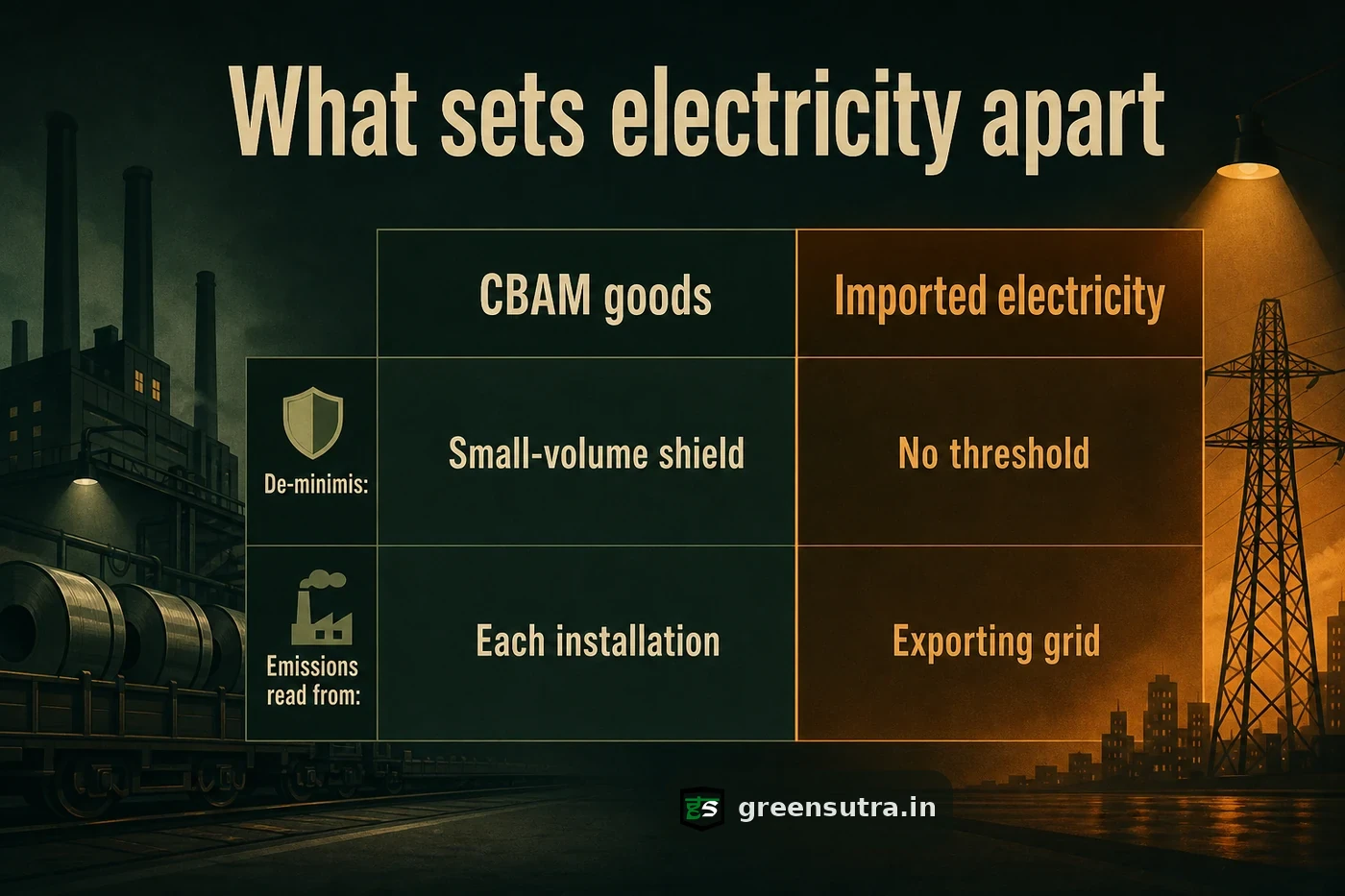
Imported electricity is one of the six product groups the Carbon Border Adjustment Mechanism covers, and it behaves unlike the material goods in two ways that matter at once. There is no de-minimis allowance: the 50-tonne per importer per year threshold that shields small consignments of cement, steel, aluminium and fertilisers does not apply, so every cross-border flow counts from the first unit. The embedded emissions are also read from the exporting country’s grid rather than from a single installation.
How the obligation is measured and when it falls due
The calculation and the deadlines follow the same regime that governs the other CBAM goods, with electricity-specific rules on the emission basis.
- Electricity is the power product itself, so its embedded emissions are those of generating it rather than an indirect addition from purchased power.
- The default basis is the exporting country’s grid emission factor; the rules point to that published national factor rather than any EU-wide number.
- The first annual declaration and certificate surrender, covering 2026 imports, is due 30 September 2027.
- The payable share of embedded emissions climbs across the phase-in, reaching 100 percent by 2034.
Which parties actually carry it
The obligation reaches parties with a physical link to the EU grid, not distant producers without one. EU importers, traders and authorised declarants hold it, alongside power exporters synchronised with the EU grid. India has no grid interconnection with the EU and cannot export electricity to it, so Indian exporters meet CBAM electricity only as a comparison against goods such as steel or cement that they do ship. CBAM compliance support covers declarant status, embedded-emissions calculation and certificate exposure. A CBAM guide sets out the covered groups and the compliance timeline.
Sources: Regulation (EU) 2023/956 · Implementing Regulation (EU) 2025/2621 · European Commission CBAM