


Article 2(7) of Regulation (EU) 2023/956 exempts electricity imported from a third country whose market is coupled and integrated with the EU internal electricity market. The relief is conditional, resting on anti-circumvention safeguards and a decarbonisation commitment from the exporting country, not on physical grid connection alone.
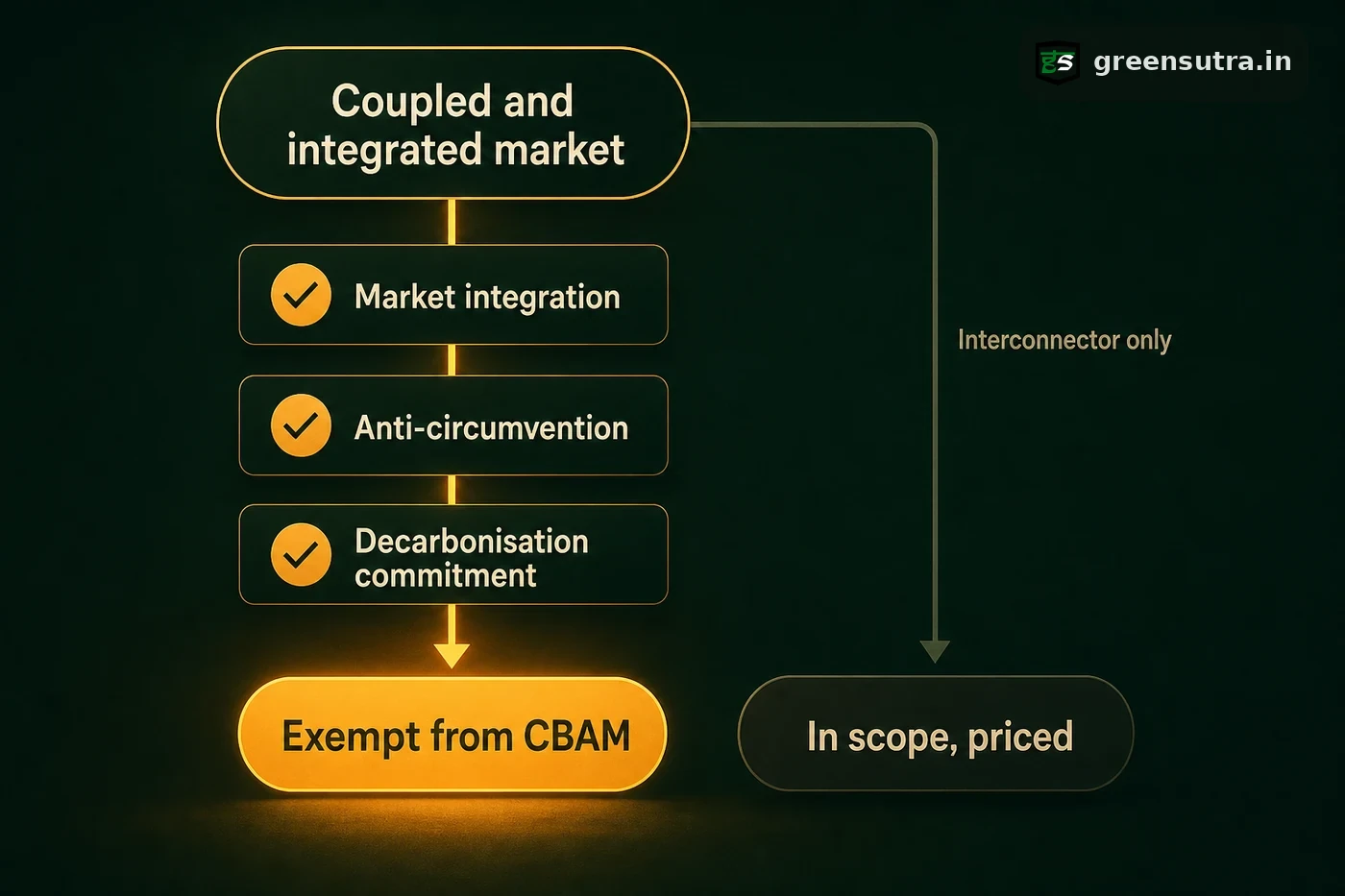
Imported electricity can be exempt from CBAM under Article 2(7) of Regulation (EU) 2023/956 when the exporting third country’s electricity market is coupled and integrated with the EU internal electricity market. The exemption is conditional. It rests on anti-circumvention safeguards and a firm decarbonisation commitment from the exporting country, not on a physical grid link. Where those conditions are absent, imported electricity is treated like any other covered flow and priced on the exporting grid’s emission factor.
Coupling, not connection
Being wired to the EU is not the same as being part of its market. That distinction sets the exemption apart from the rest of the CBAM regime, where most goods have no route to relief short of a recognised origin carbon price. A genuinely coupled and integrated market already shares the EU carbon signal, which is the rationale for exempting it. A market that merely exports power across an interconnector does not.
What the exemption tests
Article 2(7) applies to a coupled market as a whole, not to a single generator or a single supply contract within it. Three conditions frame it:
- Market integration: the exporting market must be coupled and integrated with the EU internal electricity market, not merely physically connected.
- Anti-circumvention safeguards: these guard against routing higher-carbon power through an exempt path.
- Decarbonisation commitment: the exporting country must commit to aligning its power sector with EU climate goals.
Connected exporters sometimes read an interconnector as automatic relief, when the article layers market-integration and policy tests on top. The CBAM advisory covers declarant status, embedded-emissions calculation and certificate obligations, and a CBAM guide sets out the qualifying criteria in more detail.
Sources: Regulation (EU) 2023/956 · Implementing Regulation (EU) 2025/2621 · European Commission CBAM