

Plastic Packaging EPR Registration and Compliance Consultants in India (2026)
GreenSutra manages the whole plastic packaging PIBO obligation end to end, from CPCB Common EPR portal registration and category targets to EPR credit procurement and the annual returns, from a Mumbai base and across India, so plastic packaging compliance becomes a managed, evidenced record rather than an in-house burden.
Reviewed by Team GreenSutra · Updated 24 July 2026
Who needs plastic packaging EPR registration?
A quick self-check before any commitment. If plastic packaging carries a product onto the Indian market, the obligation almost certainly reaches the business behind it.
Plastic packaging EPR applies to any Producer, Importer or Brand Owner, a PIBO, that places plastic packaging on the Indian market. If a business makes plastic packaging, wraps its product in it, imports it, or sells under its own registered brand, the obligation reaches it, and registration on the CPCB Common EPR portal comes first.
A business likely needs plastic EPR registration if it:
- sells a product in plastic packaging under its own brand, from rigid bottles and jars to flexible sachets, pouches and e-commerce mailers;
- manufactures plastic carry bags, films, sheets or multilayer packaging;
- imports plastic packaging, packaged goods, or plastic raw material such as resin or pellets;
- runs a marketplace, aggregator or retail chain that sells goods in plastic packaging.
Micro and small brand owners are exempt from the obligation, while producers and importers register regardless of size. The full rules, the five Schedule II categories and the category-wise target tables are set out in the Plastic Packaging EPR guide. This page is about getting the obligation handled. A free EPR discovery confirms whether registration is due and scopes it in a few structured questions.
Personal care, cosmetics and home-care brands
Yes. A cosmetics, skincare, haircare or toiletries brand that places its products on the Indian market in plastic packaging is a Brand Owner under Schedule II of the Plastic Waste Management Rules, 2016, and must register on the CPCB centralised portal. There is no turnover threshold and no exemption for a small catalogue. The obligation follows the packaging onto the market, whether the brand manufactures it, has it filled under contract, or imports it.
What makes personal care harder than most sectors is not registration, it is classification. A single skincare SKU routinely spans three categories, and the category decides the target, the recycled-content duty and which certificates can discharge it. Certificates are ring-fenced to the category that generated them, so a mis-sorted format cannot be corrected by buying more of something else.
| Format | Category | What decides it |
|---|---|---|
| Shampoo, lotion or personal-care bottle, pump bottle, tottle | I | Rigid, and every layer of the wall is plastic. |
| Rigid jar for cream, confectionery or pharma | I | Rigid, and every layer of the wall is plastic. |
| Rigid jar or tub with an aluminium induction seal or foil lid | I or III (unsettled) | The multilayer limb is not textually confined to flexible formats, so the same pack reads into either category. |
| Pump head, trigger head, roll-on ball, spout, dispensing nozzle | I (unsettled) | Same component question as closures. |
| Shrink sleeve, in-mould label or pressure-sensitive label on a rigid body | I or III (unsettled) | Two open questions at once: whether the decoration is its own item, and whether a non-plastic label makes the parent pack multilayered. |
| Plastic-barrier-laminate (PBL) tube, all layers plastic | II | Every layer is plastic, so the multilayer limb is not met. |
| Aluminium-barrier-laminate (ABL) tube | III | An aluminium ply is a layer of material other than plastic. Pair this with the PBL tube: the two differ only in that ply. |
| Sachet, all-plastic, single-serve, monodose or stick pack | II | An express limb: "plastic sachet". |
| All-plastic laminate: PET/PE, BOPP/CPP, PE/PA | II | More than one layer with different types of plastic, which is exactly the flexible limb and not the multilayer limb. |
| Foil-laminate sachet or pouch | III | At least one layer of plastic and at least one layer of material other than plastic. No thickness or proportion threshold exists. |
| Compostable carry bag | II or IV (unsettled) | A head-on conflict: the carry-bag definition covers bags made from compostable plastic material and tags them Category II, while Category IV claims carry bags made of compostable plastics. No priority rule exists. |
| Rigid pack below 0.9 litre or kg, small vial, sample jar, monodose pot | I (unsettled) | Rigid and all-plastic. The reuse table has two bands and none beneath 0.9, so no reuse target attaches. |
Two rows on that list are where most cosmetics portfolios go wrong. A laminated tube is Category II if every ply is plastic and Category III the moment one ply is aluminium, and the two look identical on a shelf. A rigid jar with a foil induction seal is genuinely unsettled between Category I and Category III, because the multilayer limb is not confined to flexible formats, and the two readings carry different recycled-content duties.
The full set of 76 formats, with the deciding test and the confidence level on each, is in the plastic packaging category finder.
What GreenSutra handles, end to end
The whole plastic packaging obligation, run as one accountable engagement.
GreenSutra runs the complete plastic packaging obligation, from first registration to a filed return, so it stops being an in-house burden. One specialist EPR team owns every part that catches businesses out: the correct Schedule II category for each pack, the targets that attach to it, the EPR credits that discharge them, and the return that closes the year. The rules themselves, the five categories and the target tables, are set out in the Plastic Packaging EPR guide; this is the service that gets them handled.
The complete plastic EPR service
A single engagement covers registration and the action plan, category classification, target computation, recycled-content and labelling advice, EPR credit procurement and reconciliation, return filing, data reconciliation and audit support, importer registration, marketplace-seller onboarding, and penalty response. The scope list sets out each line.
What GreenSutra needs, and what it does on the portal
Registration moves fastest when the paperwork is gathered once. GreenSutra asks for a short set of documents, then carries the portal work itself, so a business is not learning the CPCB interface on a deadline. The step by step CPCB tutorial belongs to the guide; the split below is the service, not the rulebook.
| What GreenSutra needs from the business | What GreenSutra does on the CPCB portal |
|---|---|
| Company registration and tax identifiers (PAN, GST, CIN) | Confirms the producer, importer or brand owner role and the registering authority |
| The authorised person details | Completes the registration and the compliance action plan |
| The weight of plastic packaging placed on the market over the past two financial years, by type | Classifies each pack into the correct Schedule II category |
| Consents to establish and operate, for any own manufacturing | Computes the category-wise targets for the year |
| Any prior EPR login, if a registration is being migrated | Procures matching-category EPR credits and files the returns |
GreenSutra sends a plastic EPR document and readiness checklist on request, so the file is complete before anything is submitted and a query does not stall the grant. Request the plastic EPR document and readiness checklist through a short scoping.
Plastic EPR pricing, engagement models and ongoing compliance
Transparent structure, honestly scoped. Four ways to engage, a scoping tool, a managed retainer, and where a consultant earns its place against self-filing.
Four ways to engage
Plastic EPR is priced by the shape of the obligation, not by a flat list price, because the tonnage placed on the market and the spread of Schedule II categories vary widely between businesses. There are four named ways to engage. No rupee figure is posted here, because a blended price would misstate a category-driven obligation; every quote is scoped from a short waste-data audit and moves with the volume placed on the market.
| Package | What it covers | Who it fits | How the quote is scoped |
|---|---|---|---|
| Registration (one-time) | CPCB Common EPR portal registration for the PIBO role, category classification, first-year target computation and the action plan | A producer, importer or brand owner registering for the first time | From a short waste-data audit of the packaging placed on the market |
| Managed-Compliance retainer (annual) | Everything in registration kept live year on year: category true-up, EPR credit procurement and reconciliation, annual returns, amendment monitoring and audit support | A PIBO that wants plastic EPR run for it, not chased internally | From annual tonnage and the spread of Schedule II categories |
| Importer package | Importer registration on the CPCB portal, the targets on imported packaging and raw material such as resin and pellets, and the annual return | Importers of plastic packaging, packaged goods or plastic raw material | From the number of import lines and volumes |
| Marketplace and seller package | Brand-owner registration for platforms, seller-compliance onboarding and secondary and shipping-packaging classification | Marketplaces, aggregators and D2C sellers | From SKU count and channel mix |
Estimate the plastic EPR obligation before committing
A plastic EPR cost and target calculator is in build, to estimate the category targets and an indicative cost band from the categories and tonnage placed on the market. Until it ships, a free EPR discovery is the scoping tool: it confirms whether registration is due, the categories in play and an indicative cost band in a few structured questions, with no obligation.
Ongoing plastic EPR compliance and the managed retainer
Plastic EPR is not a one-time registration. Once a business is registered, the obligation recurs: annual returns fall due, EPR credits have to be procured and reconciled against each category target, the target is trued up as the tonnage placed on the market moves, and the rules keep changing. The Managed-Compliance retainer carries that year on year. The full filing calendar and the statutory dates are set out in the Plastic Packaging EPR guide; GreenSutra tracks the operative dates on the live portal and files against them, since CPCB routinely issues administrative extensions and the confirmed date is the one on the portal.
Self-file on the CPCB portal, or bring in a consultant
A business can register and file on the CPCB portal itself. Whether that is the right call depends on how easily its packaging classifies, how it will source EPR credits, and whether it can carry the annual continuity. The comparison below sets out the difference dimension by dimension, without overstating the case for either route.
| Dimension | Self-filing in-house | GreenSutra as consultant |
|---|---|---|
| CPCB portal navigation | Learned once, then repeated each year by internal staff | Handled as routine work across many filings |
| Category classification | Judged in-house, where carry bags and foil laminates are easy to misread | Confirmed pack by pack against the five Schedule II categories |
| Target computation | Often taken from portal defaults | Computed by category and year from the eligible quantity placed on the market |
| EPR credit sourcing | Sourced ad hoc from whichever recycler is found | Sourced from an established registered-recycler network, matched by category |
| Annual returns | Remembered and filed by internal staff | Filed on a managed calendar so a deadline is not missed |
| Amendment monitoring | Tracked when someone happens to notice a change | Tracked against the live CPCB position, including the current amendment position |
| Environmental Compensation exposure | Carried by the business if a target is misread or a return slips | Reduced by getting the category, target and credit right the first time |
| Rejection or query risk | Higher when the dossier is incomplete | Lowered by a complete, checked dossier before submission |
| Time cost | Pulls staff off the core business | Carried by the EPR desk, not the business |
How a plastic EPR engagement runs
Six stages, from a waste-data audit to a managed retainer, so a one-time registration becomes an ongoing clean record.

Discovery and waste-data audit
A short review of what plastic packaging goes on the Indian market and the role the business plays in placing it there, with the past two financial years of quantities assembled, so the obligation is understood before anything is filed.

Applicability and target scoping
The PIBO role confirmed, each pack classified across the five Schedule II categories, and the category-wise targets scoped, so the scale of the obligation and the categories that apply are settled before registration.

Portal registration and action plan
Registration carried through the CPCB Common EPR portal to grant for the producer, importer or brand owner role, with the company documents and prior quantities assembled so a query does not stall it, and the compliance action plan set out.

Credit procurement and fulfilment
Matching-category EPR credits sourced from registered recyclers and reconciled against each target. GreenSutra sources those credits and does not issue or verify them, which only CPCB-registered processors can do.

Filing and annual compliance
The annual returns filed on the portal and the records kept audit-ready, with the operative dates confirmed on the live portal rather than assumed.

Managed-compliance retainer
The obligation kept current year on year as deadlines and rules move, including the current amendment position, with credits reconciled and targets trued up, so each year closes cleanly without an internal scramble.
Which organizations need plastic packaging EPR
Producers, importers and brand owners across these sectors all carry a plastic packaging EPR obligation. Here is what each faces and how GreenSutra handles it.
Producers and converters of plastic packaging
Makers and converters of plastic bottles, films, laminates, carry bags and rigid containers are producers under the rules and carry the obligation on what they place on the market. GreenSutra registers the producer, computes the category-wise obligation and files the returns.
FMCG and consumer-goods brands
A multi-SKU portfolio heavy in flexible and multilayer packaging is where classification goes wrong and the target is misread. GreenSutra classifies every pack across the categories and computes the obligation SKU by SKU, so it is right and defensible.
Food, beverage and packaged-food brands
Food, beverage, packaged-food and coffee brands ship in PET bottles, pouches and multilayer sachets that span several categories. GreenSutra classifies each pack and files the brand-owner obligation in full.
Personal care, cosmetics and home-care brands
Skincare, haircare, cosmetics, soap, toiletries and home-care brands package in tubes, pumps, sachets and rigid bottles. GreenSutra scopes the full portfolio and registers the brand-owner obligation.
Pharma, nutraceutical and wellness brands
Pharma, nutraceutical, supplement and wellness brands package in blister, bottle and pouch formats. GreenSutra brings the plastic packaging into scope and files the returns on time.
Importers
Importers of plastic packaging, packaged goods and plastic raw material such as resin and pellets carry EPR in their own right since March 2024. GreenSutra registers them on the CPCB portal and computes the targets on what they import.
D2C and e-commerce sellers
Shipping and secondary packaging, mailers and void fill are easy to forget until a return is questioned. GreenSutra brings the branded and the shipping packaging into scope and files the brand-owner obligation in full.
Marketplaces and aggregators
Platforms carry a brand-owner obligation and a seller base that has to be onboarded to compliance. GreenSutra runs the platform registration and a seller-compliance onboarding programme, so the marketplace and its sellers are covered.
Whichever sector fits, the registration, targets, credits and returns run the same accountable way. A short scoping conversation sizes the obligation before any commitment.
WhatsAppBook a free EPR consultation →What a plastic EPR engagement puts on the record
The deliverables behind the service, and the sample of what GreenSutra hands over. A tracker of the obligation, never a certificate GreenSutra could not issue.
A documented compliance record
Registration, classification, targets, credits and returns kept in one place, so the obligation is discharged on evidence rather than assertion.
A plastic EPR compliance tracker
A clear view of the targets due, the EPR credits procured and the returns filed. A sample of what GreenSutra delivers, and a tracker of the obligation, not a certificate, which only registered processors generate.
Audit-ready evidence
Quantities and records kept so a CPCB or state board query meets a complete file, not gaps, and any Environmental Compensation exposure is contained.
Continuity year on year
The managed retainer keeps the record current as the rules move, so a clean first year does not lapse into a defaulted second.
Why GreenSutra for plastic packaging EPR
The reasons behind the reputation.
EPR consultant
GreenSutra registers, classifies, computes targets, sources EPR credits from registered recyclers and files returns. It never claims to verify recycling or issue certificates, which only CPCB-registered processors can do.
The whole obligation, one team
Registration, classification, targets, credit sourcing and returns handled end to end, so nothing falls between a portal and a recycler.
Transparent engagement and pricing
Four named packages and a quote scoped from a waste audit, not a black box. The structure is published so a business knows what it is buying.
Sector playbooks
A specific approach for FMCG, D2C and e-commerce, importers, and marketplaces, so the obligation is handled the way that sector actually places packaging.
A pan-India track record since 2016
GreenSutra has advised on compliance across India since 2016, with an established registered-recycler network for EPR credit fulfilment.
Mumbai based, delivered pan India
A specialist EPR desk in Mumbai serving producers, importers and brand owners across India since 2016, with LCA, carbon and ESG under the same roof when the obligation grows into wider reporting.
Plastic EPR, the practical questions
Q·01How much does plastic packaging EPR registration cost in India?
Q·02How long does CPCB plastic EPR registration take?
Q·03What does GreenSutra need to start?
Q·04Does GreenSutra procure EPR credits for plastic packaging?
Q·05What happens if a filing deadline is missed?
Q·06Can a rejected or lapsed registration or filing be rescued?
Q·07Can GreenSutra take over plastic EPR from another consultant?
Q·08Do importers of resin or pellets need plastic EPR registration?
Q·09How does plastic EPR work for marketplaces and their sellers?
Q·10Is plastic EPR a one-time registration or an ongoing service?
Q·11What is included in the managed-compliance retainer?
Q·12Does GreenSutra issue or verify EPR certificates?
Q·13Does GreenSutra work with businesses outside Mumbai?
Q·14Are small businesses or low volumes exempt, or still required to register?
Q·15How is a plastic EPR quote scoped?
Plastic packaging EPR questions, answered
Real plastic packaging EPR questions from producers, importers and brand owners, answered by the GreenSutra team.
Who is Plastic EPR applicable to ?
According to the Plastic Waste Management Rules 2016, introduced by Ministry of Environment, Forest and Climate Change, Plastic Waste EPR is applicable to the…
Answered by the GreenSutra team→Q · 02EPR4,422 viewsWhich PIBOs are required to register with CPCB ?
As per the guidelines notified by Ministry of Environment, Forest and Climate Change, PIBOs which are operational in more than two states/UTs are required…
Answered by the GreenSutra team→Q · 03EPR4,416 viewsWhich PIBOs are required to register with SPCB/PCC?
As per the guidelines notified by Ministry of Environment, Forest and Climate Change, PIBOs which are operational in one or two states/UTs are required…
Answered by the GreenSutra team→Q · 04EPR7,998 viewsWhich category of entities are exempted from fulfilling Plastic EPR compliances?
Extended Producer Responsibility or EPR compliances are mandatory in India as an Environmental Protection Stratgey. Since the applicability of EPR Compliances in India, various…
Answered by the GreenSutra team→Q · 05EPR4,520 viewsWhat material is to be considered for plastic EPR in case of MLP (Multilayered Plastic)?
According to the new amendment published by CPCB (Central Pollution Control Board) on August 2023 as mentioned on the Plastic EPR (Extended Producer Responsibility) portal,…
Answered by the GreenSutra team→Q · 06EPR4,825 viewsWhat is the validity of Plastic, E-Waste and Battery Waste EPR registrations?
The Center for Pollution Control Board has issued respective guidelines for Plastic, E-Waste and Battery Waste EPR outlining the validity of their respective registrations…
Answered by the GreenSutra team→Solution deck · 24 slides · PDF by email
Open to correctionsPlastic Packaging EPR
A 24 slide deck for producers, importers and brand owners of plastic packaging. It covers what the rules ask after the March 2026 changes, what a missed target costs, and how the work runs from registration to the annual return.
- What EPR asks of a business, who has to comply, which packs count and what is exempt
- Registration, the targets, certificates, labels, the annual return, the penalty and the dates coming up
- How GreenSutra helps: six steps, what a client gets, and why GreenSutra
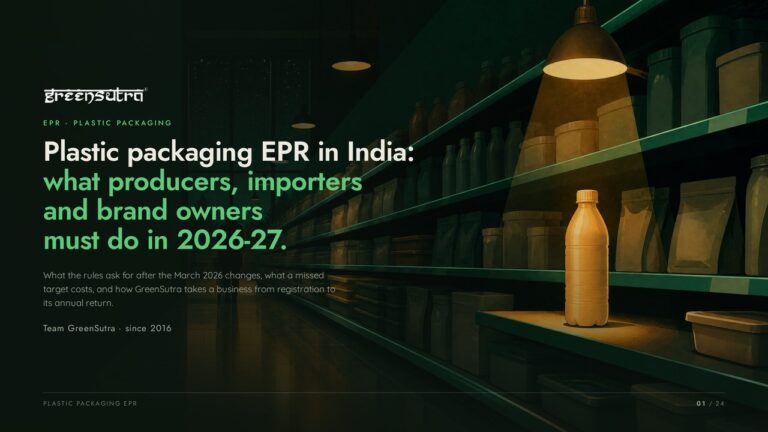 Get the deck by email
The PDF is attached to a confirmation email. There is no public download link.
Book a free plastic EPR consultation
A short conversation about the plastic packaging placed on the market, the role on it and the targets due turns into a tailored plastic EPR plan and a scoped quote, at no charge and no commitment. Schedule a call directly or send a written brief. GreenSutra's plastic EPR desk works from Unit 43, Apollo Industrial Estate, Paperbox Road, Andheri East, Mumbai 400093, Maharashtra, and delivers across India.
Pick a slot; a practitioner takes the call.
Field notes and stories
Reading on plastic, waste and the circular economy from the GreenSutra journal.

Maintained by GreenSutra · Last reviewed July 2026