


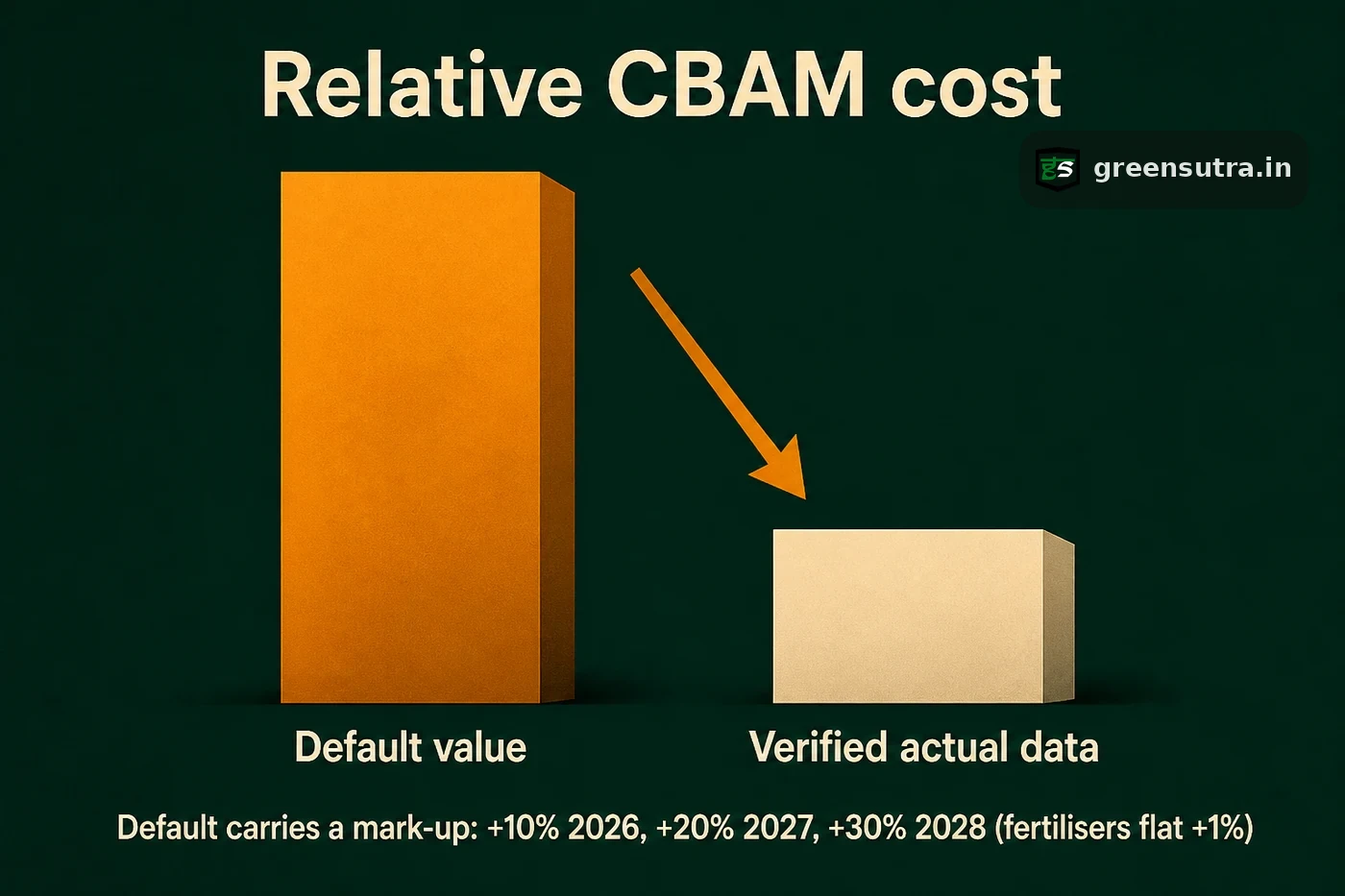
Verified actual installation data usually lowers an exporter’s CBAM cost, while default values raise it. Country-of-origin default values carry a mark-up, 10 to 30 percent for most sectors and a flat 1 percent for fertilisers, and deliberately overstate emissions. Verified plant data, once checked by an independent accredited verifier, typically prices real, lower emissions.
Default values versus verified actual data
Every CBAM declaration prices embedded emissions on one of two bases: the country-of-origin default value or verified actual installation data. Implementing Regulation (EU) 2025/2621 sets the default values, and each carries a mark-up applied on top of the base figure.
| Basis | Emissions figure | Mark-up on the base | Typical effect on cost |
|---|---|---|---|
| Default value | Country-of-origin default from IR (EU) 2025/2621 | 10 percent in 2026, 20 percent in 2027, 30 percent from 2028 for cement, iron and steel, aluminium and hydrogen; a flat 1 percent for fertilisers | Overstates emissions, raises the payable cost |
| Verified actual data | Real emissions from the producing installation | None | Usually lower, lowers the payable cost |
Why verified data usually lowers the bill
The certificate cost for an import year multiplies the tonnes shipped by the embedded emissions per tonne, by the payable share for that year, by the EU ETS linked certificate price, which averaged EUR 75.36 per tonne CO2e in the first quarter of 2026. The payable share rises from 2.5 percent in 2026 to 100 percent by 2034, so any overstatement in the emissions figure compounds as the share climbs. A default value is a deliberately conservative estimate, so replacing it with a lower verified figure reduces every subsequent multiplication.
How the data is readied for verification
Actual data has been required since 1 August 2024; default values could substitute only until 31 July 2024, with a limited tolerance allowing up to 20 percent of a complex good’s embedded emissions to rely on default or estimated values. Verified actual data must be confirmed by a verifier accredited under the EU CBAM accreditation rules, Commission Delegated Regulation (EU) 2025/2551. That verification is always performed by an independent accredited third party, never by a consultant.
The CBAM cost calculator compares the default and verified paths for a specific product, volume and year; the CBAM guide sets out the reporting timeline; and a CBAM consulting service prepares installation data for verification by an accredited verifier.
Sources: Regulation (EU) 2023/956 · Implementing Regulation (EU) 2025/2621 · European Commission CBAM