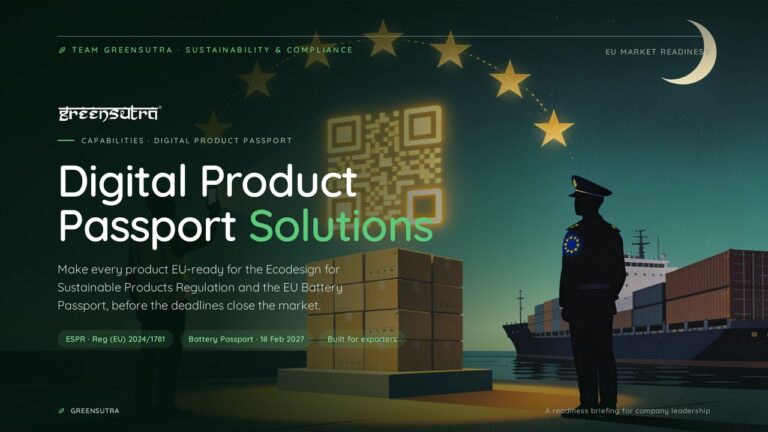
Digital Product Passport Solutions for

Export readiness for the EU Digital Product Passport under the Ecodesign for Sustainable Products Regulation, and for the EU battery passport that applies from 18 February 2027. Product level data, unique identifiers and a machine readable data carrier prepared, and the passport record built and maintained so Indian goods stay ready for the European market.

Map · Build · RegisterESPR and battery passportIndia and worldwide delivery

Reviewed by Team GreenSutra · Updated 18 June 2026

On recordFrameworkESPR · Regulation (EU) 2024/1781First dated passportBattery passport · February 2027Data carrierMachine readableRegistryEU centralScopePriority product groupsBaseMumbai
01

From an EU framework to an export-ready passport

For Indian manufacturers and exporters of batteries, textiles, metals and electronics placed on the European market.

As a digital product passport consultant serving exporters across India, GreenSutra turns the European Digital Product Passport into an export-ready record. The Digital Product Passport is a structured electronic record introduced by the Ecodesign for Sustainable Products Regulation, Regulation (EU) 2024/1781, in force since 18 July 2024. The framework sets no general deadline; under Articles 9 to 15 the passport becomes mandatory product group by product group through delegated acts of the European Commission. One accountable engagement maps a product against the priority groups and the battery rule, assembles the data a passport needs, secures the identifiers and data carrier, and maintains the record for the European market. A short DPP discovery questionnaire is the quickest way to scope a product group, the route to the European market and the data already on hand before a readiness review.

The first Working Plan, COM(2025) 187 final adopted on 16 April 2025, names six priority groups, from textiles to iron and steel, with indicative adoption years across 2026 to 2029 that are planning dates rather than law; as of June 2026 no product-specific delegated act has been adopted. The one passport fixed in dated law is the EU battery passport under Article 77 of Regulation (EU) 2023/1542, applying from 18 February 2027. Because the framework reaches products placed on the European market wherever made, Indian exporters fall within scope once a delegated act covers their goods, and the European Commission must set up the central DPP registry by 19 July 2026. India has no domestic Digital Product Passport law, so the task is export readiness. How the passport is reached, the GS1 Digital Link carrier route, who holds the duty for imported goods, the deadlines and the cost drivers are set out in full in the Digital Product Passport guide.

Who sees what: the three access tiers

A passport is not a single open file. Under ESPR Article 11 the record gives the listed actors free and easy access, but only to the information their access rights allow, and ESPR Article 14 adds a publicly accessible web portal to search and compare passport data within those rights. The battery passport tiers access the same way under Article 77 of the Battery Regulation (EU) 2023/1542. The three tiers separate what the public, the authorities and the value-chain operators each see.

Three access tiers under the Digital Product Passport and battery passport
Access tierWhoWhat the passport shows them
PublicCustomers and the general public, through the publicly accessible web portal under ESPR Article 14.The public subset of the record, the information opened to everyone under each product's access rights; for the battery passport, the information set as public under Annex XIII.
AuthoritiesMarket surveillance and customs authorities under ESPR Articles 11 and 15; for the battery passport, notified bodies, market surveillance authorities and the Commission.Access for enforcement and, at release for free circulation, the registration identifier and commodity code verified against the central EU registry once it is operational.
Economic operatorsRepairers and recyclers under ESPR Article 11; for the battery passport, persons with a legitimate interest such as repairers, remanufacturers, second-life operators and recyclers.The information their access rights allow for repair, remanufacture, second-life use and end of life, available even after the operator ceases activity.
02

Product groups covered by the Digital Product Passport

The first priority groups under the ESPR Working Plan, indicative on timing, alongside the one passport already fixed in dated law.

The Digital Product Passport becomes mandatory product group by product group through delegated acts under the ESPR. The first Working Plan, COM(2025) 187 final, names the priority groups below with indicative adoption years across 2026 to 2029, which are planning dates rather than law; as of June 2026 no product-specific delegated act has been adopted. The one passport fixed in dated law is the EU battery passport, which applies from 18 February 2027.

Textiles

Textiles with a focus on apparel, a leading India to EU trade flow, named a priority group in the first ESPR Working Plan.

Indicative · Working Plan ~2027Apparel · footwear

Furniture

Furniture as a finished product group named in the first Working Plan.

Indicative · Working Plan ~2028Final products

Tyres

Tyres as a finished product group placed on the European market.

Indicative · Working Plan ~2027Final products

Mattresses

Mattresses as a finished product group, the latest indicative planning year of the six.

Indicative · Working Plan ~2029Final products

Iron and steel

Iron and steel as an intermediate product group, the earliest indicative planning year of the six.

Indicative · Working Plan ~2026Intermediate products

Aluminium

Aluminium as an intermediate product group placed on the European market.

Indicative · Working Plan ~2027Intermediate products

Batteries

Light means of transport, industrial batteries above 2 kWh and electric vehicle batteries, the one passport fixed in dated law under Article 77 of the Battery Regulation.

Dated · from 18 February 2027LMT · industrial · EV

A precise check of which product groups a business places on the EU market, and whether the dated battery track applies, is the first step of every DPP readiness review.

03

How a DPP engagement runs

From product scoping and data mapping to a built passport record, secured identifiers, a registered passport and a maintained record.

Consultant mapping a battery, a textile bolt and a steel part to a product passport data sheet on a wall chart at a night workbench
01

Map the product and the data

The product confirmed against the ESPR priority groups and the battery passport rule, the supply chain mapped, and the product level data a passport will need identified.

Analyst assembling a digital product passport record from supply tier documents into structured material and recycled content data on a night office screen
02

Assemble the record across supply tiers

Material composition, recycled content, substances of concern, durability, repair and end of life data gathered across every supply tier into one structured passport record.

Engineer scanning a QR code data carrier on a product to reach its digital product passport record among warehouse shelves at night
03

Secure identifiers and the data carrier

Unique product, operator and facility identifiers secured to the standards referenced in Annex III, and a machine readable data carrier such as a QR code prepared.

Compliance analyst before a glowing EU digital product passport registry screen beside an export crate bound for the European market at night
04

Register and ready for customs

The identifiers readied for the central EU registry the Commission must set up by 19 July 2026, and the registration identifier prepared for customs at release for free circulation.

Compliance team maintaining a digital product passport record shared with manufacturer, importer and recycler readers along a value chain at a night desk
05

Maintain the passport across the chain

Data governance set so the passport stays accurate, complete and up to date, accessible to each actor by their access rights, even after the operator ceases activity.

04

How a digital product passport works

The passport follows a product from value-chain data through a data carrier to the central EU registry and its readers.

The passport journey: product, carrier, record bench, registry, value-chain access and market surveillanceTechnical drawing of the digital product passport journey under the Ecodesign for Sustainable Products Regulation and the EU Battery Regulation. A physical product, such as a battery, a textile or steel, carries a teal data carrier, typically a QR code or data matrix holding a unique product identifier. A scan resolves the carrier. At a record build bench the product data fields assemble into the passport, covering materials, recycled content, durability, repair and end of life. The unique identifiers are registered in a green EU digital product passport registry vault, which the European Commission must set up by 19 July 2026 and which holds an identifier ledger. Along the value chain three actors, a recycler, a buyer and a customs officer, each read the field of the passport relevant to them. At a saffron market surveillance checkpoint the passport is verified at the point of control and the identifier is matched against the registry before the product is released onto the European market.1122334455667788AABBCCDDEEFFREGULATIONESPR 2024/1781BATTERY REG 2023/1542REGISTRY BY 19 JUL 2026DELEGATED ACTSPRODUCT AND CARRIERDATA CARRIER BORNE01SCAN AND RESOLVECARRIER READ02RECORD BUILDFIELDS ASSEMBLE03DPP REGISTRYIDENTIFIERS REGISTERED04VALUE CHAIN ACCESSACTORS READ FIELDS05SURVEILLANCEMATCHED AT CONTROL06PER UNITQR · DATA MATRIXPASSPORT SPINE · NTSSCANNEDBUNIQUE IDMACHINE READABLERESOLVES TO DPPDETAIL B · NTSIDMATERIALSMAKERUSEDURABILITYREPAIRCARBONFOOTPRINTSUBSTANCESEOLRECOVERYDISPOSALPASSPORT RECORD BUILTIDENTIFIER LEDGERUID REGISTEREDEACH READS A FIELDEND OF LIFEDURABILITYUNIQUE IDIDENTIFIER MATCHEDPLACED ON MARKETKEYPRODUCTCARRIER AND DATAREGISTRYCONTROLDRAWINGPASSPORT JOURNEYSTATUSDWG NOGS·DPP·02REVBDATE2026·06
01Product and carrier

A physical product, such as a battery or a textile, carries a machine readable data carrier such as a QR code holding its unique product identifier.

02Scan and resolve

Scanning the data carrier resolves the identifier to the digital product passport, the structured electronic record held for that product.

03Record build

Product level data assembles into the passport record: material composition, recycled content, durability, repair and end of life information.

04DPP registry

The unique identifiers are registered in the central EU registry the Commission must set up by 19 July 2026.

05Value chain access

Each actor, the manufacturer, the importer and the recycler, reads the passport for the information relevant to them, by their access rights.

06Market surveillance

Market surveillance and customs verify the registered identifier and commodity code against the product once the registry is operational.

Product level data is gathered across the value chain and carried by a machine readable data carrier such as a QR code, the unique identifiers are registered in the central EU registry, and the passport is read by each actor along the chain and verified by customs and market surveillance once the registry is operational. The battery passport applies from 18 February 2027.

05

DPP exposure self-check

Two answers map a business onto the EU Digital Product Passport.

Two questions place a business against the EU Digital Product Passport: the product groups it places on the European market and the route by which they reach it. The result separates the indicative ESPR groups from the dated battery passport and states what to prepare next.

Two questions decide DPP exposure: which product groups the business places on the European market, from textiles, furniture, tyres, mattresses, iron and steel and aluminium to batteries, and the route by which they reach it. A DPP readiness review works through both with the product on the table.

Request a DPP readiness review

Answers stay in this browser. Nothing is sent until a contact channel is opened.

The passport follows each product from the data gathered across its value chain to the data carrier and the registry, and a readiness review turns that path into a built, maintained passport record.

Request a DPP readiness review
06

Benefits of DPP solutions

What passport readiness earns an exporter before each delegated act applies.

B·01

Market access protected

A compliant, registry-matched passport keeps covered goods moving into the European market, since a product without one can be refused release for free circulation once the registry is operational.

B·02

Ahead of the deadline

Product level data assembled before each delegated act applies, and before the battery passport date of 18 February 2027, so the obligation is met without a last-minute scramble.

B·03

Trusted supplier status

Verified, traceable product data positions the exporter as a preferred supplier to European buyers who must source passport-ready goods.

B·04

Circular advantage

The traceability data behind a passport, from recycled content to repair and end of life information, also supports durability and circularity claims that grow in value over time.

Indian export goods crossing a port toward the European market each carrying a scannable digital product passport carrier
Traceability that protects market access
07

Why GreenSutra leads DPP readiness

The reasons a digital product passport consultant in India is trusted by exporters to the European market.

R·01

EU regulatory fluency

Working knowledge of the Ecodesign for Sustainable Products Regulation, its delegated-act mechanism and the EU battery passport, so guidance separates indicative planning from binding obligation.

R·02

Supply chain data depth

Product level data assembled across multiple Indian supply tiers, from material composition and recycled content to substances of concern and end of life.

R·03

Export readiness focus

A clear export-readiness brief that prepares Indian goods for the European market without assuming any domestic Indian passport law, since none exists.

R·04

End to end delivery

Mapping, data assembly, identifiers, data carrier and registry readiness handled as one accountable engagement, or any stage standalone.

R·05

Mumbai based, serving worldwide

DPP readiness delivered to exporters in India and worldwide from a Mumbai base.

08

DPP questions, answered

Q·01What are DPP solutions?
DPP solutions prepare a business for the European Union Digital Product Passport introduced by the Ecodesign for Sustainable Products Regulation, Regulation (EU) 2024/1781, and for the EU battery passport under the Battery Regulation (EU) 2023/1542. The work maps the product against the priority groups, assembles the product level data a passport needs across the supply chain, secures the unique identifiers, prepares a machine readable data carrier such as a QR code, and sets the data governance that keeps the record accurate, complete and up to date for the European market.
Q·02When is the DPP mandatory?
The Ecodesign for Sustainable Products Regulation has been in force since 18 July 2024, but the framework sets no general passport deadline. The Digital Product Passport becomes mandatory product group by product group, only when a product-specific delegated act under Article 4 is adopted and applies. The first Working Plan, adopted on 16 April 2025, gives indicative adoption years across 2026 to 2029, but these are planning dates rather than law, and as of June 2026 no product-specific delegated act has been adopted. The one passport already fixed in dated law is the EU battery passport, which applies from 18 February 2027.
Q·03When does the EU battery passport apply and to which batteries?
Under Article 77 of the Battery Regulation (EU) 2023/1542, the battery passport applies from 18 February 2027 to each light means of transport battery, each industrial battery with a capacity greater than 2 kWh, and each electric vehicle battery placed on the European market. It does not cover every battery; portable and consumer batteries below those thresholds are outside the Article 77 passport. Access is tiered, some information public, some restricted to notified bodies, market surveillance and the Commission, and some reserved to persons with a legitimate interest such as repairers and recyclers.
Q·04Does the DPP apply to Indian manufacturers exporting to the EU?
Yes. The Ecodesign for Sustainable Products Regulation applies to products placed on the European market regardless of where they are manufactured. An Indian exporter of a covered product, such as a battery, a textile or a steel or aluminium product, must provide a compliant passport once a delegated act covers that product group. India has no domestic Digital Product Passport law, so the obligation is the European Union and the work is export readiness, preparing the product data and identifiers ahead of each European deadline.
Q·05How much does a digital product passport cost to implement?
No single figure fits, because the cost is driven by the work each business actually faces rather than a fixed fee. The main drivers are data readiness across the supply chain; the number of distinct product lines and models that each need their own passport record; the product group involved and the requirements its delegated act sets, with the dated battery passport carrying the most defined demands; the depth of the supply chain that must supply material, recycled content and substances of concern data; and whether identifiers, a data carrier and ongoing data governance are built once or maintained across many products. A readiness review scopes these drivers before any work is sized.
Q·06Digital product passport vs battery passport: what is the difference?
The two rest on different regulations. The Digital Product Passport is the broad framework introduced by the Ecodesign for Sustainable Products Regulation, Regulation (EU) 2024/1781, rolled out product group by product group through delegated acts, with the priority groups named in the first Working Plan but no product-specific delegated act adopted as of June 2026. The battery passport is the one passport already fixed in dated law: under Article 77 of the Battery Regulation (EU) 2023/1542 it is mandatory from 18 February 2027 for light means of transport batteries, electric vehicle batteries and industrial batteries above 2 kWh. In short, the battery passport is a specific dated obligation, while the Digital Product Passport is the wider ESPR framework whose timing follows each delegated act.
10

Request a DPP readiness review

A short conversation about the product, the European market it serves and the data already on hand turns into a tailored Digital Product Passport plan. Schedule a call directly or send a written brief.

01Schedule a call

Pick the service and a slot; a practitioner takes the call.

02Write to us
Contact Us
Preferred reply channel

DPP mapped, built and registered for EU export readinessRequest a DPP readiness review

Scope your DPP readiness

Tell us about your products and data — our team maps the ESPR and battery-passport obligations and returns a tailored Scope of Work.

Start your DPP discovery →