

Indian aluminium exported to the EU without verified emissions data is assessed at India-specific defaults from Implementing Regulation (EU) 2025/2621: 1.87 tCO2e per tonne for unwrought metal, 2.59 for wire, 3.41 for bars and rods and 4.13 for plates, sheets, strip and foil, each carrying a 10 percent mark-up in 2026 that rises to 30 percent from 2028.
How the aluminium defaults are set
CBAM prices the carbon embedded in aluminium imported into the European Union, and where an importer declares goods without verified installation data, the European Commission’s default values in Implementing Regulation (EU) 2025/2621 apply. Three rules shape the India numbers. First, defaults follow the country of origin, so the India set reflects Indian production routes. Second, aluminium is an Annex II good under Regulation (EU) 2023/956, so only direct embedded emissions are priced; indirect, electricity-related emissions are excluded, so the grid mix behind a smelter adds nothing to the certificate obligation. Third, each default carries a regulatory mark-up of 10 percent in 2026, 20 percent in 2027 and 30 percent from 2028.
India defaults climb with each stage of working
The India default rises with every stage of working, from 1.87 tCO2e per tonne for unwrought metal to 4.13 for plates, sheets, strip and foil.
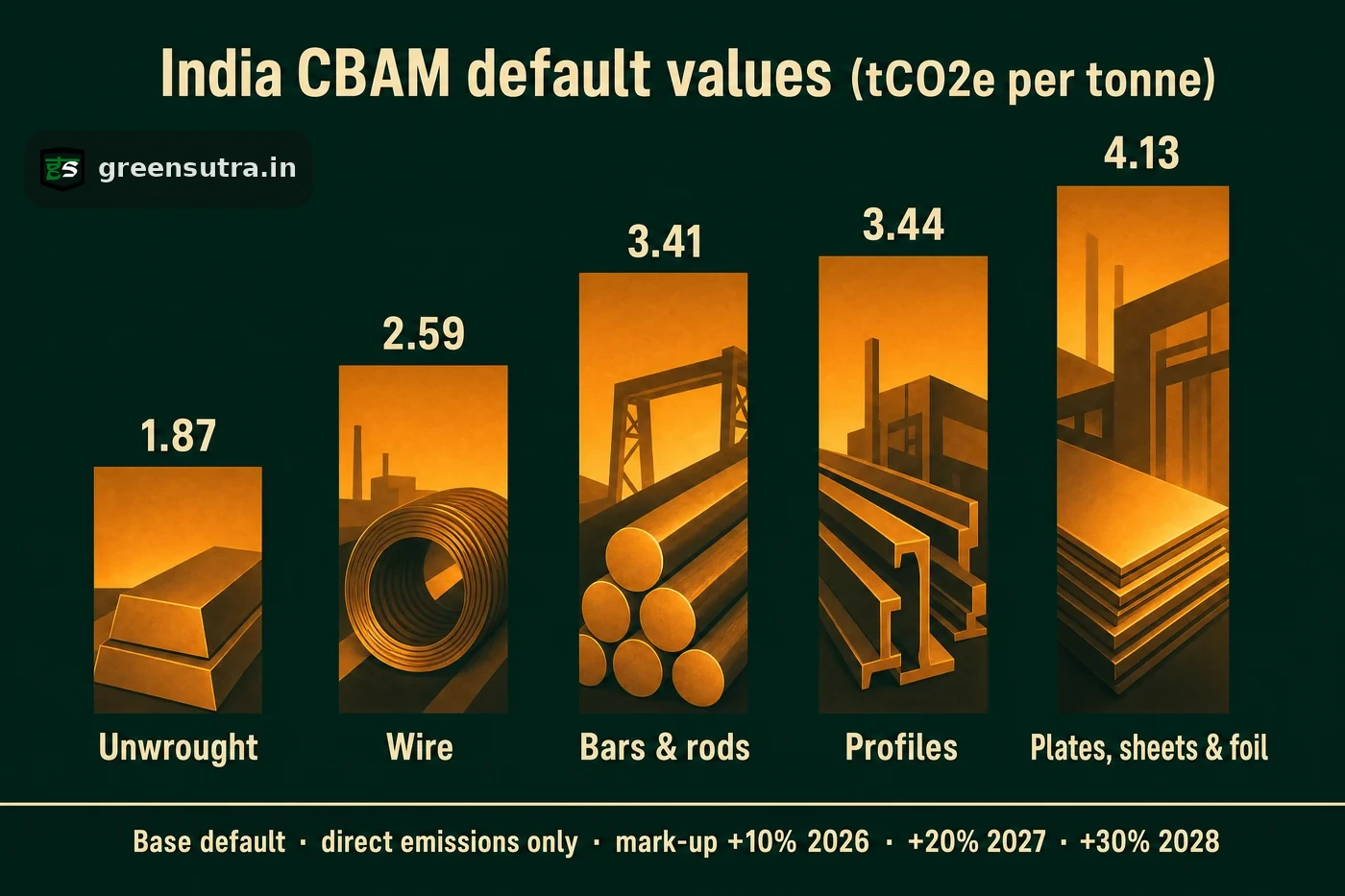
| Product | CN code | Base default (tCO2e/t) | 2026 with mark-up |
|---|---|---|---|
| Unwrought aluminium | 7601 | 1.87 | 2.06 |
| Wire | 7605 | 2.59 | 2.85 |
| Bars and rods | 7604 10 10 | 3.41 | 3.75 |
| Profiles, tubes and structures | 7604 (profiles) · 7608 · 7610 | 3.44 | 3.79 |
| Plates, sheets, strip and foil | 7606 · 7607 | 4.13 | 4.54 |
Source: Implementing Regulation (EU) 2025/2621, Annex I, India values. Direct emissions only.
The unwrought figure sits close to independent estimates: the Hasanbeigi dataset (ORF 2025) estimates Indian direct smelting intensity at 1.75 tCO2e per tonne, consistent with the 1.87 default.
What the climb means for an Indian exporter
Product mix, not just tonnage, drives the CBAM bill. Two consignments of equal weight carry different certificate obligations when one ships unwrought metal at 1.87 and the other ships foil at 4.54 with the 2026 mark-up, and the gap widens as the payable share climbs from 2.5 percent in 2026 to 100 percent by 2034 against an EU ETS-linked certificate price that averaged EUR 75.36 per tonne of CO2e in Q1 2026. Three steps follow for any exporter on the default path:
- Map every exported line to its CN code; the covered range runs from CN 7601 to 7616, detailed in which aluminium products CBAM covers.
- Compare the aluminium position with the India steel defaults; the same country-of-origin and mark-up rules apply across both groups.
- Model the exposure year by year in the CBAM cost calculator, then engage a CBAM consulting service to prepare installation data for verification by an accredited verifier.
Sources: Implementing Regulation (EU) 2025/2621 · Regulation (EU) 2023/956