


Recycled aluminium lowers CBAM exposure because scrap-based production carries far less embedded direct carbon than primary metal smelted from ore, and CBAM prices the direct emissions of the specific installation. A recycled-route producer that declares verified installation data can sit well below the marked-up country default, which does not distinguish production routes.
Why the production route drives the CBAM number
Primary aluminium smelted from ore carries far more embedded carbon than recycled, scrap-based metal, and CBAM is designed to price that difference. Aluminium (CN 7601 to 7616) is an Annex II good under Regulation (EU) 2023/956, so only direct emissions are priced, and they attach to the specific installation that produced the goods. Default values do not distinguish production routes: one figure per product per origin applies whether the metal came from a smelter or a remelt shop, plus a mark-up of 10 percent in 2026, 20 percent in 2027 and 30 percent from 2028. India’s unwrought aluminium default is 1.87 tCO2e per tonne, 2.06 with the 2026 mark-up; the full set appears in the Indian aluminium default values answer.
How verified data captures the recycled advantage
Verified installation data is the mechanism that converts a recycled route into a lower CBAM bill. CBAM reporting has required actual rather than estimated data since 1 August 2024, monitored under the calculation-based or measurement-based methods of Implementing Regulation (EU) 2025/2547. An accredited verifier checks the figures, and the installation and its emissions data sit in the CBAM registry behind the importer’s annual declaration, first due 30 September 2027. On that path a recycled-route producer can declare well below the marked-up country default, because the route-blind default overstates a scrap-based installation. The steel sibling on verified emissions data walks the same path.
Working stages still add emissions
Recycled input does not remove CBAM exposure from worked products. Rolling, drawing and extrusion each add processing emissions, and the India default ladder shows how the number climbs with fabrication:
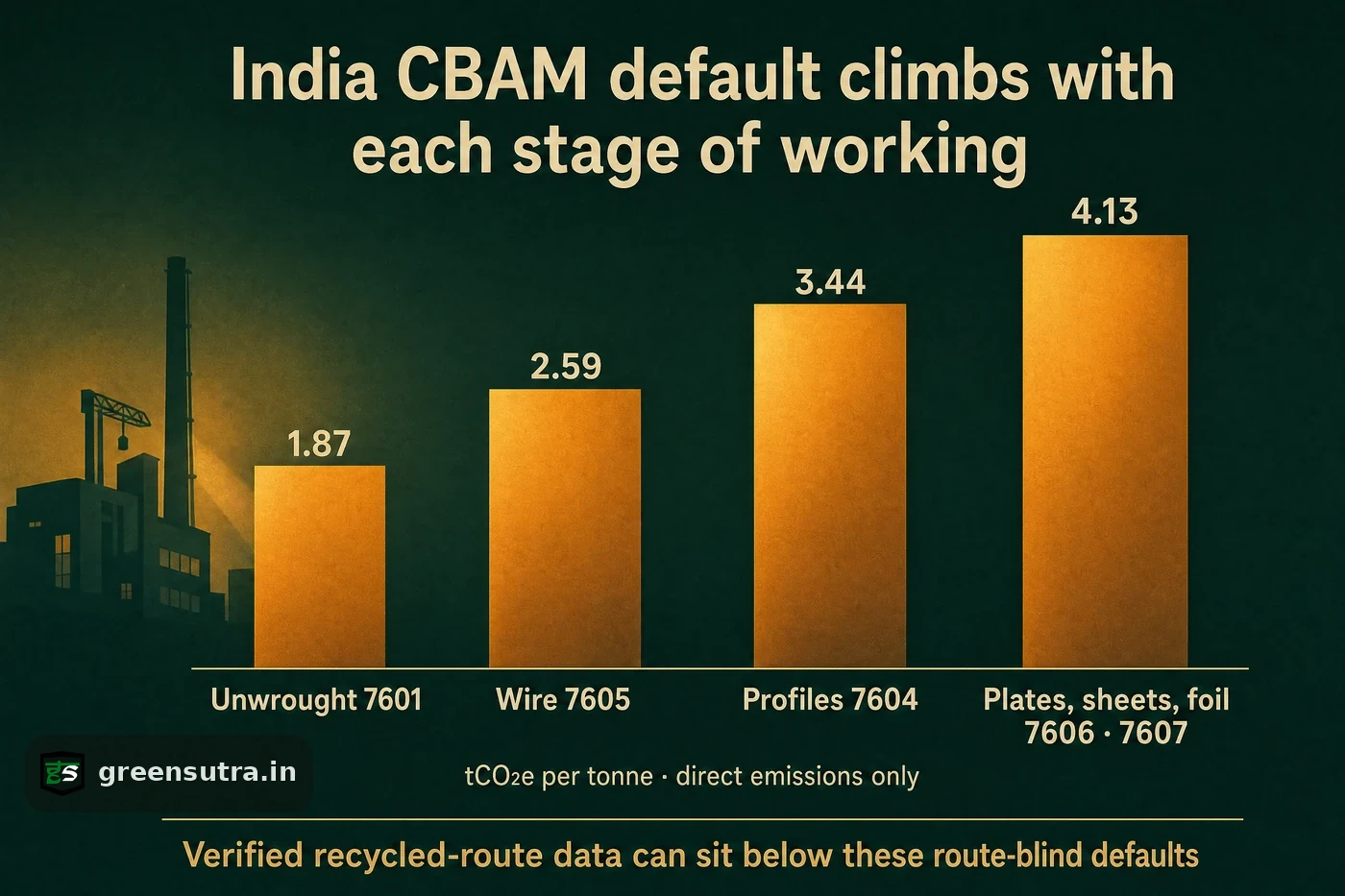
| Stage of working | Representative CN | India base default (tCO2e/t) | 2026 with mark-up |
|---|---|---|---|
| Unwrought aluminium | 7601 | 1.87 | 2.06 |
| Wire | 7605 | 2.59 | 2.85 |
| Profiles (incl. hollow) | 7604 | 3.44 | 3.79 |
| Plates, sheets, strip and foil | 7606 · 7607 | 4.13 | 4.54 |
Source: Implementing Regulation (EU) 2025/2621, Annex I. Direct emissions only.
A remelter shipping foil therefore needs installation-level data covering the downstream working steps, not only the melt. Three moves follow:
- Map every product to its CN heading (7601 to 7616) under Annex I of Regulation (EU) 2023/956.
- Compare each heading’s marked-up India default against the installation’s actual scrap share and process emissions.
- Scope the verified-data effort in the CBAM discovery questionnaire, then engage the CBAM solutions consulting service to prepare installation data for verification by an accredited verifier.
Sources: Regulation (EU) 2023/956 · Implementing Regulation (EU) 2025/2621 · European Commission CBAM page