


Verified emissions data replaces CBAM default values once the producing installation’s embedded emissions pass accredited verification. Those emissions are determined under the calculation-based or measurement-based approach of Annex IV of Regulation (EU) 2023/956 and Implementing Regulation (EU) 2025/2547. The importer may declare verified figures or default values, and verified figures avoid the 10 to 30 percent mark-up carried by steel default values.
How verified data replaces a default value
Article 7(2) of Regulation (EU) 2023/956 lets the importer declare actual emissions or default values, and only actual emissions need verification. Embedded emissions are determined at the producing installation under one of two approaches set out in Annex IV of Regulation (EU) 2023/956 and detailed in Implementing Regulation (EU) 2025/2547: a calculation-based approach built on activity data and emission factors, or a measurement-based approach built on continuous measurement of emission sources. The resulting dataset is verified by an accredited verifier, an independent third party; a consultant such as GreenSutra prepares the data but never performs the verification itself. Once verified, the figures are shared with EU importers and authorised declarants through the CBAM registry, where they replace the country-of-origin default for the goods concerned.
What the switch is worth
Default values carry a deliberate mark-up of 10 percent in 2026, 20 percent in 2027 and 30 percent from 2028 onwards, so a defaults-only declaration always prices more emissions than the published base value. Verified data removes the mark-up, and efficient installations declare below the default itself. On a single line of 500 tonnes a year of hot-rolled flat steel from India, with the payable share rising from 2.5 percent in 2026 to 100 percent in 2034, the two paths diverge sharply.
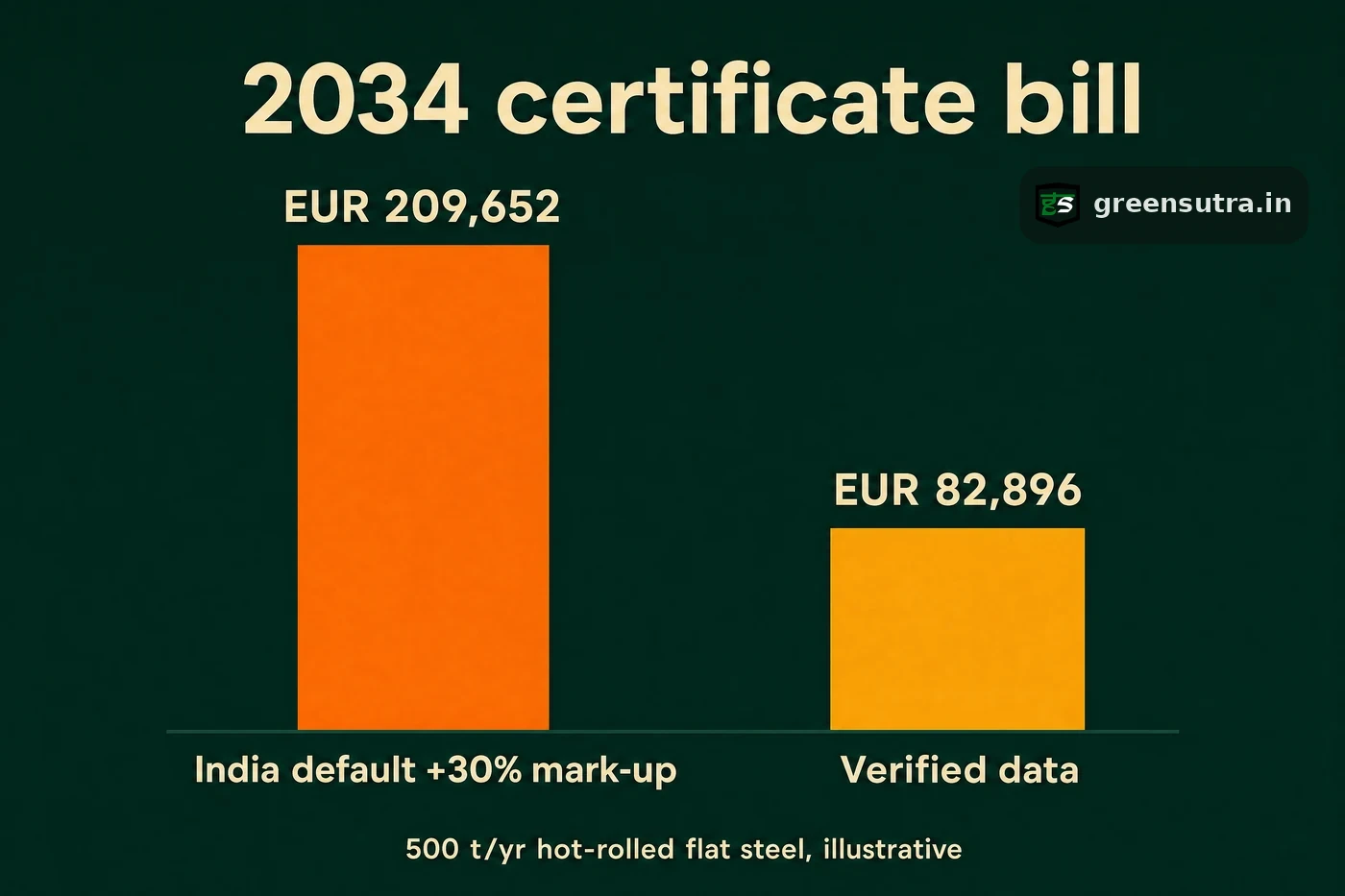
| Declaration path | 2034 certificate bill |
|---|---|
| India default with the 30 percent mark-up | about EUR 209,652 |
| Verified data at roughly half the default | about EUR 82,896 |
Figures are illustrative estimates from GreenSutra’s steel cost illustration, built on the Implementing Regulation (EU) 2025/2621 India defaults and the Q1 2026 EU ETS average of EUR 75.36 per tonne of CO2e. The saving is about 60 percent on one product line; the full default schedule appears in the sibling answer on CBAM default values for Indian steel exports.
Four steps from installation to registry
A steel exporter moves from estimates to verified declarations in four steps:
- Quantify embedded emissions from installation data: production volumes, source streams, precursor inputs and the direct emissions of each production route.
- Prepare the monitoring methodology documentation that fixes system boundaries and the chosen calculation-based or measurement-based approach.
- Have the dataset verified by an accredited verifier; verification is always a third-party act.
- Share the verified figures with importers and authorised declarants through the CBAM registry so every declaration draws on actual data.
Structured preparation shortens that cycle. The CBAM discovery intake maps products and installations in one pass, and the CBAM solutions service covers quantification and report preparation up to the point of independent verification.
Sources: Regulation (EU) 2023/956 · Implementing Regulation (EU) 2025/2621 · European Commission CBAM