

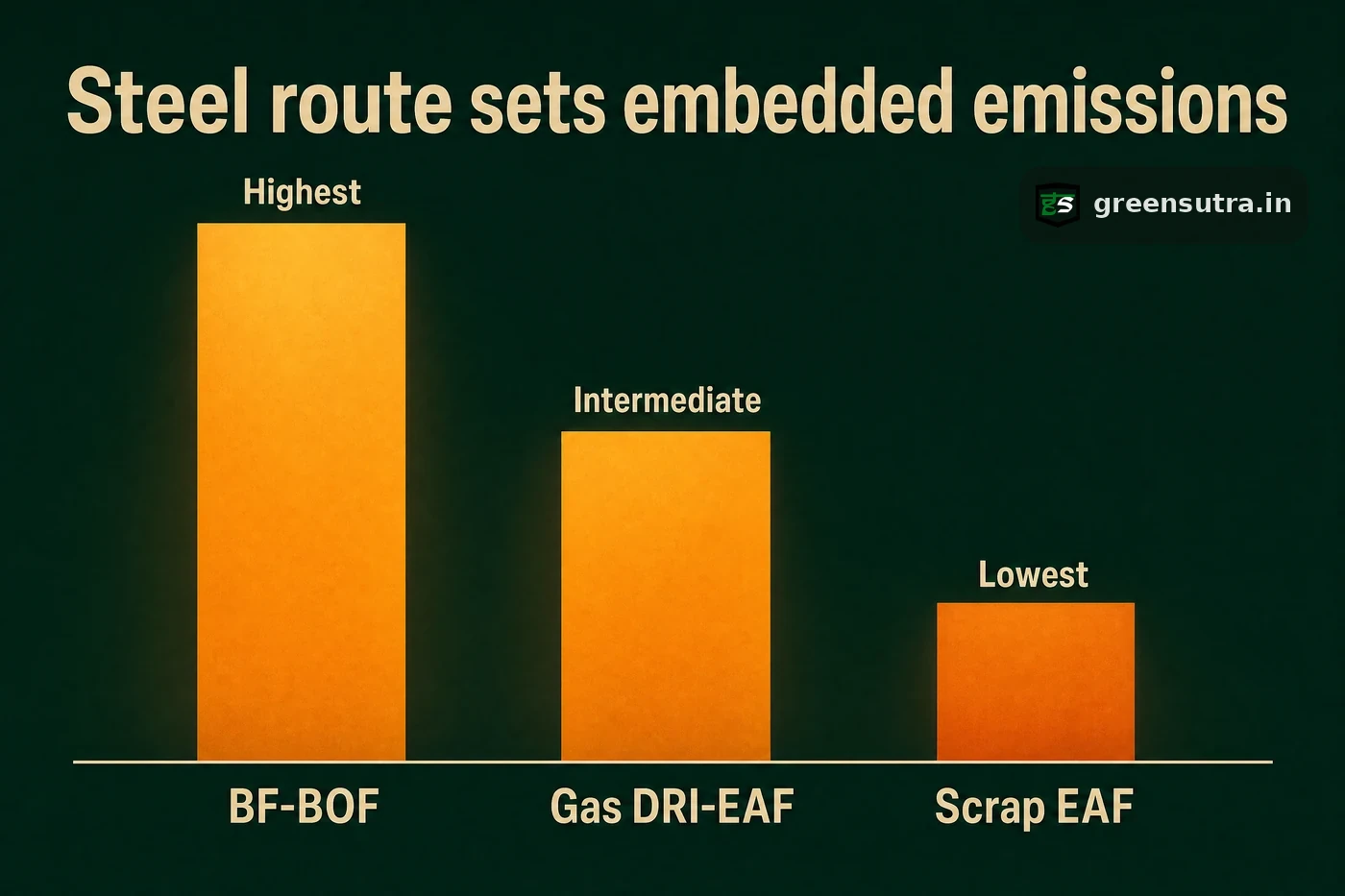
The production route sets a steel CBAM bill: BF-BOF (blast furnace to basic oxygen furnace) steel carries the highest embedded emissions, gas-based DRI-EAF sits in between and scrap-based EAF is the lowest. Verified installation data captures the route; at roughly half the India default, the 2034 bill (500 tonnes a year, hot-rolled flat) falls from about EUR 209,652 to EUR 82,896.
Three routes, three emission levels
Steel reaches the market through three main production routes, and the route sets the embedded emissions that a CBAM bill prices.
| Route | How the steel is made | Embedded emissions |
|---|---|---|
| BF-BOF | Blast furnace to basic oxygen furnace: iron ore reduced with coke, then converted | Highest |
| Gas-based DRI-EAF | Direct reduced iron made with natural gas, melted in an electric arc furnace | Intermediate |
| Scrap-based EAF | Recycled scrap melted in an electric arc furnace | Lowest |
The European Commission’s production-route benchmarks for the definitive period remain provisional, published in draft form only, so the ordering above is the dependable planning fact. Iron and steel is an Annex II good under Regulation (EU) 2023/956, so the certificate obligation prices direct embedded emissions only; electricity-related indirect emissions are monitored and reported but not priced, a distinction unpacked in the answer on indirect electricity emissions.
Route mix explains the country patterns
National route mix shows up directly in country default values. Türkiye’s EAF-heavy industry gives it a below-average emissions intensity, while China’s BF-heavy fleet runs at an estimated 2.0 to 2.2 tCO2 per tonne (sector intensity estimates). The published defaults in Implementing Regulation (EU) 2025/2621 reflect the same pattern: hot-rolled flat products under CN 7208 carry a base default of 2.43 tCO2e per tonne for Türkiye against 4.28 for India, whose full table appears in the answer on Indian steel default values.
Verified route data versus marked-up defaults
The production route is exactly what verified installation data captures and marked-up defaults ignore. Defaults carry a regulatory mark-up of 10 percent in 2026, 20 percent in 2027 and 30 percent from 2028, while the payable share of embedded emissions climbs from 2.5 percent in 2026 to 100 percent by 2034. On an illustrative line of 500 tonnes a year of hot-rolled flat steel on India defaults, the certificate cost rises from about EUR 4,400 in 2026 to over EUR 200,000 in 2034. Verified installation data at roughly half the default cuts that 2034 bill from about EUR 209,652 to EUR 82,896, about a 60 percent cut. A route-specific position can be sized year by year in the CBAM cost calculator, after which a CBAM consulting service calculates installation-level embedded emissions and prepares the CBAM report for verification by an accredited verifier.
Sources: Regulation (EU) 2023/956 · Implementing Regulation (EU) 2025/2621 · European Commission CBAM