

NON-FERROUS METAL EPR GUIDE
Non-Ferrous Metal EPR in India
Non-ferrous metal EPR is the Indian rule that makes the business which places aluminium, copper and zinc products on the market responsible for the metal they become at end of life. It was created by the Hazardous and Other Wastes (Management and Transboundary Movement) Amendment Rules, 2025 and, per the notification, its obligations commence on 1 April 2026, administered by the Central Pollution Control Board. This guide sets out the eighteen products in scope, who registers, how the dedicated portal is being established, the compliance calendar, the rising recycling and recycled-content targets, and how environmental compensation applies. Registration is not yet open, so the practical value of the guide now is getting ready.
Updated 2026 · about 12 min read · CPCB · India
On this page▾
Non-ferrous metal EPR at a glance
Non-ferrous metal EPR is administered by the Central Pollution Control Board under the Hazardous and Other Wastes (M&TM) Amendment Rules, 2025, with obligations commencing 1 April 2026 per the notification and the online portal being established.
What non-ferrous metal EPR is
Extended Producer Responsibility for non-ferrous metal holds the producer that places aluminium, copper and zinc products on the Indian market responsible for the metal they become at end of life, on the polluter-pays principle.
Non-ferrous metal EPR makes the producer of aluminium, copper and zinc products responsible for ensuring a defined share of the metal is collected and recycled once the product reaches end of life. EPR stands for Extended Producer Responsibility, and it operationalises the polluter-pays principle under the Environment (Protection) Act, 1986.
It is not a standalone rule. The regime was created by the Hazardous and Other Wastes (Management and Transboundary Movement) Amendment Rules, 2025, notified by gazette G.S.R. 438(E) on 1 July 2025. The amendment inserts a new Chapter VIII, headed Extended Producer Responsibility for Scrap of Non-Ferrous Metals, together with Schedules X to XIII, into the Hazardous and Other Wastes (M&TM) Rules, 2016. Anyone researching the rule should look for the 2025 amendment to the hazardous-waste rules, not for a separate non-ferrous metal law.
When it starts. Per the notification, the obligations commence on 1 April 2026, which makes the financial year 2026-27 the first compliance year. The Central Pollution Control Board administers the regime and is required to establish a dedicated online portal for registration, returns and EPR certificates. As this guide is written the portal is being established rather than open, so the immediate task for a business in scope is to get ready.
The commercial side, where a consultant prepares a business, computes its target and, once the portal opens, registers it and files the returns, sits on the non-ferrous metal EPR service page. This guide holds the how-it-works detail.
Who needs non-ferrous metal EPR
The recycling obligation falls on the producer, but the rules also draw in a separately obligated manufacturer, plus recyclers, refurbishers, bulk consumers and collection agents, all of whom register.
The rules reach a chain of roles, and it matters which one a business is, because the duties differ.
Producer, the recycling-obligated role. The producer carries the EPR recycling target. The definition is brand-owner centred and folds in importers: a business that sells aluminium, copper or zinc products under its own brand, whether it makes them or buys them in, and a business that imports such products, is a producer. This is the role a consultant registers for the recycling obligation.
Manufacturer, the recycled-content-obligated role. Separately, a manufacturer of the products carries the minimum recycled-content duty under Schedule XIII, a supply-side obligation to build a rising share of recycled metal into new products. A business can be both a producer and a manufacturer.
Recyclers, refurbishers, bulk consumers and collection agents each register in their own right. A recycler melts and refines the end-of-life metal and generates the EPR certificates that producers buy. Registered entities may not transact with unregistered ones, so registration pulls the whole chain onto the portal.
Because the register is not yet open, the practical step now is to confirm which role or roles a business holds and assemble the data each will need. A business that owes non-ferrous metal EPR often also owes plastic packaging or e-waste EPR on related products, which the full EPR guide covers across all six CPCB streams.
The three metals and eighteen products (Schedule X)
Scope is a closed list. The rules cover aluminium, copper and zinc and their alloys, and only the eighteen finished products named in Schedule X trigger the obligation.
Rule 44(k) defines the metals in scope as aluminium, copper or zinc, or their alloys. No other base metal is brought in. The obligation is then triggered only by the finished products listed in Schedule X, which names exactly eighteen product families.
| # | Product family |
|---|---|
| 1 | Cans for beverages, aerosols and similar products |
| 2 | Packaging foils for food, pharma and similar products |
| 3 | Doors, windows and shutters |
| 4 | Aluminium composite panels |
| 5 | Aluminium partitioning, grills and similar products |
| 6 | Utensils: cookware, canisters, storage and similar products |
| 7 | Furniture: tables, chairs, benches, ladders, including doorknobs, handles and hardware |
| 8 | Roofing and ceiling sheets |
| 9 | Motors, pumps, alternators and similar products (other than automobile grade) |
| 10 | Conductor cables, wires and strips (other than automobile grade) |
| 11 | Sanitary ware and fittings |
| 12 | Electrical fittings (other than automobile grade) |
| 13 | Aluminium alloy bicycles |
| 14 | Transformers (other than automobile grade) |
| 15 | Electric generator sets |
| 16 | Centralised air-conditioning plants |
| 17 | Apparel products, for example belt buckles, zips and shoes |
| 18 | Toys |
The only carve-out written into Schedule X is the "other than automobile grade" qualifier on four items: motors and pumps, cables and wires, electrical fittings, and transformers. Beyond that, the obligation reaches imported used products and scrap, where the importer is treated as a producer, and it reaches the manufacturing scrap and waste generated during production under Rule 51(2). The rules are silent on how metal already regulated under the e-waste, battery or end-of-life-vehicle streams is treated, an overlap the CPCB is expected to clarify through guidelines.
How registration will work
Registration will run on a dedicated CPCB online portal. Under Rule 50 the Central Pollution Control Board has six months from commencement, so until about October 2026, to make that portal functional. Until it opens, the work is preparation.
- Confirm the role and the scopeEstablish whether the business is a producer, a manufacturer, or both, and which of the eighteen Schedule X products it places on the market or makes. This settles which obligations apply before the portal opens.
- Assemble the dataGather the identity documents and the weight of each product placed on the market, by metal, so a registration and a target computation can be completed the moment registration opens.
- Register when the portal opensRegister on the dedicated CPCB portal once it is functional. The rules require producers, manufacturers, recyclers, refurbishers, bulk consumers and collection agents to register, and registered entities may transact only with other registered entities.
- Compute the target and source certificatesThe recycling target is computed by weight and discharged by sourcing matching EPR certificates from registered recyclers on the portal.
- File the half-yearly and annual returnsFile the half-yearly return by 31 October and the annual return by 30 June of the following financial year, and keep the records for audit.
The dedicated CPCB non-ferrous portal is being established under Rule 50 (about October 2026) and is not described here as live. The live registration steps are confirmed against the portal once it opens.
Compliance calendar and key dates
Two calendars govern non-ferrous metal EPR: a recurring filing rhythm of a half-yearly return and an annual return, and the rollout of the new rulebook, most of which is still ahead.
Part A. The recurring compliance calendar
Once registered, a producer files on a half-yearly and annual rhythm. These are the statutory dates.
| Return | Due date |
|---|---|
| Half-yearly return | 31 October |
| Annual return | 30 June of the following financial year |
| First annual return (FY 2026-27) | 30 June 2027 |
Part B. The regulatory rollout
- Aug 2024The Ministry of Environment, Forest and Climate Change publishes the draft amendment for public comment.
- 1 Jul 2025The Hazardous and Other Wastes (M&TM) Amendment Rules, 2025 are notified (G.S.R. 438(E)), inserting Chapter VIII and Schedules X to XIII.
- 1 Apr 2026Per the notification, the non-ferrous metal EPR obligations commence. The financial year 2026-27 is the first compliance year and the recycling target begins at 10 per cent.
- ~Oct 2026The statutory deadline, six months from commencement, by which the CPCB must make the dedicated online portal functional for registration, returns and certificates.
- FY2028-29The minimum recycled-content mandate on manufacturers begins, at 5 per cent for all three metals.
- FY2032-33The recycling target reaches 75 per cent and holds at that level.
The rollout dates are drawn from the notification. As this guide is written, no primary source dated after the 1 April 2026 commencement had confirmed that the portal is live or that commencement held without a further extension, so the operative status is confirmed against the current CPCB position rather than assumed. The dates in Part A apply once a business is registered.
Your non-ferrous metal EPR targets
Non-ferrous metal EPR carries two separate obligations: a recycling target on producers that rises to 75 per cent, and a minimum recycled-content mandate on manufacturers that rises per metal.
The recycling target (Schedule XI), on producers. The target is a share of the metal a producer placed on the market, computed by weight against the quantity placed in an earlier year, lagged by the average life of the product as set by the CPCB, which reflects how long-lived these metal goods are. It rises on a fixed schedule.
| Financial year | Recycling target |
|---|---|
| 2026-27 and 2027-28 | 10% |
| 2028-29 and 2029-30 | 30% |
| 2030-31 and 2031-32 | 50% |
| 2032-33 onward | 75% |
An importer of used products or scrap carries a full 100 per cent obligation on the quantity imported in the prior year. A unit set up after 1 April 2026 begins its obligation only after two years.
The recycled-content mandate (Schedule XIII), on manufacturers
Separately from the recycling target, a manufacturer must build a minimum share of recycled metal into new products. The mandate begins in the financial year 2028-29 at 5 per cent for all three metals, and rises so that by the financial year 2031-32 it reaches 10 per cent for aluminium, 20 per cent for copper and 25 per cent for zinc, measured against the total metal used in the product.
The recycling target is discharged by procuring EPR certificates, covered next. The cost is set by a certificate market that does not yet exist for this new stream, so no rupee figure can be quoted. A short scoping turns a product list and prior-year weights into a year-by-year picture of the target that will be due.
EPR certificates and the refurbishing route
A producer will meet the recycling target by buying weight-based EPR certificates from registered recyclers on the portal. The certificate market opens with the portal, so this describes the mechanism the rules set out, not a live exchange.
EPR certificates are the instrument that discharges the recycling target. A registered recycler that melts and refines the end-of-life metal generates a certificate for the verified weight processed, in denominations from 100 kilograms up to 10,000 kilograms. A producer buys and holds certificates against its target on the CPCB portal, and every transaction is recorded there. The quantity a producer needs is computed by a formula the rules set out, the EPR obligation quantity, which multiplies the quantity placed on the market by a conversion factor the CPCB assigns to each product.
Validity and limits. A certificate is valid for two years. A producer may buy up to its current-year liability plus any carried-over shortfall plus a further ten per cent, which caps speculative accumulation. The exchange price is not a free market: the rules peg it to a band between a floor of 30 per cent and a ceiling of 100 per cent of the environmental compensation rate, so the price moves with a compensation figure the CPCB has yet to publish. No rupee value is stated here for that reason.
The refurbishing route defers. For the products listed in Schedule XII, a refurbishing certificate lets a producer defer part of its target, but the deferral is temporary: only 75 per cent of the deferred quantity is ever added back, so the route postpones rather than removes the duty. Because the portal and the certificate market are being established, these mechanics describe how the rules will work once trading opens.
Penalties: environmental compensation
Non-compliance will be enforced through environmental compensation, a levy that does not cancel the underlying obligation, alongside liability under the parent Act. The rupee rate has not been published.
Environmental compensation is the financial levy the CPCB imposes for falling short of the recycling target or a filing obligation, applied after a hearing and in line with CPCB guidelines. Its statutory basis is Section 15 of the Environment (Protection) Act, 1986.
Paying compensation does not extinguish the obligation. The unmet quantity is carried forward for up to three years. The compensation is refunded on a sliding scale if the shortfall is made good in time, at 85 per cent, 60 per cent or 30 per cent where the shortfall is addressed after one, two or three years respectively, and nothing is refunded after three years.
Over-generation of certificates beyond a five per cent margin, and a record of three or more violations, can trigger revocation of a registration. The specific rupee rate of compensation has not yet been notified by the CPCB, so this guide describes the mechanism rather than quoting an amount.
Non-ferrous metal EPR questions, answered
Common questions on what the rule is, which metals and products it covers, who registers, when it starts, whether the portal is open, the targets and the returns.
What is non-ferrous metal EPR in India?+
It is Extended Producer Responsibility for aluminium, copper and zinc products, which makes the producer responsible for ensuring a rising share of the metal is recycled at end of life. It was created by the Hazardous and Other Wastes (Management and Transboundary Movement) Amendment Rules, 2025, notified as G.S.R. 438(E) on 1 July 2025, and, per the notification, its obligations commence on 1 April 2026, administered by the Central Pollution Control Board.
Is there a separate Non-Ferrous Metal Waste Rules?+
No. There is no standalone non-ferrous metal law. The regime is created by a 2025 amendment to the Hazardous and Other Wastes (M&TM) Rules, 2016, which inserts a new Chapter VIII and Schedules X to XIII. The phrase Non-Ferrous Metal Waste Rules is an informal market name for that amendment.
Which metals and products are covered?+
The metals are aluminium, copper and zinc and their alloys. The obligation is triggered only by the eighteen finished-product families named in Schedule X, which range from beverage cans, foils, doors and windows and utensils to cables, transformers, generator sets, bicycles, apparel fittings and toys. Four items, covering motors, cables, electrical fittings and transformers, carry an other than automobile grade carve-out.
Who has to register?+
The producer, meaning the brand owner of the products and importers, carries the recycling target. A manufacturer carries a separate recycled-content duty. Recyclers, refurbishers, bulk consumers and collection agents also register. Registered entities may transact only with other registered entities, so the whole chain comes onto the portal.
Is the CPCB portal open and can a business register now?+
Not yet, as far as can be confirmed. The rules require the CPCB to make a dedicated online portal functional within six months of the 1 April 2026 commencement, which is about October 2026, and non-ferrous is not yet on the CPCB list of live EPR portals. The useful work now is readiness: confirming the role, the products in scope and the data, so registration and the target computation can be completed the moment the portal opens.
When does non-ferrous metal EPR start?+
Per the notification, the obligations commence on 1 April 2026, which makes the financial year 2026-27 the first compliance year, with the recycling target beginning at 10 per cent. The exact operative status is confirmed against the current CPCB position, because the commencement date had been extended once already, from 2025 to 2026.
What are the recycling targets?+
The recycling target rises from 10 per cent for the financial years 2026-27 and 2027-28, to 30 per cent for 2028-29 and 2029-30, to 50 per cent for 2030-31 and 2031-32, and to 75 per cent from 2032-33 onward. It is applied by weight to the quantity placed on the market in an earlier year, lagged by the average life of the product. Importers of used products or scrap carry a full 100 per cent obligation.
What is the recycled-content mandate?+
Separately from the recycling target, manufacturers must build a minimum share of recycled metal into new products under Schedule XIII. It begins in 2028-29 at 5 per cent for all three metals and rises by 2031-32 to 10 per cent for aluminium, 20 per cent for copper and 25 per cent for zinc, measured against the total metal used in the product.
When are the returns due?+
A registered producer files a half-yearly return by 31 October and an annual return by 30 June of the following financial year. The first annual return, for the financial year 2026-27, falls due on 30 June 2027. The operative dates are confirmed on the portal once it is live, since administrative extensions are common.
How much will non-ferrous metal EPR cost?+
No rupee figure can honestly be given yet. The main cost is the EPR certificates needed to meet the target, and their price is pegged to an environmental-compensation rate that the CPCB has not yet published, on a certificate market that opens with the portal. The registration and audit fees are also not yet notified. A scoping now sizes the obligation in tonnes so the cost can be attached the moment the figures are published.
Primary sources
The rules cited in this guide come from the Government of India notification and the Central Pollution Control Board.
Related guides and tools
The non-ferrous metal EPR service page carries the engagement; the discovery scopes readiness; the parent guide covers the neighbouring streams.
EPR tools
Related reading
Get non-ferrous metal EPR ready
This guide sets out how non-ferrous metal EPR works; a short scoping applies it to a specific catalogue while there is time to prepare. A few structured questions about the aluminium, copper and zinc products placed on the market and the role in each turn into a clear picture of the target and the registration that will apply. The service page sets out the full engagement.
Reviewed 24 July 2026
Solution deck · 21 slides · PDF by email
Open to correctionsNon-Ferrous Metal Recyclers EPR
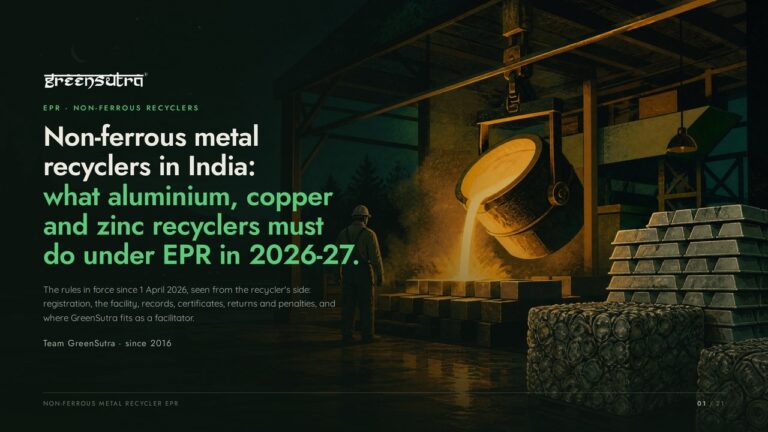
A 21 slide deck for aluminium, copper and zinc recyclers. It covers the rules in force since 1 April 2026 from the recycler's side, from registration and the facility to records, certificates, returns and penalties.
- What counts as recycling, why producers and manufacturers need recyclers, who a recycler may deal with, and what CPCB has still to publish
- Registration, the facility, records, certificates, selling, returns and penalties
- How GreenSutra helps: six services for recyclers, from a facilitator that is not a broker
 Get the deck by email
The PDF is attached to a confirmation email. There is no public download link.