


GCP stands for the Green Credit Programme, India’s market based mechanism for rewarding voluntary environmental action. Notified under the Green Credit Rules, 2023, it lets a person, community, company or institution earn green credits, where a green credit is a single unit of incentive granted for a specified activity that benefits the environment. It is administered by ICFRE under the Ministry of Environment, Forest and Climate Change.
What a green credit is, and who runs the programme
The Green Credit Rules, 2023 were notified by the central government on 12 October 2023 under the Environment (Protection) Act, 1986. Under the Rules a green credit is a singular unit of an incentive granted for a specified activity that delivers a positive impact on the environment. The programme is administered by the Indian Council of Forestry Research and Education, or ICFRE, under the Ministry of Environment, Forest and Climate Change. ICFRE registers projects, sets the methodology for each activity, issues the credits, and maintains the digital registry and platform on which they are recorded. India presented the idea to the world as the Green Credit Initiative, launched with the UAE at COP28 in Dubai in December 2023 as part of the LiFE, or Lifestyle for Environment, movement. Registration is through the government portal at moefcc-gcp.in.
The eight activities, and what is live today
The Rules identify eight kinds of activity that can earn green credits:
- Tree plantation
- Water management
- Sustainable agriculture
- Waste management
- Air pollution reduction
- Mangrove conservation and restoration
- Ecomark label development
- Sustainable building and infrastructure
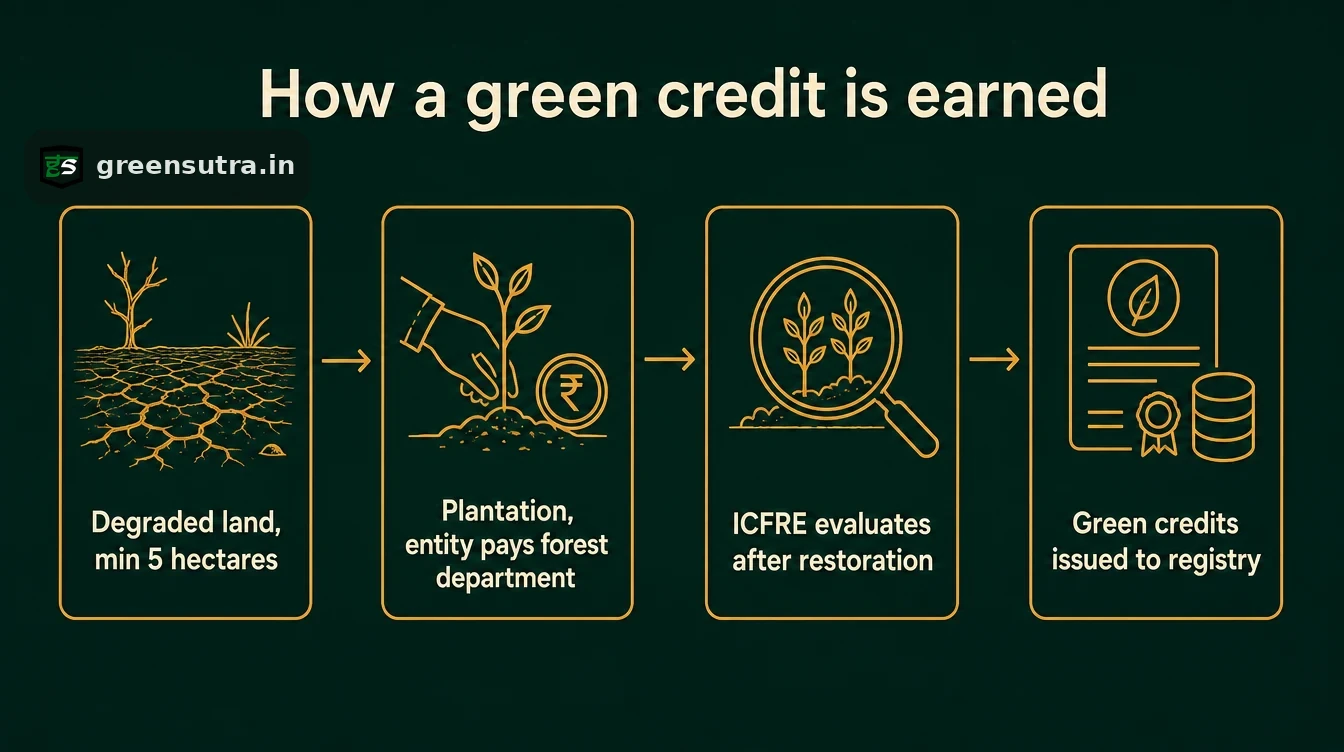
Only tree plantation has been made operational so far. Its methodology, approved in February 2024, asks states and union territories to identify degraded land, wasteland or watershed parcels of at least five hectares under forest department control, which participating entities pay the department to plant. ICFRE issues the credits once the plantation is evaluated and judged successful, on an indicative basis of one green credit per tree. A revised methodology in 2025 lets credits be claimed after five years of restoration on degraded forest land, subject to the plot reaching a minimum canopy density of around forty percent, and it relaxes the earlier fixed count of trees per hectare.
Green credits are not carbon credits
A green credit is not the same as a carbon credit. The Green Credit Programme runs independently of the Carbon Credit Trading Scheme, 2023, and rewards the environmental action itself rather than a measured tonne of greenhouse gas avoided or removed. One project, such as an afforestation drive, may earn green credits and, where it also delivers verified emission reductions, carbon credits as well, but the two are counted and reported separately.
| Green credit | Carbon credit | |
|---|---|---|
| What it rewards | A specified environmental activity with a positive impact | One tonne of CO2e reduced, avoided or removed |
| Governing framework | Green Credit Rules, 2023 (MoEFCC, administered by ICFRE) | Carbon Credit Trading Scheme, 2023 (India’s CCTS) |
| Unit basis | Activity based, for example one credit per tree | Emissions based, per tonne of CO2e |
| Main purpose | Incentivise broad voluntary environmental action | Price and offset greenhouse gas emissions |
What it means for Indian companies
For a company, green credits are a structured way to record and show environmental action. A green credit project can support a corporate social responsibility programme, while the underlying activity, whether afforestation, water or waste, also belongs in sustainability disclosure. Listed companies already report such initiatives under BRSR, so a single project can appear both as a CSR commitment and as an environmental metric in an ESG report. Keeping green credits distinct from carbon credits matters here, because the two sit in different parts of a disclosure and should not be double counted. GreenSutra advises on where green credit activity fits within ESG and BRSR reporting and how it sits alongside a company’s carbon footprint and GHG accounting. It does not issue, trade or verify green credits, which remain with ICFRE and its notified methodologies.
Sources: Green Credit Programme notification, PIB, 12 October 2023 · Green Credit Programme portal, MoEFCC and ICFRE · Global Green Credit Initiative at COP28, PIB