

No. Iron and steel is listed in Annex II of Regulation (EU) 2023/956, so CBAM prices only the direct embedded emissions of steel imports; indirect emissions from purchased electricity are excluded from the certificate obligation, as for aluminium and hydrogen. Cement and fertilisers, by contrast, are charged on direct plus indirect emissions.
Why steel is priced on direct emissions only
Iron and steel is listed in Annex II of Regulation (EU) 2023/956, which limits the CBAM certificate obligation for the product group to direct embedded emissions. Emissions released at the producing installation are priced; emissions embedded in the electricity purchased to run it are not. The same rule covers aluminium and hydrogen, while cement and fertilisers are charged on direct plus indirect emissions.
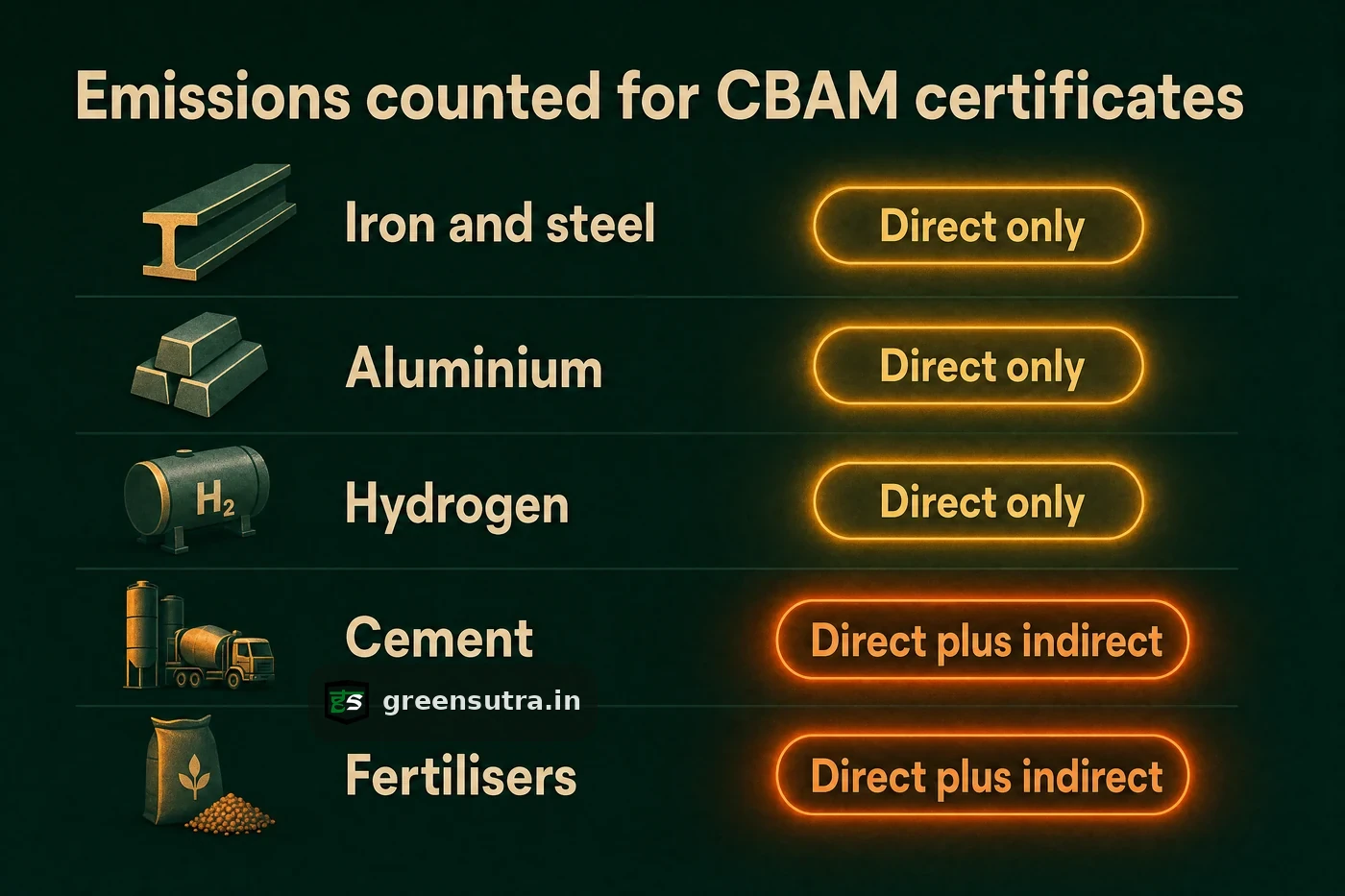
| Product group | Emissions counted for certificates |
|---|---|
| Iron and steel | Direct only |
| Aluminium | Direct only |
| Hydrogen | Direct only |
| Cement | Direct plus indirect |
| Fertilisers | Direct plus indirect |
The split matters because the six covered product groups are often described as if a single rule applied to all of them. Any exposure model that adds electricity emissions to a steel certificate bill overstates the obligation.
Indirect emissions are still reported
Indirect electricity emissions for steel must still be monitored and reported; they simply do not add to the number of certificates surrendered. The exclusion sits on the pricing side, not the compliance side. Embedded emissions are determined under a calculation-based or measurement-based approach, per Implementing Regulation (EU) 2025/2547 and Annex IV of Regulation (EU) 2023/956, and CBAM reporting has required actual rather than estimated data since 1 August 2024. The figures flow into the first annual declaration, due 30 September 2027 for 2026 imports. Steel installations therefore keep collecting electricity data; the reporting burden remains even though the price signal does not.
The double advantage of scrap-based EAF steel
Scrap-based electric arc furnace production gains a double advantage from the Annex II rule. Among the main production routes, blast furnace to basic oxygen furnace (BF-BOF) carries the highest embedded emissions, gas-based DRI-EAF sits in between, and scrap-based EAF is the lowest, so an EAF installation declares the smallest direct figure to begin with. Its dominant energy input, electricity, then falls entirely outside the certificate obligation. The route that emits the least directly is also the route whose remaining footprint CBAM does not price for steel. Türkiye’s EAF-heavy industry, with below-average emissions intensity, shows the pattern at country scale.
Route economics only pay off once the declared number is known. Importers without verified installation data fall back on country-of-origin defaults, detailed for India in the default values answer, and the resulting certificate bill year by year is worked through in the steel cost answer. The full mechanism is mapped in the CBAM guide. Quantifying route-level emissions, preparing installation data for an accredited verifier and managing certificate exposure is the consulting brief behind GreenSutra’s CBAM solutions service.
Sources: Regulation (EU) 2023/956 · European Commission CBAM