


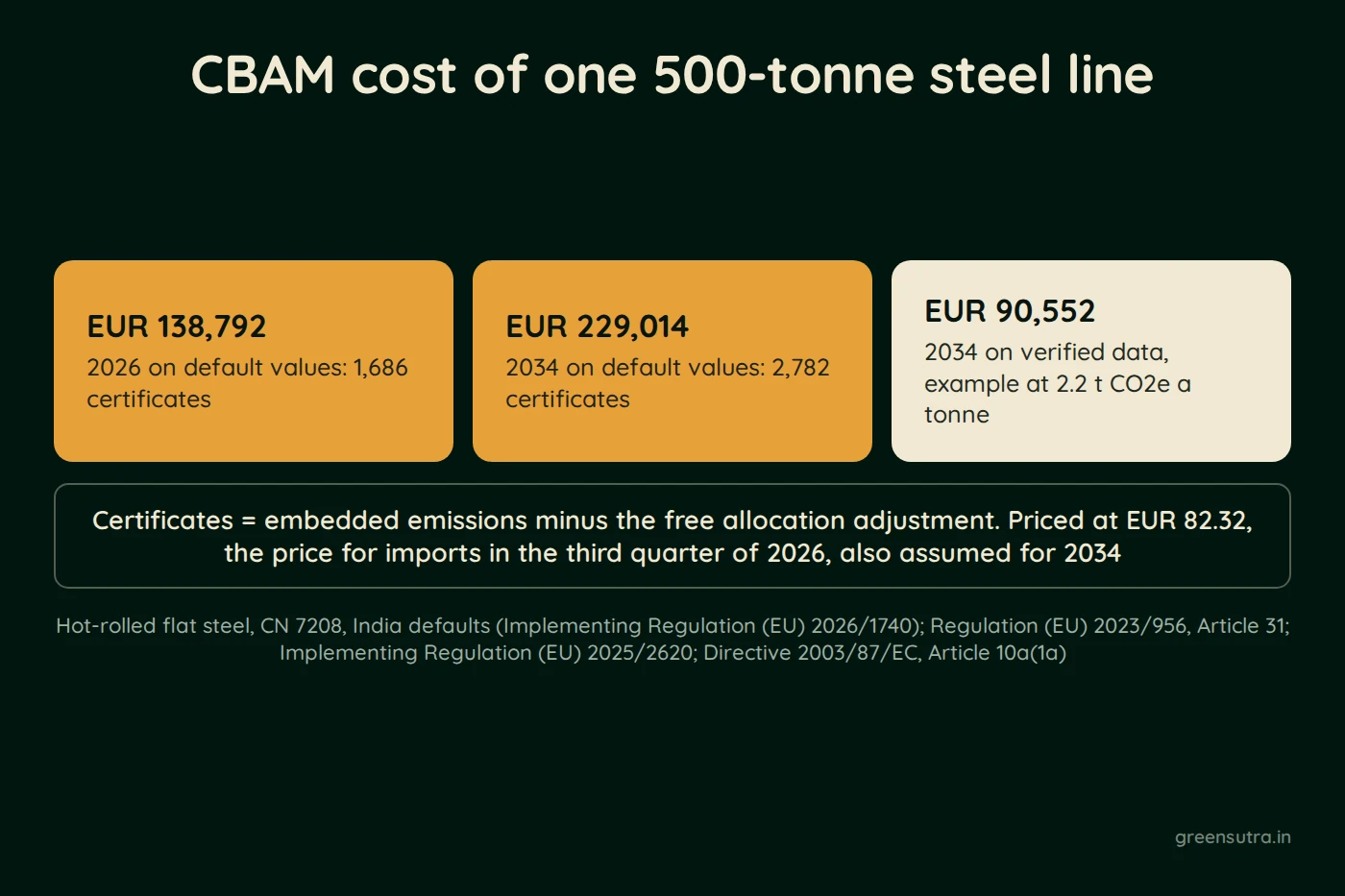
A steel exporter bears CBAM as a cost through price and contract terms, because the EU declarant surrenders the certificates. That cost is the number of certificates for its steel, times the certificate price. Certificates are due for the embedded emissions, marked up default or verified actual, minus the free allocation adjustment. An illustrative 500 tonne line of Indian hot-rolled flat steel on default values, all imported in the third quarter of 2026, needs 1,686 certificates. That is about EUR 138,792 at that quarter’s price of EUR 82.32.
What sets the CBAM cost of a steel consignment
Three numbers set the CBAM cost of any steel consignment entering the European Union: the embedded emissions figure, the free allocation adjustment deducted from it, and the certificate price. The emissions figure is either the country of origin default value of Implementing Regulation (EU) 2025/2621 or verified actual data from the producing installation. The default carries a mark-up of 10 percent in 2026, 20 percent in 2027 and 30 percent from 2028 for steel (fertilisers carry a flat 1 percent). For Indian hot-rolled flat steel the base default of 4.28 tCO2e per tonne becomes 4.71 with the 2026 mark-up; the full India set is listed in the default values explainer. In 2026 the certificate price is the average EU ETS auction price for the quarter of import. For the third quarter it is EUR 82.32 per tonne of CO2e. Steel is an Annex II good, so only direct embedded emissions are priced.
The declarant surrenders certificates for the embedded emissions minus the free allocation adjustment, and minus any carbon price deduction, never below zero. The adjustment mirrors the free allocation EU producers of the same good still receive. On default values it is the good’s CBAM benchmark, times the CBAM factor for the year, times the cross-sectoral correction factor, times the mass imported. The deduction shrinks each year. The CBAM factor is 97.5 percent in 2026, 95 percent in 2027, 90 percent in 2028 and 77.5 percent in 2029. It falls to 51.5 percent in 2030, 39 percent in 2031, 26.5 percent in 2032 and 14 percent in 2033. From 2034 nothing is deducted for free allocation. In 2026, 2.5 percent of the benchmark is no longer deducted. That figure is not 2.5 percent of the embedded emissions.
A worked illustration on India defaults
Example: a single export line of 500 tonnes of hot-rolled flat steel (CN 7208) on India default values, with every tonne imported in the third quarter of 2026. Imports in other quarters use that quarter’s price. For 2026 each tonne carries 4.708 tonnes of CO2e after the 10 percent mark-up. The free allocation adjustment is 0.975 x 1.00 x 1.370, or 1.336, which leaves 3.372 certificates a tonne.
| Year and basis | Share of the benchmark still deducted (CBAM factor) | Certificates and illustrative bill |
|---|---|---|
| 2026, default path | 97.5 percent | 1,686 certificates, about EUR 138,792 |
| 2034, default path | 0 percent | 2,782 certificates, about EUR 229,014 |
| 2034, verified data, example at 2.2 tonnes of CO2e a tonne | 0 percent | 1,100 certificates, about EUR 90,552 |
All three bills use the third-quarter 2026 price of EUR 82.32. The 2034 rows assume that price and the India base default of 4.28 stay unchanged. The rise comes from the shrinking deduction and the higher mark-up, not from the price. Verified data at 2.2 tonnes of CO2e a tonne, roughly half the default, cuts the 2034 bill by about 60 percent. The verified path is a data project: the installation monitors its own emissions, and the figures must be verified by an accredited verifier before they replace the default.
Why the cost arrives before the first invoice
EU buyers can price the coming CBAM cost into contracts before the first certificate is surrendered. The first annual declaration for 2026 imports is due on 30 September 2027. Sizing the exposure early protects margin and market share. The CBAM cost calculator models the bill product by product, year by year. The CBAM discovery session maps the emissions data gap. A CBAM consulting service prepares installation data for verification by an accredited verifier.
Sources: Regulation (EU) 2023/956 · Implementing Regulation (EU) 2025/2621 · European Commission CBAM