


CBAM default values for steel carry a regulatory mark-up of 10 percent in 2026, 20 percent in 2027 and 30 percent from 2028 onwards under Implementing Regulation (EU) 2025/2621. For Indian hot-rolled flat steel (CN 7208) the base default of 4.28 tCO2e per tonne becomes 4.71, then 5.14, then 5.56.
How the mark-up schedule works
Implementing Regulation (EU) 2025/2621 fixes a year-based mark-up on every CBAM default value: 10 percent for goods imported in 2026, 20 percent in 2027 and 30 percent from 2028 onwards. The mark-up sits on top of the country-specific base default, and the marked-up figure, not the base, is what enters the embedded emissions declaration. The schedule does not depend on the product, the origin or the importer; the same percentages apply across every default value in the regulation’s Annex I. Because the mark-up rises while the payable share of embedded emissions also climbs, from 2.5 percent in 2026 toward 100 percent in 2034, the default path becomes more expensive on both counts at once.
The escalation on hot-rolled flat steel (CN 7208)
A single product line shows the whole schedule. India’s base default for hot-rolled flat steel under CN 7208 is 4.28 tCO2e per tonne, and the mark-up lifts it in steps:
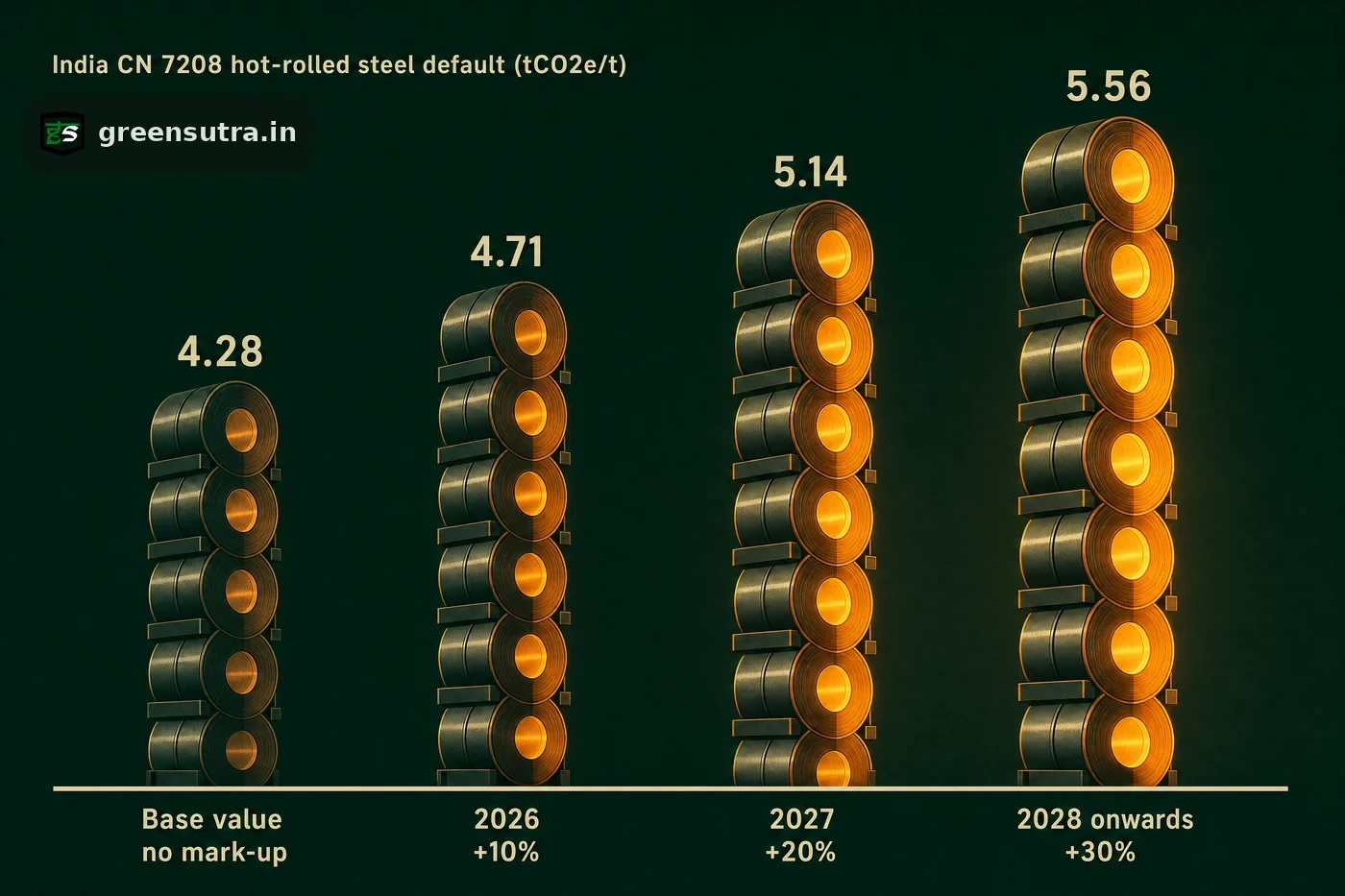
| Period | Mark-up | India default, CN 7208 (tCO2e/t) |
|---|---|---|
| Base value | none | 4.28 |
| 2026 | +10 percent | 4.71 |
| 2027 | +20 percent | 5.14 |
| 2028 onwards | +30 percent | 5.56 |
The full India table across pig iron, DRI, bars and stainless products sits in the sibling answer on CBAM default values for Indian steel exports.
Why the mark-up exists
The mark-up is the price of not supplying verified data. A default value is a deliberately conservative estimate: the European Commission cannot see an individual installation’s real performance, so the fallback figure is set cautiously high and the mark-up adds a rising premium that keeps the default route unattractive. An importer that files verified emissions data for steel, confirmed by an accredited verifier, declares the installation’s actual figure with no mark-up at all; CBAM reporting has required actual rather than estimated data since 1 August 2024. The escalating schedule therefore works as a deadline, since every year spent on defaults prices more emissions than the last. Both paths can be modelled year by year in the CBAM cost calculator before installation data is prepared with a CBAM consulting service for verification by an accredited verifier.
Sources: Implementing Regulation (EU) 2025/2621 · Regulation (EU) 2023/956