

A non-EU supplier must give its EU importer an installation-level data pack: installation identity, production route, activity data, and specific embedded emissions per tonne, direct plus attributable indirect where the good counts both, together with verification status. Actual installation data has been required since 1 August 2024, not default values.
The five fields of a CBAM supplier data pack
A CBAM data pack sent from a non-EU producer to its EU importer collapses into five fields. Each field feeds the importer’s CBAM declaration and traces a per-tonne emissions figure back to the installation that made the goods.
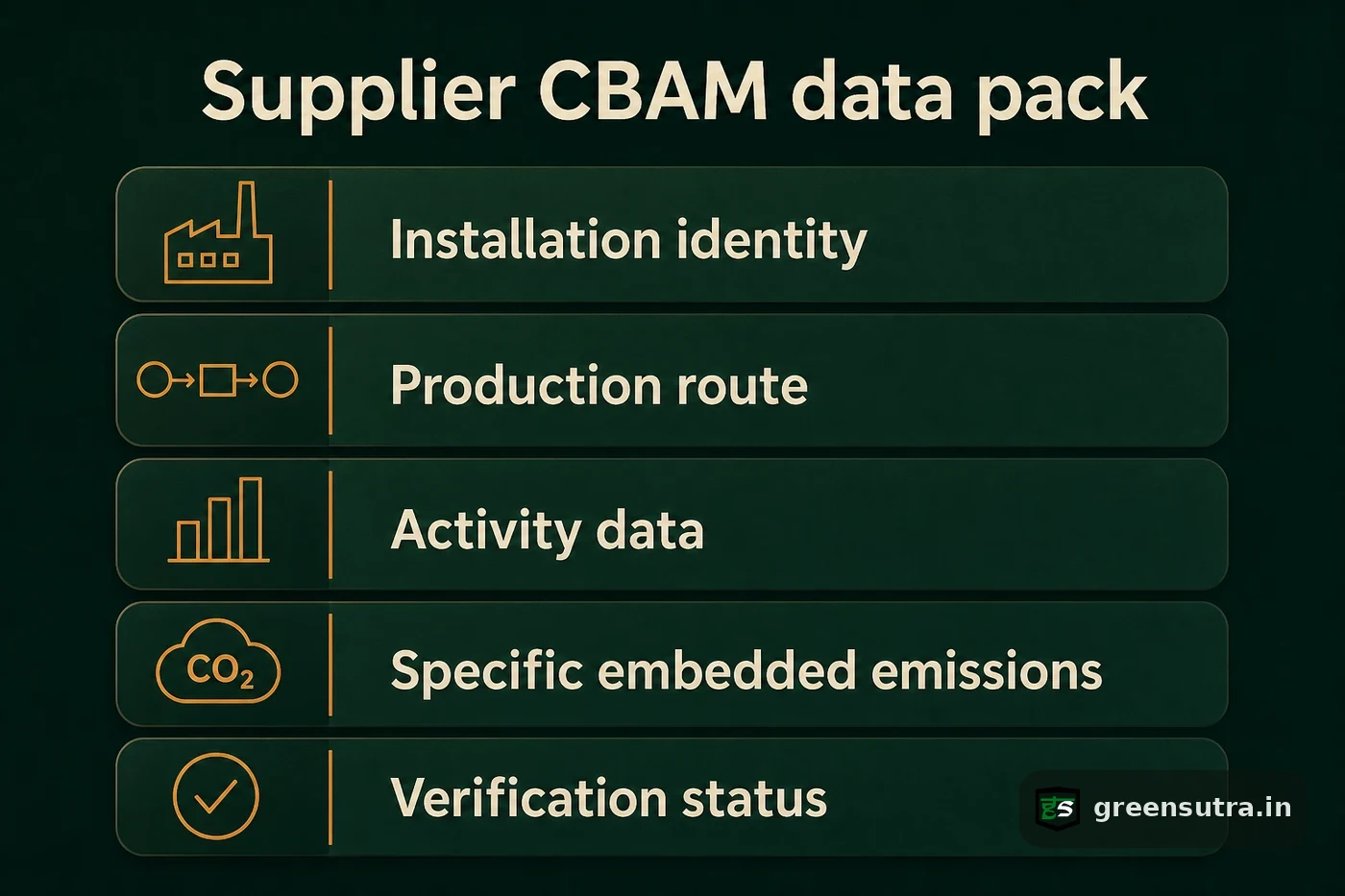
| Field | What the supplier reports |
|---|---|
| Installation identity | The producing installation’s name, location, operator and process boundary, so every figure ties to a known source. |
| Production route | The manufacturing route or technology, which largely sets the emissions profile. |
| Activity data | Production output and the fuel and energy inputs behind the period’s emissions. |
| Specific embedded emissions | Direct emissions per tonne of product, plus attributable indirect emissions where the good counts both. |
| Verification status | Whether an accredited verifier has checked the figures, or whether they remain unverified. |
Direct only, or direct plus indirect
How many emissions lines the pack carries depends on the product group. Two of the six covered groups price indirect emissions alongside direct ones; the rest price direct emissions only.
| Emissions counted | Covered groups |
|---|---|
| Direct plus indirect | Cement, fertilisers |
| Direct only | Iron and steel, aluminium, hydrogen |
So the attributable indirect line, mainly purchased electricity, is mandatory only where the good sits in the direct-plus-indirect group. For a direct-only good the pack reports direct process and fuel emissions and leaves indirect out.
From default values to actual data
Actual installation data has been required since 1 August 2024; country-of-origin default values could substitute only until 31 July 2024. A limited tolerance lets up to 20 percent of a complex good’s embedded emissions rest on default or estimated values. The direct figure is built through a calculation-based or a measurement-based approach, and the final declaration must be checked by a verifier accredited under Commission Delegated Regulation (EU) 2025/2551.
GreenSutra builds the supplier data pack, calculating embedded emissions and readying installation figures for that independent verification. The CBAM discovery session maps the data gap between supplier and importer, the CBAM guide sets out the reporting timeline, and the CBAM consulting service prepares the pack for verification by an accredited verifier.
Sources: Regulation (EU) 2023/956 · Implementing Regulation (EU) 2025/2621 · European Commission CBAM