


How an EPD is verified rests on independent third-party checking: an approved verifier examines the underlying LCA and draft declaration against the relevant Product Category Rules and ISO 14025, then a programme operator registers and publishes the confirmed EPD, typically valid for up to five years from registration.
Third-party verification under ISO 14025
An Environmental Product Declaration is a Type III declaration under ISO 14025, reporting a product’s life cycle environmental performance against Product Category Rules, with the underlying study conducted to ISO 14040 and ISO 14044. Before publication, an approved independent verifier examines the LCA and the draft EPD against the applicable PCR and ISO 14025, confirming the declared data as reliable and credible. This independent check, not the preparation of the study, is what makes a declaration “third-party verified”. A consultant delivering life cycle assessment support prepares the study and the declaration; the verification itself is always performed by the independent verifier, never by the consultant that authored the work. For construction products, the core Product Category Rules are set by EN 15804, which fixes how the life cycle data is calculated, reported and presented, so declarations from different programme operators can be compared. That comparability holds within a category: EPDs made to the same Product Category Rules are comparable, while EPDs made to different rules or programmes are not automatically comparable.
Who does what
The programme operator administers the whole route, maintaining the PCR library and the public register and managing verification and registration. Responsibilities separate cleanly across the three stages.
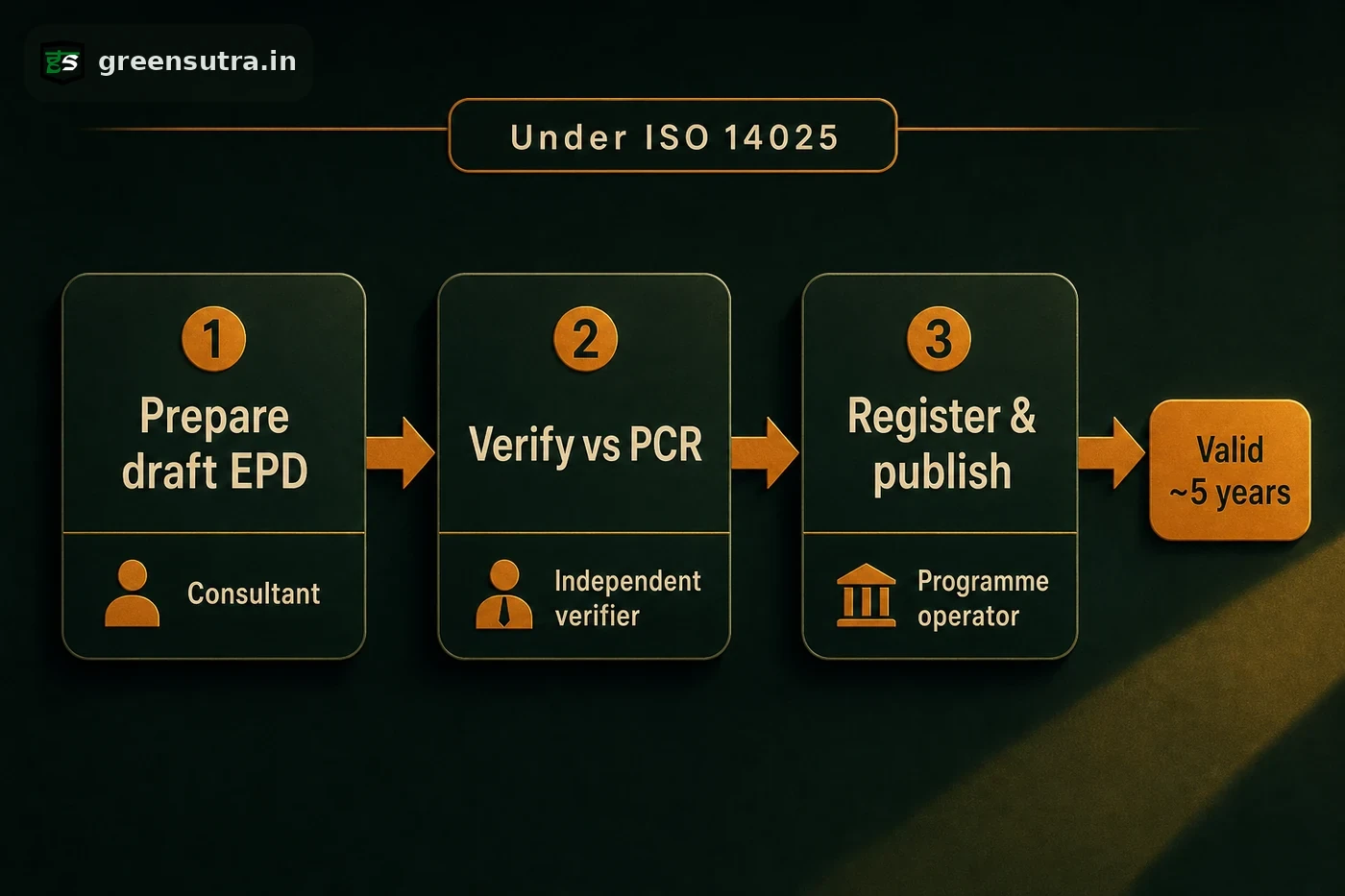
| Stage | Responsible party | Output |
|---|---|---|
| Prepare the LCA and draft EPD | Consultant, the study author | Draft declaration to ISO 14040/14044 and the PCR |
| Verify | Approved independent verifier | Confirmation against the PCR and ISO 14025 |
| Register and publish | Programme operator | Registered EPD in the public library |
Registration, publication and validity
Once verified, the EPD is registered with the programme operator and published in its public library, where declarations are available to download. The validity then follows programme-operator practice, as set out in the LCA guide:
- Validity period: an EPD is typically valid for up to five years from registration, a period set by the programme operator.
- ISO 14025 basis: ISO 14025 requires an EPD to state a period of validity but leaves the duration to the programme operator, and major operators set five years.
- Renewal: renewal at the end of the period requires re-verification and re-registration, not a simple extension.
Sources: ISO 14025 · EPD International