


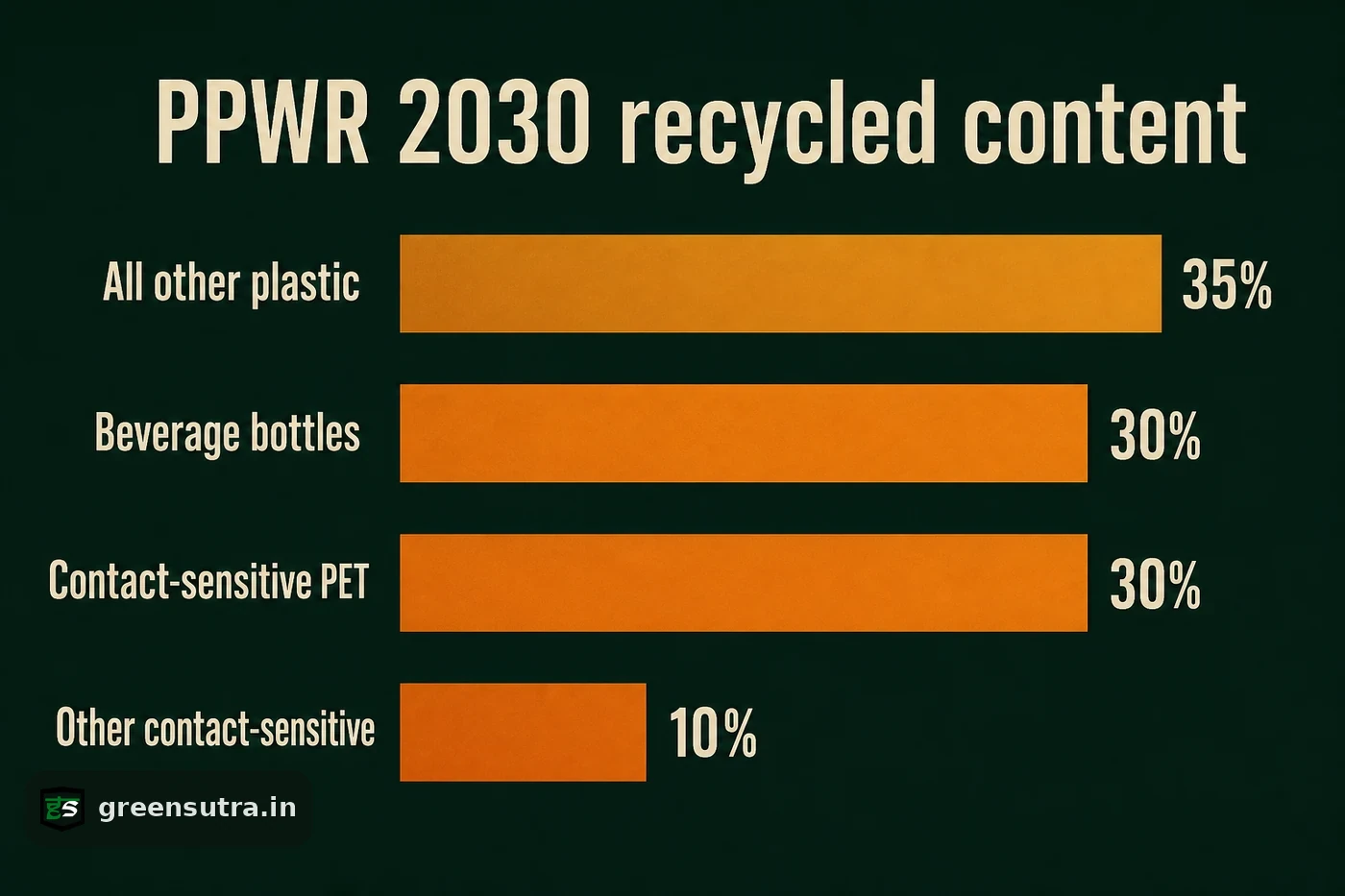
PPWR recycled content targets, set by Article 7 of Regulation (EU) 2025/40, require minimum post-consumer recycled plastic averaged per plant and year: from 2030, 30 percent for contact-sensitive PET, 10 percent for other contact-sensitive plastics, 30 percent for single-use beverage bottles and 35 percent for all other plastic packaging, rising in 2040.
How PPWR sets recycled content
Article 7 of Regulation (EU) 2025/40 requires a minimum share of recycled plastic in the plastic part of packaging placed on the EU market. The recycled content is measured as post-consumer plastic waste, averaged per manufacturing plant and per year. Targets apply from 1 January 2030 (or three years after the calculation-methodology implementing act enters into force, whichever is later) and step up from 1 January 2040. GreenSutra’s PPWR consulting maps packaging to these categories and drafts the recycled-content evidence that the EU importer relies on.
Minimum recycled content by category
The 2030 figures are differentiated by category, not a flat rate. The table below lists the percentages for each category.
| Packaging category | From 2030 | From 2040 |
|---|---|---|
| Contact-sensitive PET, other than single-use beverage bottles | 30% | 50% |
| Contact-sensitive packaging in other plastics (non-PET), other than single-use beverage bottles | 10% | 25% |
| Single-use plastic beverage bottles | 30% | 65% |
| All other plastic packaging | 35% | 65% |
Only post-consumer recyclate counts toward these figures, and the precise timing tracks the calculation-methodology implementing act. The single-use plastic beverage bottle figure is 30 percent in 2030 and 65 percent in 2040, so the highest 2040 requirement, 65 percent, applies to both single-use beverage bottles and all other plastic packaging.
Exemptions and readiness
Several packaging types sit outside the targets. Article 7 exempts:
- plastic parts below 5 percent of the total packaging-unit weight;
- compostable plastic packaging;
- immediate packaging of medicinal products and contact-sensitive plastic packaging for food for infants and young children;
- medical devices and packaging for the transport of dangerous goods.
For a business-to-business sale, the EU importer is the producer and carries the recycled-content duty, while the Indian supplier supplies the data. The EU PPWR guide sets out the wider readiness steps. GreenSutra’s consultants often see recycled-content sourcing treated as a last-minute procurement fix rather than a design decision taken early. Any conformity or laboratory testing sits with independent accredited third parties, not with the consultant.
Sources: Regulation (EU) 2025/40 (EUR-Lex) · European Commission, Packaging waste