


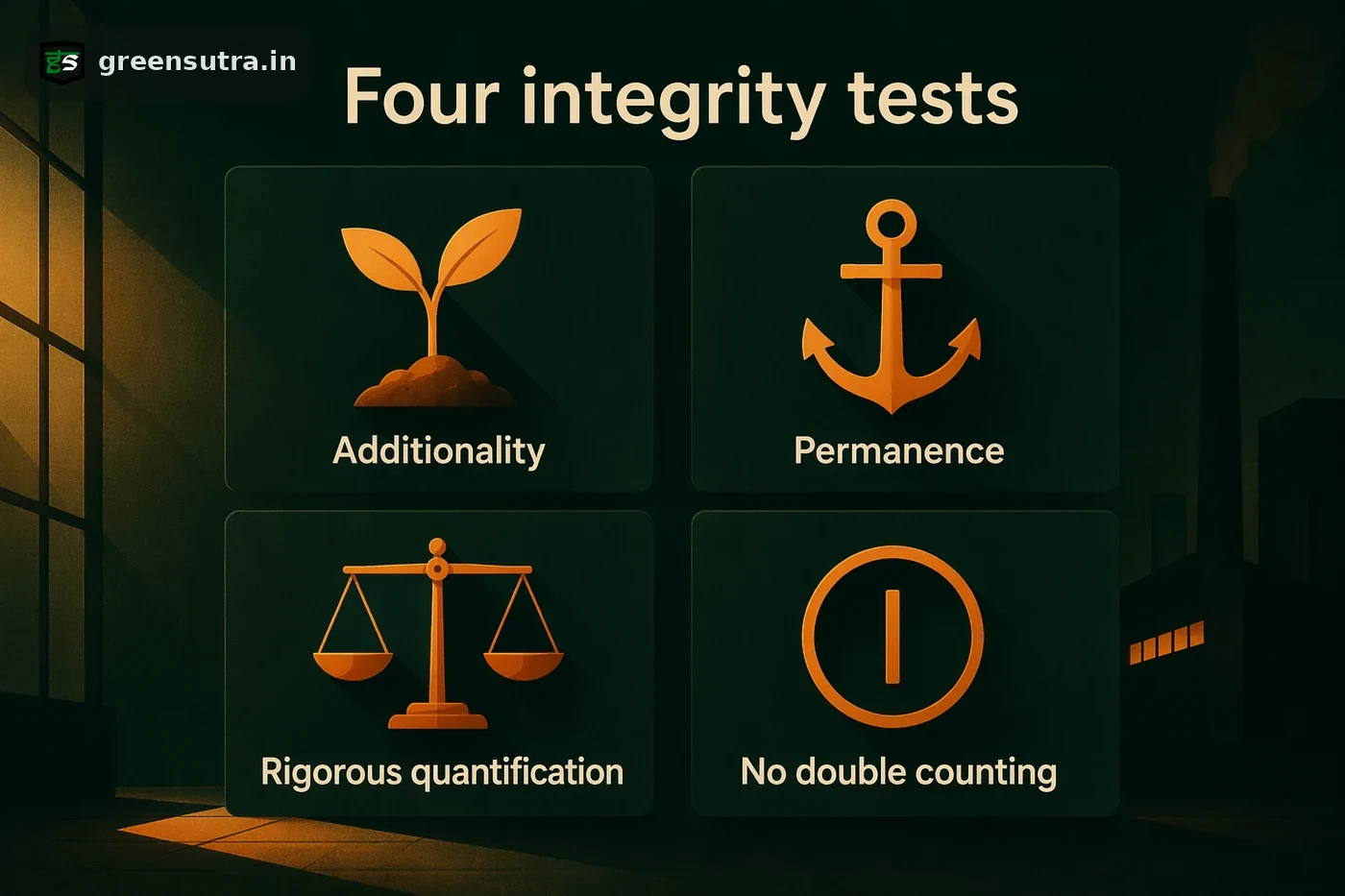
Carbon credit quality is judged against the Core Carbon Principles published by the Integrity Council for the Voluntary Carbon Market, whose ten principles, under the emissions impact theme, test additionality, permanence, rigorous quantification and no double counting, so each credit, notionally one tonne of carbon dioxide equivalent, represents a real, durable and uniquely counted climate outcome.
What high quality means
Carbon credit quality is not a marketing label but a measurable standard. The recognised benchmark is the set of Core Carbon Principles published by the Integrity Council for the Voluntary Carbon Market, an independent governance body that defines high integrity through ten principles grouped in three themes: governance, emissions impact and sustainable development. Governance covers programme governance, registry tracking, transparency and rigorous independent third party validation and verification. Emissions impact covers additionality, permanence, rigorous quantification and no double counting. Sustainable development covers benefits, safeguards and contribution toward the net zero transition. A carbon footprint programme treats these principles as the screen before any credit is bought to neutralise residual emissions.
The core integrity tests
Four tests sit at the heart of credit integrity, and each is precise:
- Additionality: the reductions or removals would not have occurred without the incentive created by carbon credit revenue.
- Permanence: the outcome is durable, and where a reversal risk exists there must be measures to address it and compensate reversals.
- Rigorous quantification: conservative, complete and scientific methods underpin the tonnage claimed.
- No double counting: a credit is counted only once toward any mitigation target or goal.
One carbon credit usually represents a mass equivalent to one metric tonne of carbon dioxide, so any weakness in these tests inflates what that tonne actually delivers.
Avoidance versus removal
A further quality distinction separates avoidance from removal. Both can carry a Core Carbon Principle label, but they are not interchangeable for every claim.
| Credit type | What it does | Net zero use |
|---|---|---|
| Avoidance | Prevents emissions that would otherwise occur, measured against a counterfactual scenario. | Can carry a CCP label, but not eligible for SBTi net zero neutralisation. |
| Removal | Takes carbon out of the atmosphere and stores it durably. | Eligible under the SBTi standard, which restricts neutralisation to carbon removals. |
ISO 14068 similarly requires that offset credits used for a carbon neutrality claim be verified, additional, permanent and not double counted.
Buying with confidence
Quality is verified by accredited independent bodies, not by a consultant. GreenSutra’s consultants often see buyers scrutinise the additionality and permanence claims behind a credit far more closely than its headline price. Reduction always comes first, with high quality credits reserved for the residual that cannot yet be eliminated; the carbon footprint guide sets out that measure, reduce, neutralise sequence.
Sources: ICVCM Core Carbon Principles · SBTi Corporate Net-Zero Standard · ISO 14068