


Avoided emissions, sometimes labelled Scope 4, are the emissions that do not occur when a product or service replaces a more carbon intensive alternative, measured against a baseline; the WBCSD Guidance on Avoided Emissions v2.0 requires them to be reported separately from Scopes 1 to 3, never netted against a footprint.
What avoided emissions (Scope 4) mean
Avoided emissions describe the reduction a product, service or solution enables when it is used in place of a more carbon intensive alternative, measured against a reference or counterfactual scenario. The label Scope 4 is informal shorthand, not a fourth inventory scope. The recognised methodology is the WBCSD Guidance on Avoided Emissions v2.0, published in July 2025. An avoided emissions figure is a claim about the decarbonising impact of a solution once it reaches the market, distinct from the emissions an organisation is responsible for. GreenSutra’s carbon footprint consulting treats the two measures as separate exercises.
How avoided emissions differ from Scopes 1 to 3
The accounting rule is strict: avoided emissions sit outside the corporate inventory. They are not part of Scope 1, Scope 2 or Scope 3, must be reported separately, and cannot be subtracted from a footprint or used to meet a net zero target.
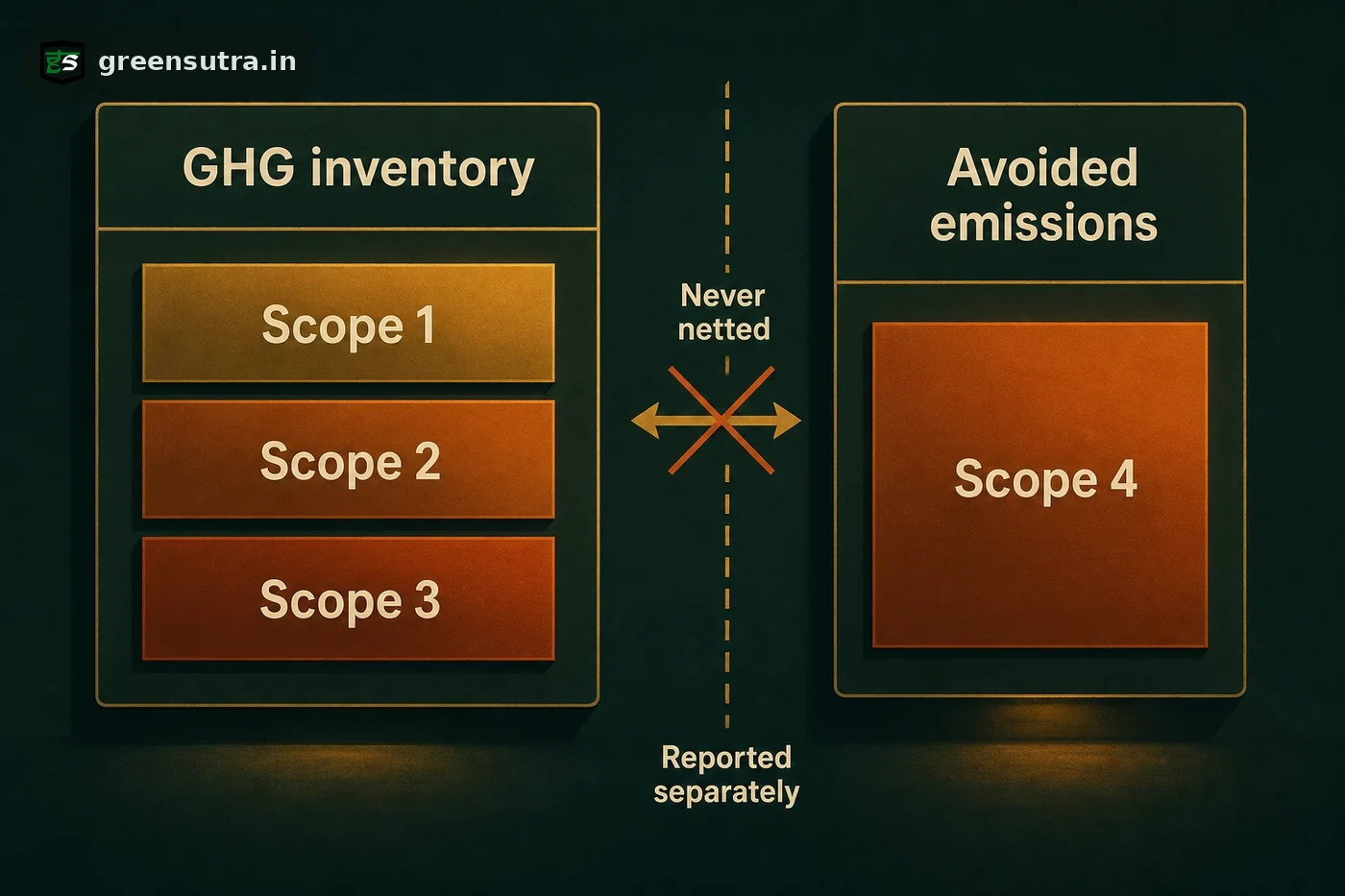
| Aspect | Scope 1, 2 and 3 inventory | Avoided emissions (Scope 4) |
|---|---|---|
| What it measures | Emissions the organisation is responsible for | Emissions not occurring versus a baseline |
| Where it sits | Inside the GHG inventory | Outside the inventory, reported separately |
| Use in targets | Basis for reduction and net zero targets | Cannot be netted or counted toward net zero |
Cautions on baselines and claims
An avoided emissions figure depends heavily on the chosen baseline and attribution assumptions, so it is a sensitive number that repays careful documentation. Treated transparently and separately, it can evidence the climate benefit of low carbon products; conflated with the inventory, it misleads. Key cautions when reporting avoided emissions:
- The figure is a claim about a solution’s decarbonising impact, not a reduction in the reporter’s own emissions.
- Results depend on baseline and attribution choices, so they are not comparable across companies.
- The number must never be netted against the reported Scope 1, Scope 2 and Scope 3 footprint.
The carbon footprint guide explains how the underlying Scope 1, Scope 2 and Scope 3 inventory is built. GreenSutra’s consultants often see avoided emissions claims lose credibility when the chosen baseline is left undocumented.
Sources: WBCSD Guidance on Avoided Emissions · GHG Protocol Corporate Standard