


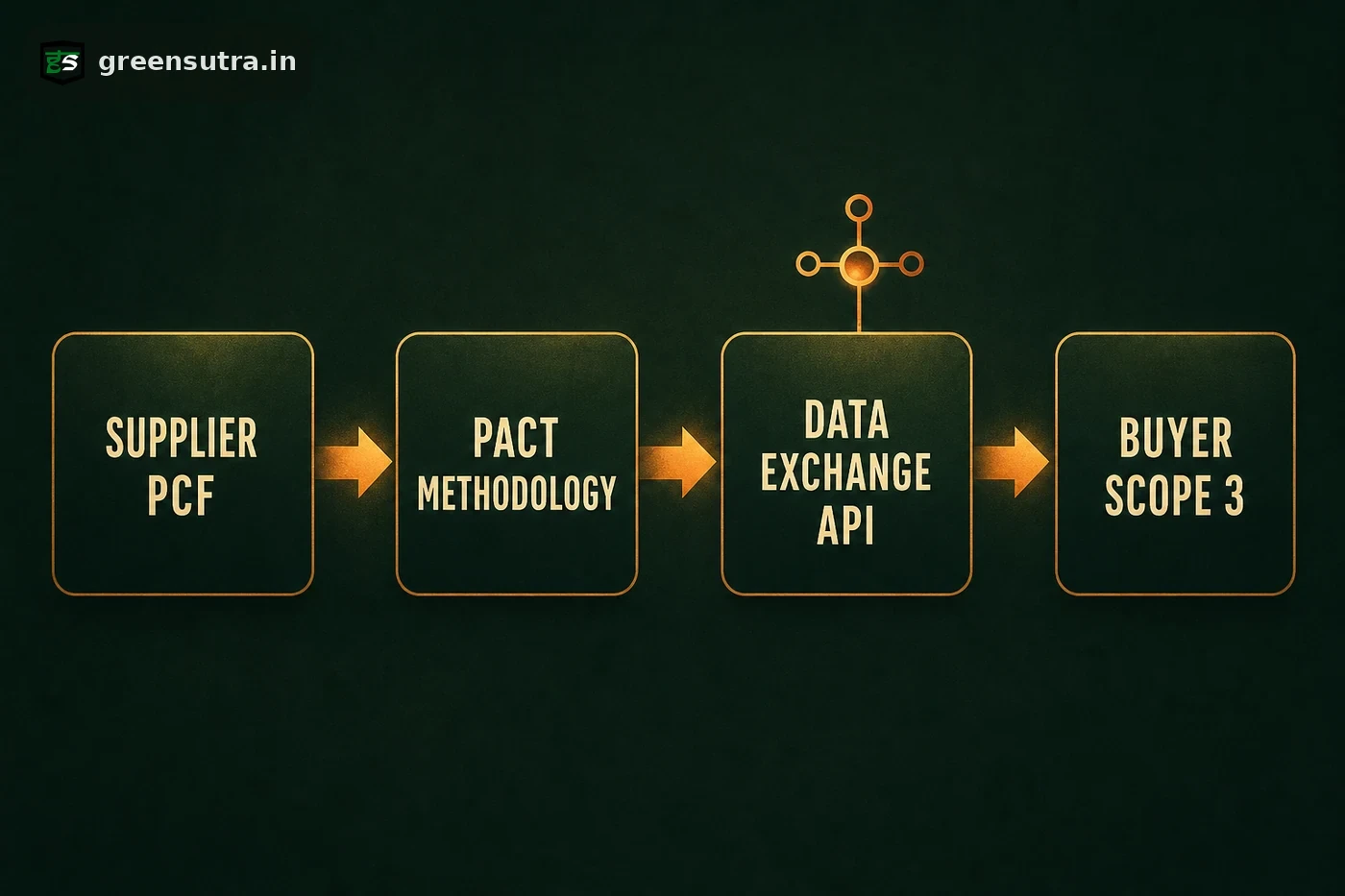
PCF data exchange lets companies share primary product carbon footprints across the value chain, and the World Business Council for Sustainable Development runs the Partnership for Carbon Transparency (PACT), whose Methodology Version 3 and Technical Specifications standardise a cradle to gate footprint and an interoperable data model so any supplier figure feeds a buyer’s Scope 3 accounting.
What PCF data exchange means
A product carbon footprint is the sum of greenhouse gas emissions across a product’s life cycle, expressed in carbon dioxide equivalent per functional or declared unit to ISO 14067:2018. PCF data exchange is the structured passing of that figure from a supplier to a downstream buyer, so a supplier’s measured footprint becomes supplier-specific primary input to the buyer’s Scope 3 inventory rather than a generic database average. Because ISO 14067 and the GHG Protocol Product Standard both prefer primary data gathered from specific processes and suppliers, credible exchange depends on primary data travelling with the number, which is where standardised frameworks and carbon footprint solutions meet.
The WBCSD PACT framework
Exchanging primary product carbon footprints between companies is governed by the Partnership for Carbon Transparency (PACT), a cross-industry initiative led by the World Business Council for Sustainable Development. The methodology first appeared as the Pathfinder Framework, whose Version 2.0 launched on 26 January 2023, and it has since been renamed. The current document is the PACT Methodology Version 3, released on 30 April 2025, which withdraws Version 2 while allowing footprints calculated under Version 2 to remain valid for up to three years under stated conditions.
| Component | Current version | Purpose |
|---|---|---|
| PACT Methodology | Version 3, released 30 April 2025 | Harmonised calculation of cradle to gate footprints using supplier-specific primary data |
| Technical Specifications for PCF Data Exchange | Version 3.0.3, released 18 November 2025 | Standardised data model and HTTP REST API for exchanging footprints between systems |
Interoperability across the value chain
The Technical Specifications define interoperability as the ability to exchange data between host systems irrespective of the vendors of those systems, without translation or transformation, through a standardised data model and an HTTP REST API supporting both synchronous retrieval and asynchronous, event-based exchange across a peer-to-peer network. Each exchanged footprint carries data-reliability indicators, including a primary data share metric, the share of primary data in the final absolute footprint value excluding biogenic carbon dioxide uptake, which the specification requires to be reported. Practical readiness covers:
- a cradle to gate boundary, from raw-material acquisition to the point the product leaves the production facility
- supplier-specific primary data for material, technology-specific processes
- reported data-reliability indicators, so the buyer can weight the figure
Across GreenSutra’s carbon footprint work, suppliers most often struggle to separate genuinely primary supplier data from generic database averages before a footprint can be exchanged. The carbon footprint guide sets out how the underlying inventory is built.
Sources: WBCSD PACT · PACT Technical Specifications · ISO 14067:2018