


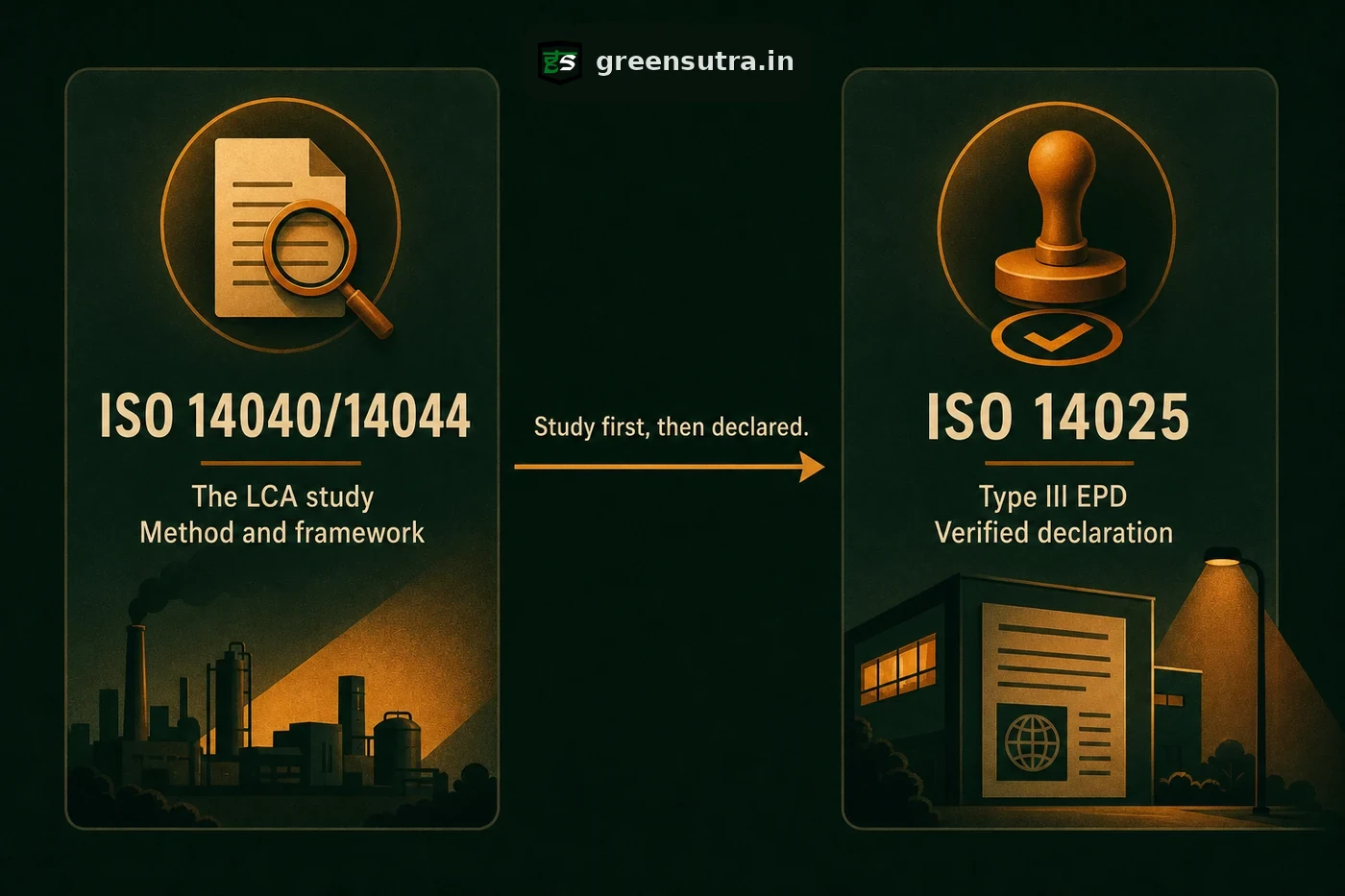
ISO 14044 vs ISO 14025 marks the split between method and declaration: ISO 14040 and ISO 14044 set the principles and requirements for conducting a life cycle assessment across many impact categories, while ISO 14025 governs a Type III environmental product declaration, an independently verified EPD reporting that study against Product Category Rules.
What ISO 14040 and ISO 14044 govern
ISO 14040 (2006) sets the principles and framework for life cycle assessment, and ISO 14044 (2006) sets the requirements and guidelines for conducting one, including data quality and the critical review requirement. Together they define the study methodology: the four phases, goal and scope, inventory, impact assessment and interpretation, and the multi-impact analysis that covers water, land, resources and acidification alongside global warming potential.
What ISO 14025 governs
ISO 14025 (2006) governs a different output, a Type III environmental declaration, or EPD. An EPD is an independently verified declaration reporting a product’s life cycle environmental performance against Product Category Rules, with the underlying study conducted to ISO 14040 and ISO 14044. For construction products, EN 15804 provides the core Product Category Rules used within an ISO 14025 EPD programme, so declarations from different programme operators align.
The difference at a glance
| Aspect | ISO 14040 / ISO 14044 | ISO 14025 |
|---|---|---|
| Purpose | Principles, framework and requirements for an LCA study | Programme and format for a Type III EPD |
| Output | The life cycle assessment study | An independently verified environmental declaration |
| Scope | Many impact categories at once | Reports the LCA against Product Category Rules |
| Verification | Critical review where required | Independent verifier plus programme operator |
| For construction | Sets the underlying method | EN 15804 supplies the core PCR |
How the two fit together
The two are sequential rather than alternatives. An LCA to ISO 14040 and ISO 14044 is the study; an EPD to ISO 14025 is the verified, published declaration built from that study. Verification of an EPD is performed by an independent verifier and a programme operator, never by the consultant that prepares the study. A full study carries the panel critical review only where a public comparative assertion is disclosed to the public. Key points to keep straight:
- An LCA study can exist without an EPD; an EPD cannot exist without an LCA study to ISO 14040 and ISO 14044.
- ISO 14044 covers many impact categories, whereas a carbon footprint to ISO 14067 is one category inside a full LCA.
- EPD verification is done by an independent third party and a programme operator, not by the consultant.
Across GreenSutra’s life cycle assessment work, an early request for an EPD often turns out to need the underlying ISO 14040 and ISO 14044 study built first. A step by step walk through of the four phases and the EPD route sits in the LCA guide.