


A screening LCA is a streamlined study following the ISO 14040 and 14044 phases with reduced scope and more background data to find environmental hotspots quickly, whereas a full LCA provides the complete data quality and all impact categories an EPD or a public comparative claim needs, which an independent third party then verifies.
What a screening LCA is
A screening LCA, also called a streamlined LCA, follows the same ISO 14040 and 14044 phases as a full study but deliberately reduces scope, data collection or the number of impact categories, leaning more on recognised background datasets than on primary plant data so that environmental hotspots surface quickly and at lower effort. It suits an early decision on where to focus, or a first pass before a producer commits to a full life cycle assessment. The trade-off is reduced precision and comprehensiveness against a complete analysis.
Screening LCA against full LCA
Both routes run the same four ISO phases, so the difference is one of depth, rigour and intended use rather than of method. A full, ISO-compliant LCA becomes necessary where the result is:
- declared as an EPD to ISO 14025 and independently verified;
- used in a public comparative assertion that one product is superior or equivalent to another;
- submitted as a regulatory declaration of life cycle performance.
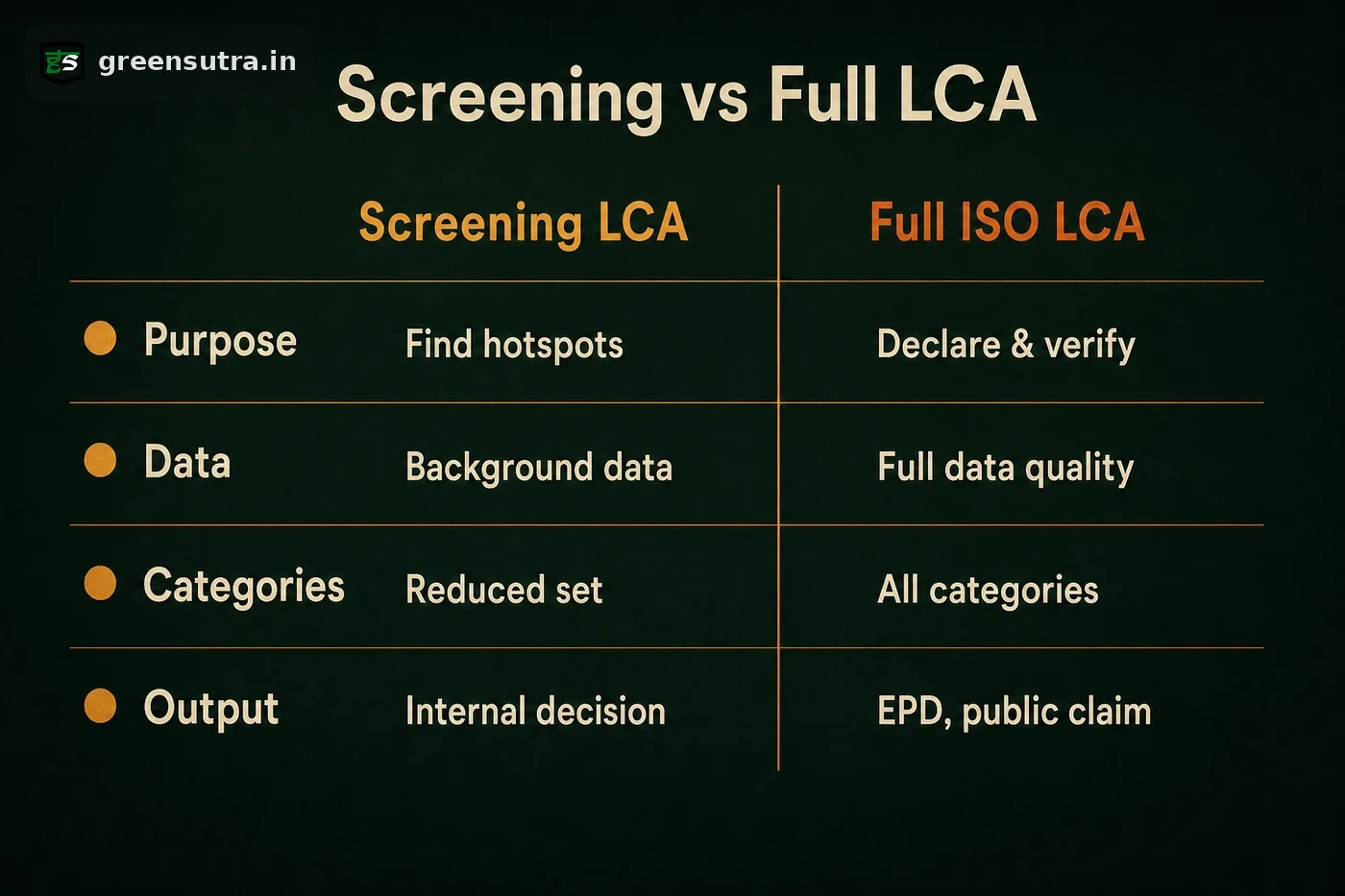
| Aspect | Screening LCA | Full ISO-compliant LCA |
|---|---|---|
| Purpose | Find hotspots, prioritise, first pass | Declare, compare publicly, verify |
| Data | More background datasets, less primary | Full ISO 14044 data quality |
| Impact categories | Reduced set | All relevant categories |
| Output | Internal decision support | EPD, public claim, regulatory declaration |
| Review | None required | Panel critical review for a public comparative assertion |
Which one a company needs
The choice follows from the intended use of the result, not from a different standard. A screening study answers where a product’s footprint concentrates, so it is right for prioritisation and design decisions. A full study is needed where the output must be defensible to third parties: an EPD to ISO 14025, a public comparative assertion, or a regulatory declaration, each requiring the full data quality ISO 14044 specifies, all relevant impact categories, and, for a public comparative assertion, the panel critical review. In GreenSutra engagements, a screening study most often surfaces the handful of stages that dominate a product’s footprint before any full assessment begins. A short scoping conversation through LCA Discovery fixes the goal and scope, which sets whether a screening or a full study fits. Duration depends on the system boundary and how much primary data is available.