


The CSRD scope and timeline is set by Directive (EU) 2022/2464 and phased by company size, with the 2025 stop the clock directive delaying large undertakings to financial years from 1 January 2027 and listed SMEs to 2028, while the 2026 Omnibus I directive raised thresholds to 1,000 employees and EUR 450 million net turnover.
What the CSRD requires and who it reaches
The Corporate Sustainability Reporting Directive (CSRD), Directive (EU) 2022/2464, entered into force on 5 January 2023 and obliges companies in scope to report against the European Sustainability Reporting Standards (ESRS), set by EFRAG and built on double materiality. Scope is phased by company size and by whether an entity sits inside the EU or reaches it as a non EU group. A structured ESG programme treats the directive as two moving parts: an enacted timetable and a still evolving level of detail.
Enacted phasing versus proposed detail
Two later instruments reshaped the original schedule and must be read separately from the base directive.
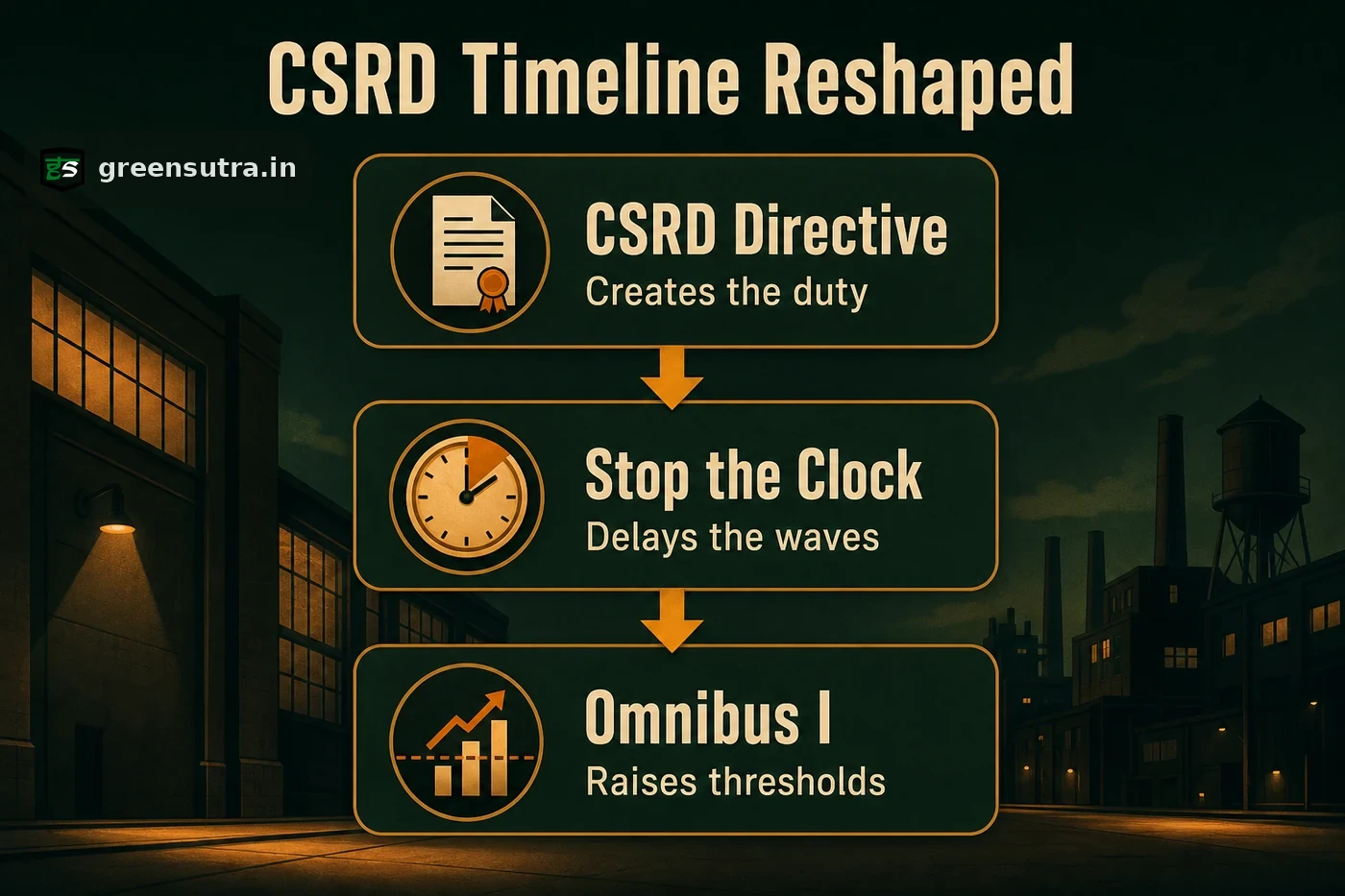
| Instrument | Status | Key effect | Dates |
|---|---|---|---|
| Directive (EU) 2022/2464 (CSRD) | Enacted | Creates the obligation to report against the ESRS | In force 5 January 2023 |
| Directive (EU) 2025/794 (stop the clock) | Enacted | Postponement only, no threshold change; large undertakings delayed to financial years from 1 January 2027, listed SMEs to 2028 | In force 17 April 2025; transpose by 31 December 2025 |
| Directive (EU) 2026/470 (Omnibus I) | Enacted | Raises the general EU threshold to 1,000 employees and EUR 450 million net turnover, applying for financial years from 1 January 2027; narrows third country thresholds | In force 18 March 2026; transpose by 19 March 2027 |
| Simplified ESRS, about 1,073 to about 320 datapoints | Proposed, not final | EFRAG draft reduction of roughly 70 percent, delivered through a Commission delegated act | Draft 3 December 2025 |
The 1,000 employee threshold rise is enacted, not merely proposed, though it takes operational effect through national transposition that is still under way. The simplified ESRS datapoint reduction remains an EFRAG draft and must not be treated as final law.
What it means for an Indian supplier
A non EU group is captured only where all of the following hold:
- EU net turnover above EUR 450 million in each of the last two consecutive years, and
- an EU subsidiary above EUR 200 million net turnover, or an EU branch above EUR 200 million net turnover.
Non EU group reporting is expected to begin around financial year 2028. Even below these thresholds, an EU customer captured by the directive often asks its Indian suppliers for the same environmental, social and governance data to complete its own disclosure, which is why an assurance ready data file matters ahead of any direct obligation. The ESG reporting guide sets out how that evidence base is built. GreenSutra’s consultants often see Indian exporters assume the directive cannot reach them, then meet an EU customer requesting the same data long before any statutory obligation applies.