


No. The escalating EU duty on Russian and Belarusian fertilisers, set by Regulation (EU) 2025/1227, is a separate trade tariff, not part of CBAM. Both measures can apply to the same nitrogen import, but only CBAM prices embedded carbon; the tariff is a conventional origin-based duty that stacks on top.
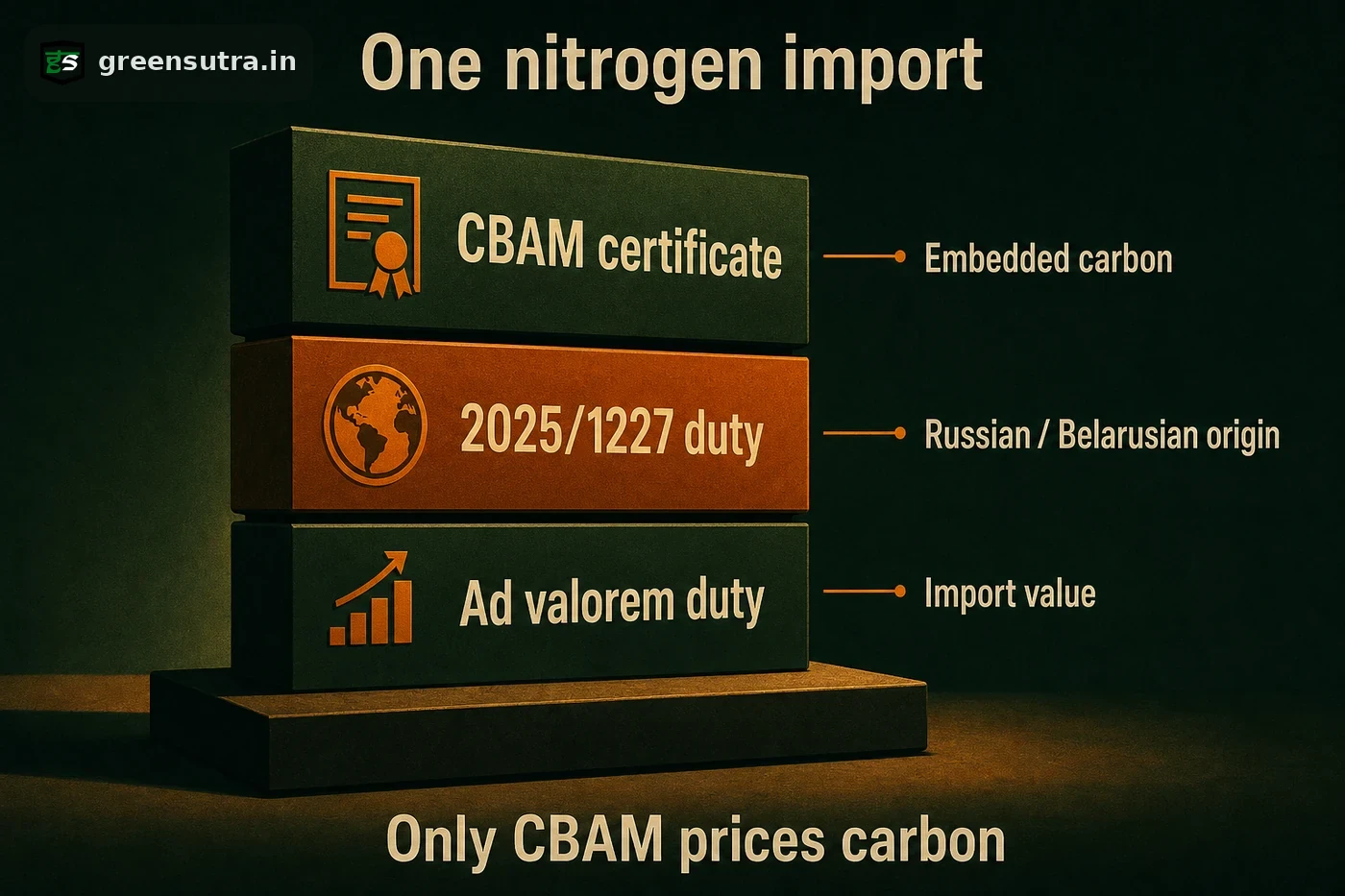
No. The two instruments are legally and functionally distinct. CBAM prices the embedded carbon of covered goods so that imports carry a cost comparable to the emissions-trading charge borne by EU producers. The duty on Russian and Belarusian fertilisers is a conventional trade measure tied to origin, not to carbon content, and it applies whether or not a CBAM obligation also arises on the same consignment.
Where the fertiliser tariff comes from
Regulation (EU) 2025/1227 entered into force on 1 July 2025 and targets fertilisers of Russian and Belarusian origin. It sits alongside CBAM rather than inside it, with its own legal basis, its own scope and its own escalating schedule. Nothing in it changes how CBAM is calculated or reported.
How the charges stack on one nitrogen import
For an in-scope shipment of Russian or Belarusian origin, three charges can accumulate:
- the 2025/1227 duty, adding EUR 40 per tonne on CN 3102 in 2025 to 2026 and climbing to EUR 315 per tonne by July 2028;
- a 6.5 percent ad valorem duty;
- any CBAM certificate cost, charged separately on the embedded emissions of the goods.
Only the last of these reflects carbon. Importers sometimes read the trade duty and the certificate cost as a single fertiliser levy, when they are billed independently and attach to different things: one to origin, the other to verified or default embedded emissions.
CBAM advisory covers declarant status, embedded-emissions calculation and certificate cost, keeping the carbon obligation distinct from origin-based trade duties. A CBAM guide sets out which measure applies to which fertiliser origin.
Sources: Regulation (EU) 2025/1227 · Regulation (EU) 2023/956 · European Commission CBAM