


Egypt is the largest single supplier of urea to the EU, followed by Russia with Belarus and then Algeria. Because urea and ammonia carry the most embedded carbon among CBAM fertilisers, these nitrogen-heavy origins face the largest carbon-border adjustment as the definitive regime prices embedded emissions through certificate surrender.
Egypt, Russia with Belarus, and Algeria supply most of the urea that the EU imports, and they are the origins CBAM affects most because nitrogen fertilisers carry the highest embedded carbon of any product in the group. CBAM neither bans these flows nor adds a fixed levy; it requires importers to account for the embedded emissions of each consignment and, once certificates are surrendered, to pay a share of those emissions at the EU ETS price. Origins whose product is carbon-heavy therefore carry the heaviest obligation.
The EU fertiliser import picture
The EU imported about EUR 2.7 billion of nitrogenous fertilisers under CN 3102 and about EUR 1.1 billion of ammonia under CN 2814 in 2024. Urea makes up over 70 percent of the nitrogen value, so the urea supplier mix largely sets where the CBAM obligation lands.
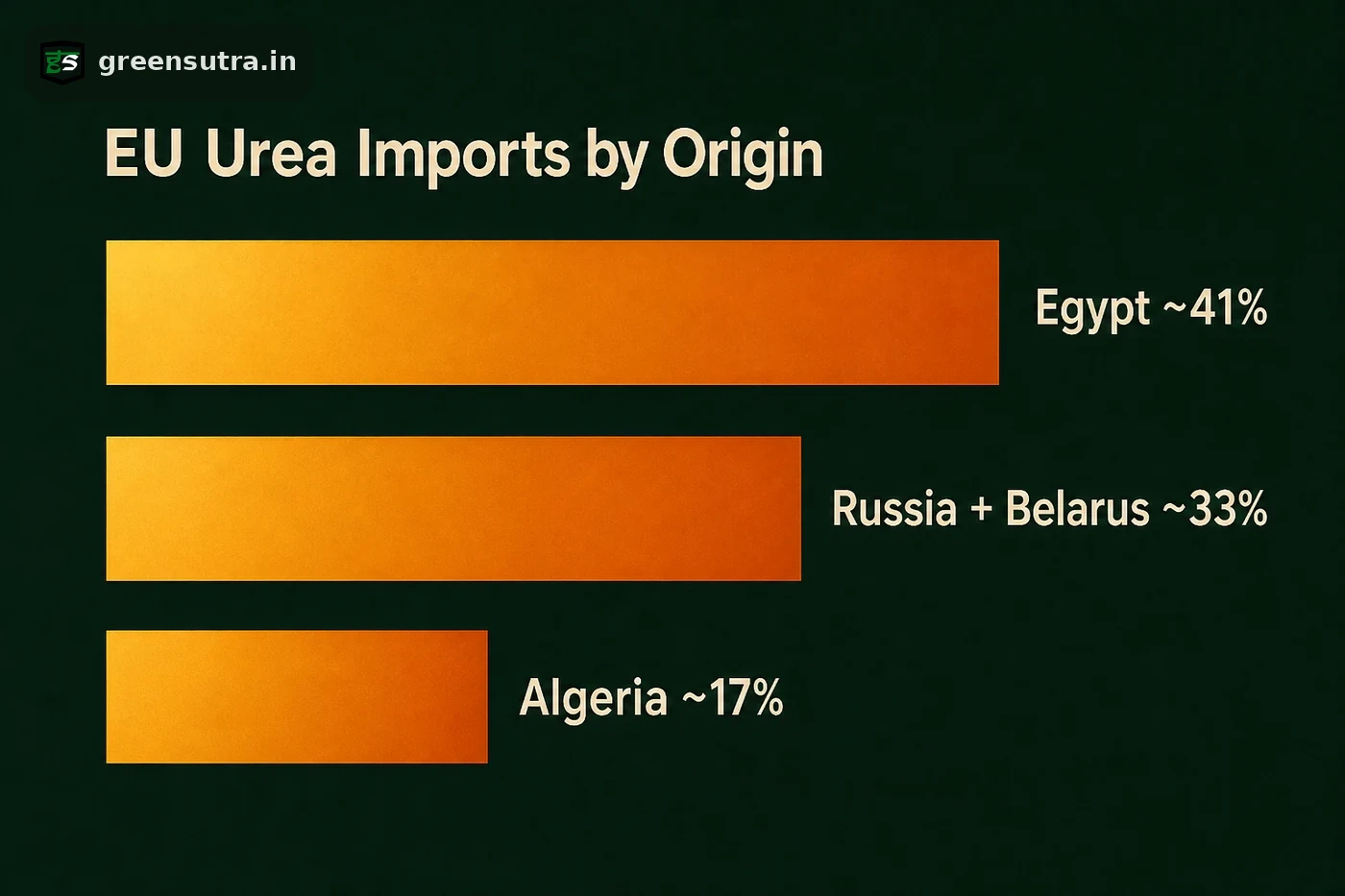
| Origin | Share of EU urea imports |
|---|---|
| Egypt | about 41 percent |
| Russia with Belarus | about 33 percent |
| Algeria | about 17 percent |
Ammonia arrives from a wider set of origins, including Russia, Trinidad and Tobago, Algeria, Egypt and the United States, so that obligation spreads across several countries rather than one.
Why nitrogen origins carry the weight
- Ammonia and urea hold the most embedded carbon in the group, driven by the natural-gas feedstock used to make them.
- Fertilisers count both direct and indirect emissions, unlike the direct-only steel and aluminium groups, and carry a flat 1 percent mark-up on default values held constant across 2026, 2027 and 2028.
- A separate EU duty on Russian and Belarusian fertilisers applies on top of any CBAM cost, not within it, so those two origins sit under two distinct measures.
- India is a minor exporter and a structural net importer of fertilisers, so its direct EU fertiliser position is limited.
Each plant is assessed on its own verified installation data rather than a single national average, so two suppliers in the same country can declare different figures. CBAM advisory covers declarant status, embedded-emissions calculation and certificate obligations, and the CBAM guide sets out the evidence a supplier needs to assemble.
Sources: Regulation (EU) 2023/956 · DG AGRI trade statistics · European Commission CBAM