


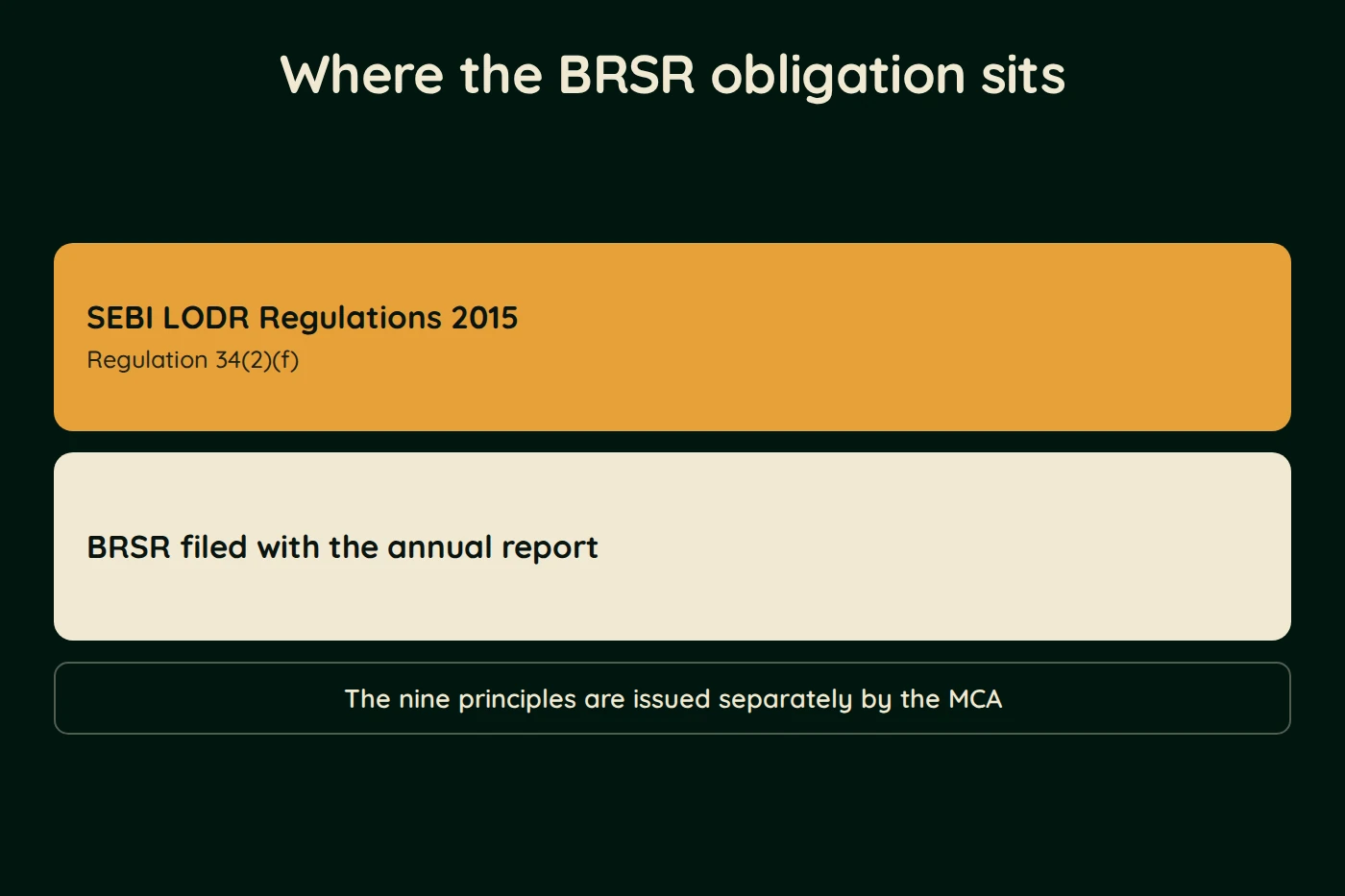
The BRSR is required under the SEBI (Listing Obligations and Disclosure Requirements) Regulations 2015, at Regulation 34(2)(f). The Securities and Exchange Board of India is the regulator, and the obligation applies to the top 1,000 listed entities by market capitalisation.
The Business Responsibility and Sustainability Report is a listing obligation rather than a company-law filing, which shapes both who it binds and where it is lodged.
The instrument
The disclosure requirement sits in the SEBI (Listing Obligations and Disclosure Requirements) Regulations 2015, at Regulation 34(2)(f). That regulation governs the annual report content a listed entity must provide, and the BRSR is required as part of it. The format itself is prescribed by SEBI through an annexure and subsequent circulars rather than in the regulation text.
Two authorities, two roles
A frequent error is to attribute the whole framework to SEBI. Two bodies are involved:
- The Securities and Exchange Board of India issues the disclosure format and mandates the filing through the listing regulations.
- The Ministry of Corporate Affairs issued the National Guidelines on Responsible Business Conduct on 15 March 2019, which supply the nine principles the format is built on.
So the principles are Ministry of Corporate Affairs principles, and the reporting format built on them is a SEBI instrument.
Who it binds
The obligation attaches to the top 1,000 listed entities by market capitalisation, and became mandatory from financial year 2022-23 after a voluntary year in financial year 2021-22. Because the test is a market capitalisation rank rather than a turnover figure, an entity can move into or out of scope between years without any change in its size measured in rupees.
Sources: SEBI BRSR framework circular
The BRSR guide sets out the format and the principles. BRSR reporting services covers compliance for listed entities.