


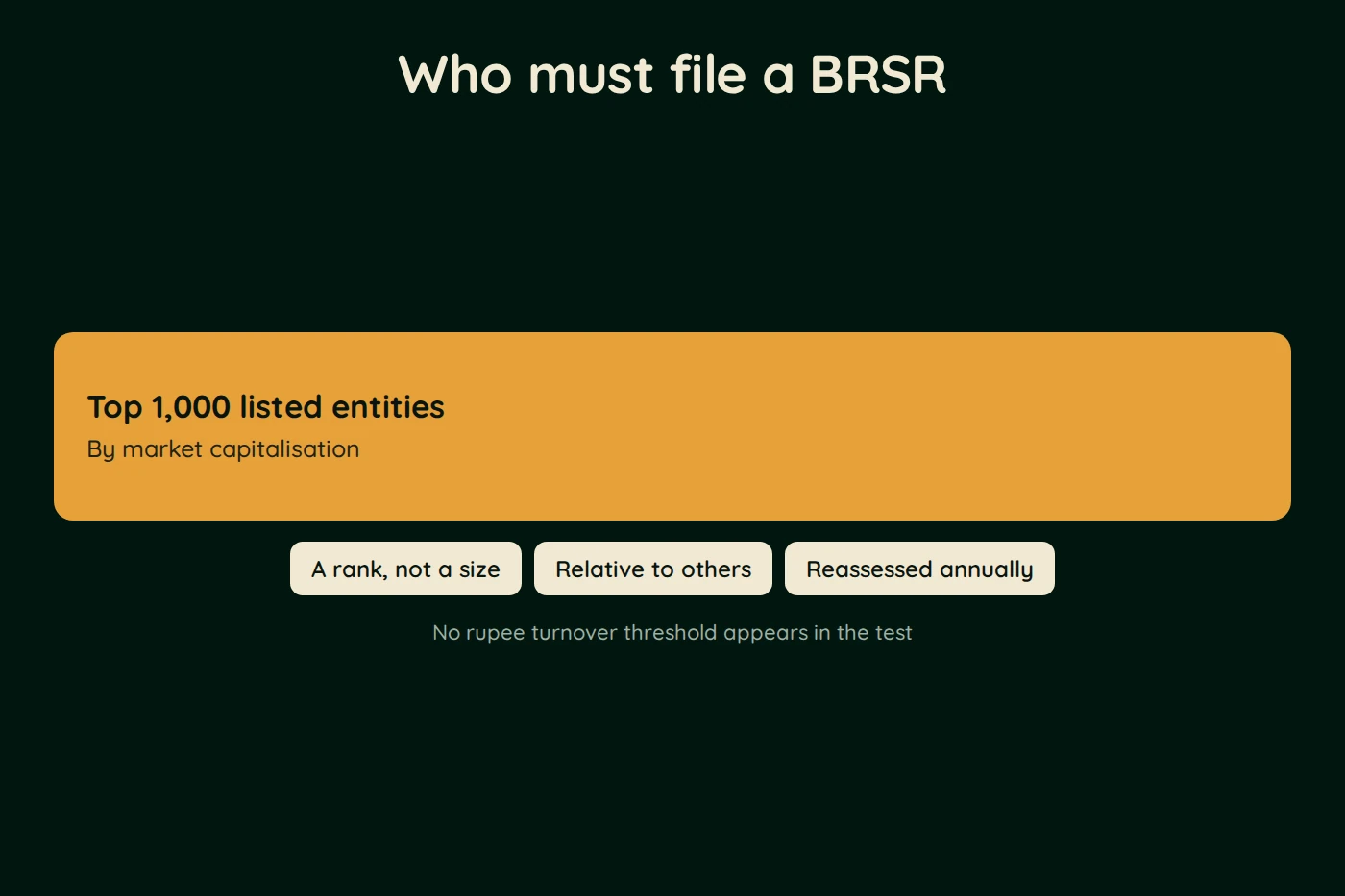
The top 1,000 listed entities by market capitalisation must file a Business Responsibility and Sustainability Report. The test is a market capitalisation rank, not a turnover figure, so an entity can enter or leave scope between years purely because its rank moved relative to other listed companies.
Applicability is the first question a listed entity asks, and the answer is narrower and more mechanical than it is often described.
The test
Filing applies to the top 1,000 listed entities by market capitalisation, and has been mandatory since financial year 2022-23. Three features of that test matter:
- It is a rank, not a size. No rupee turnover or profit threshold appears anywhere in the applicability test.
- It is relative. An entity can move into scope without growing, if entities above it shrink.
- It is annual. Scope is reassessed rather than fixed once.
What it does not depend on
Sector is irrelevant. Whether the entity has an existing sustainability programme is irrelevant. Whether it already reports under an international framework is irrelevant to whether the BRSR is required, although that existing reporting can be cross-referenced rather than duplicated.
The separate question of assurance
Filing scope and assurance scope are different populations. Every entity in the top 1,000 files. Only entities inside the applicable BRSR Core tier for a given year must obtain reasonable assurance or a third-party assessment, and those tiers phase in from the top 150 through to the top 1,000 across four financial years. An entity ranked, for example, in the mid hundreds files each year but reaches the assurance obligation later than the largest entities.
The practical planning point
Because rank is reassessed annually, an entity close to a tier boundary is best served by preparing to the next tier rather than the current one. Building assurable data after a tier date has passed is materially harder than building it before.
Sources: SEBI BRSR framework circular
The BRSR guide explains scope and the assurance glide path. BRSR reporting services covers readiness for entities approaching a tier.