


The Ministry of Corporate Affairs released the National Guidelines on Responsible Business Conduct on 15 March 2019. They revised the 2011 National Voluntary Guidelines on Social, Environmental and Economic Responsibilities of Business, aligning them with the United Nations Sustainable Development Goals and the United Nations Guiding Principles on Business and Human Rights.
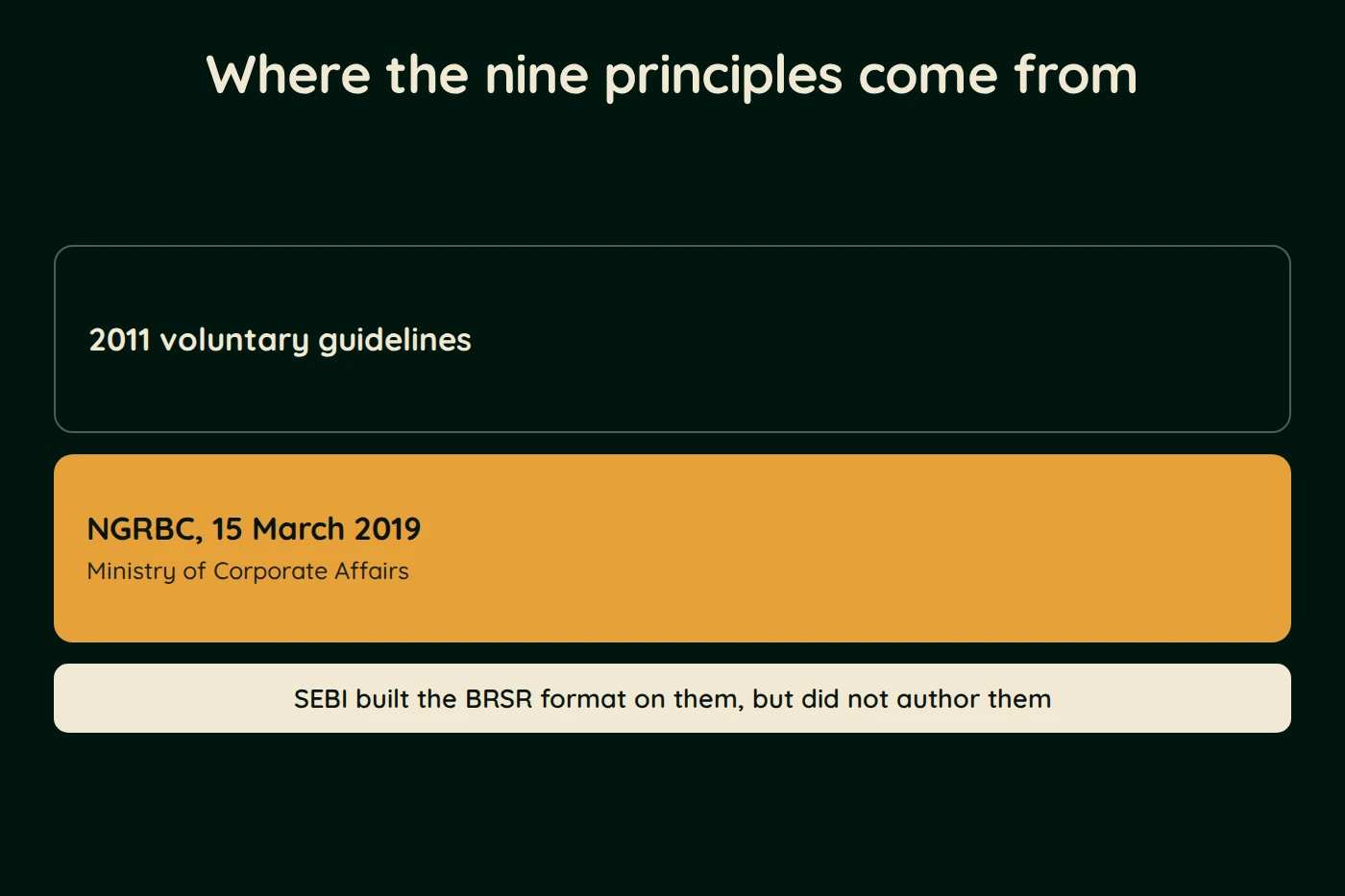
Provenance matters here more than it usually does, because the nine principles behind the BRSR are routinely misattributed.
Who issued them
The National Guidelines on Responsible Business Conduct, abbreviated NGRBC, were released by the Ministry of Corporate Affairs on 15 March 2019. They set out nine principles of responsible business conduct for Indian enterprises.
What they replaced
The NGRBC revised the 2011 National Voluntary Guidelines on Social, Environmental and Economic Responsibilities of Business. The revision aligned the principles with two international instruments: the United Nations Sustainable Development Goals, and the United Nations Guiding Principles on Business and Human Rights.
The misattribution to correct
The nine principles are Ministry of Corporate Affairs principles. The Business Responsibility and Sustainability Report is the disclosure format the Securities and Exchange Board of India built on them. Saying that SEBI authored the nine principles is incorrect, and the distinction has a practical consequence: the principles apply as a statement of responsible conduct for Indian business generally, while the BRSR filing obligation reaches only the top 1,000 listed entities by market capitalisation.
Why the structure follows from this
Because the format was built on an existing principle set, Section C of the BRSR is organised as nine blocks, one per principle, rather than by the more familiar environmental, social and governance grouping. An entity looking for all its environmental data will find it concentrated under Principle 6 rather than in a section labelled environmental.
Sources: Ministry of Corporate Affairs, NGRBC, 15 March 2019
The BRSR guide lists all nine principles in full. BRSR reporting services covers principle-wise disclosure for listed entities.