


The fairness attribute pairs two unrelated-looking measures: instances of data breach as a percentage of total data breaches or cyber-security events, and the number of days of accounts payable. It cross-references to Principle 9 and Principle 1 of the essential indicators.
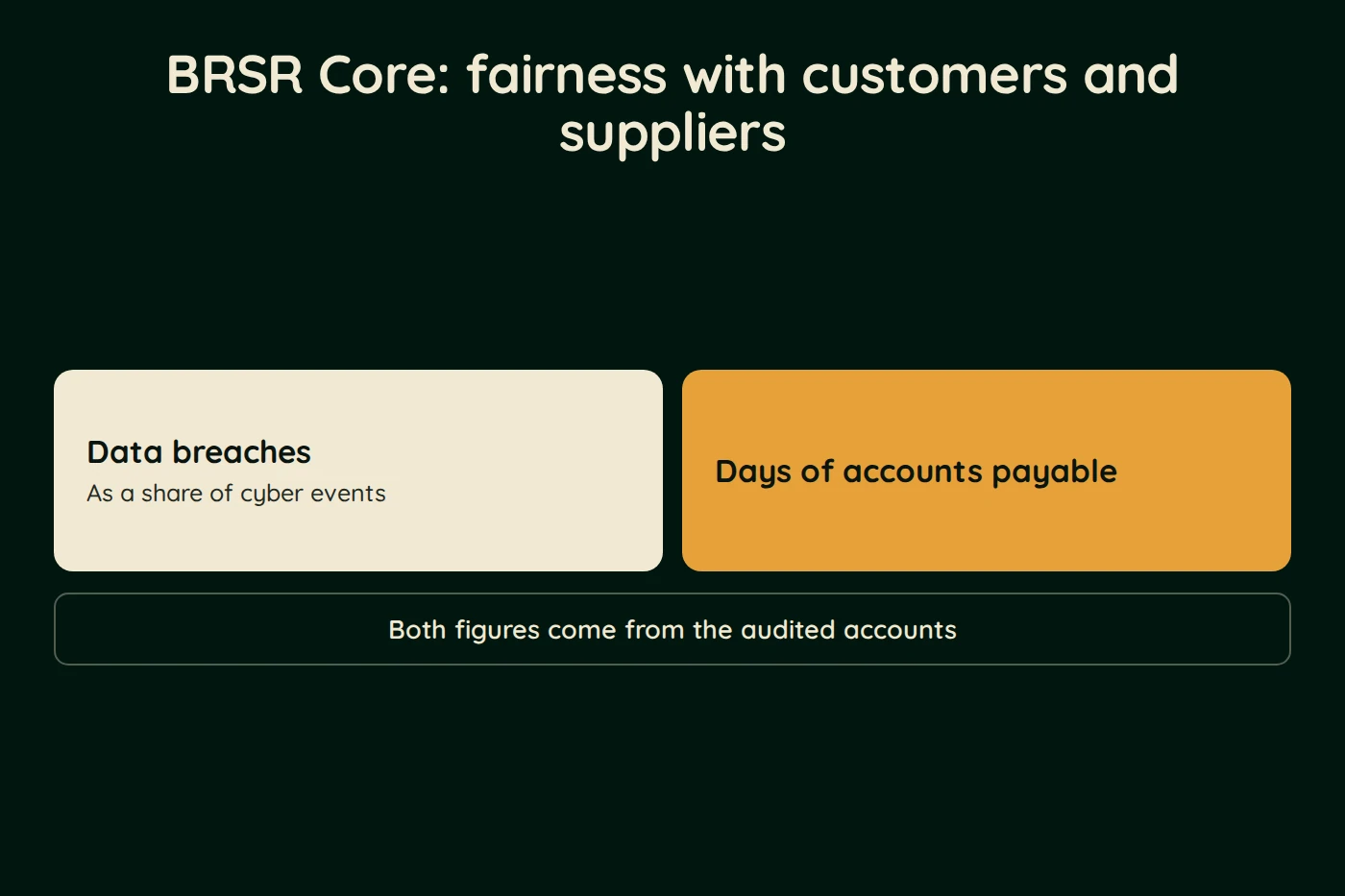
Fairness in engaging with customers and suppliers is the eighth of the nine BRSR Core attributes. Its two measures look unconnected until the logic behind them is clear.
The two measures
- Instances of data breach, expressed as a percentage of total data breaches or cyber-security events
- The number of days of accounts payable, computed as accounts payable multiplied by 365 and divided by the cost of goods or services procured
The logic joining them
One measure looks at treatment of customers, the other at treatment of suppliers. Data breaches concern the customer side, where the entity holds information it did not create and is expected to protect. Days of accounts payable concerns the supplier side, where a long payment cycle transfers working capital strain onto suppliers, disproportionately onto smaller ones. Both are fairness measures in the sense of how the entity behaves toward parties that depend on it.
Why days of accounts payable is a disclosure at all
Payment delay is not usually thought of as a sustainability metric. It is included because extended payment terms are a well-recognised pressure on small suppliers in India, and the figure is computed from audited financial statement inputs, which makes it unusually easy to verify compared with most social indicators.
The reconciliation point
Because accounts payable and cost of goods or services procured both come from the financial statements, this attribute has to agree with the audited accounts. Any divergence is immediately visible, so the figure is taken from the financial reporting process rather than compiled separately.
Sources: SEBI Annexure I, Format of BRSR Core
The BRSR guide covers all nine Core attributes. BRSR reporting services covers governance disclosures for listed entities.