


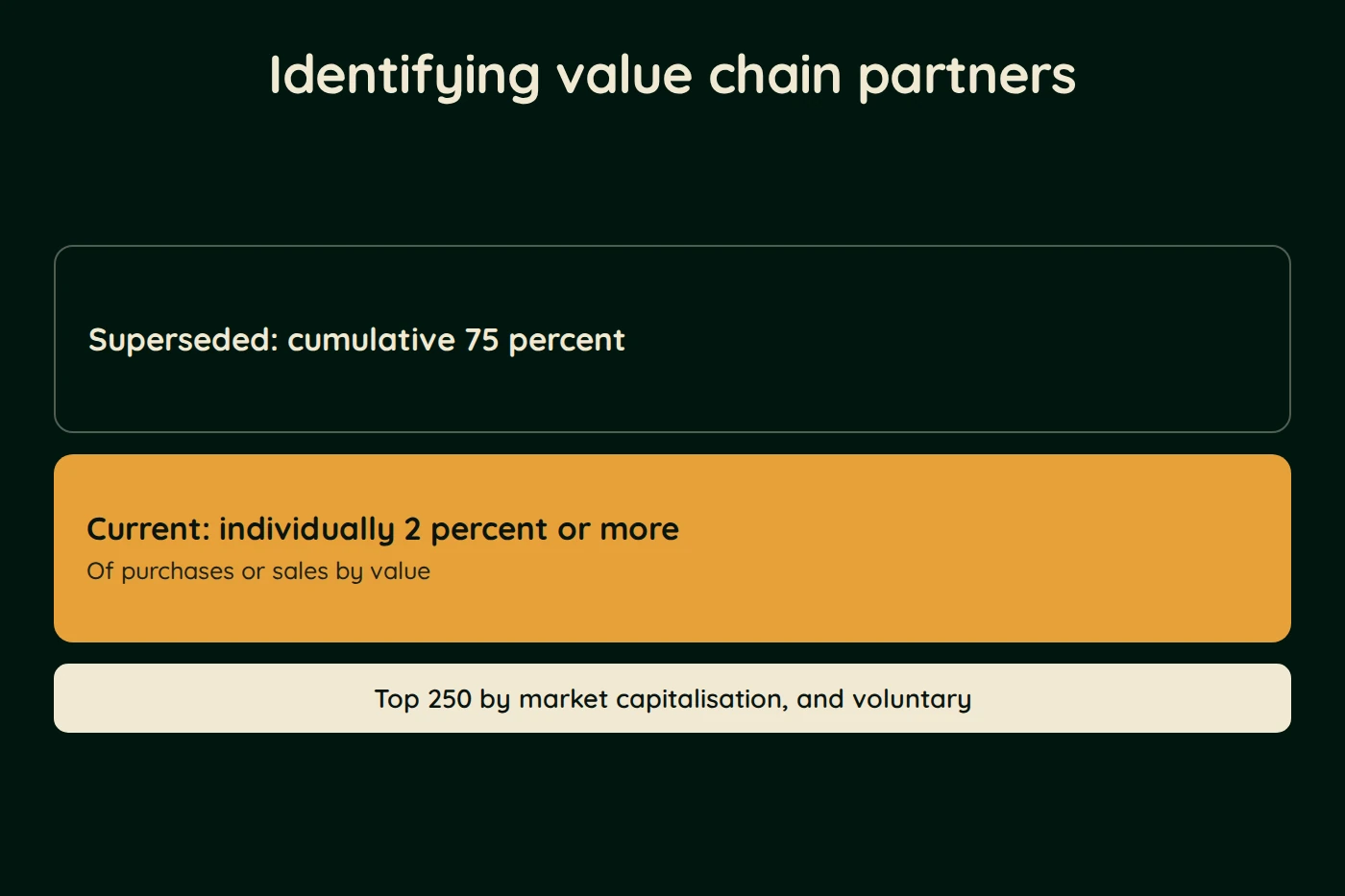
The current test identifies partners individually comprising 2 percent or more of the entity purchases or sales by value. An entity may then limit disclosure to partners cumulatively covering 75 percent. That 75 percent figure was the original 2023 identifying basis and now survives only as an optional cap.
Value chain partner identification changed materially in March 2025, and the superseded test is still widely quoted, which produces the wrong partner list.
Who this applies to
Value chain ESG disclosure applies to the top 250 listed entities by market capitalisation. That figure is a market capitalisation rank, not a rupee turnover threshold.
The current test
Under the SEBI circular dated 28 March 2025, value chain partners are those individually comprising 2 percent or more of the entity purchases or sales by value. Separately, the entity may limit its disclosure to partners cumulatively covering 75 percent of its purchases or sales.
What changed, and why it matters
| Original framework, 12 July 2023 | Current position, 28 March 2025 | |
|---|---|---|
| Identifying test | Partners cumulatively accounting for 75 percent of purchases or sales | Partners individually at 2 percent or more |
| Role of 75 percent | The definition itself | An optional disclosure cap |
| Status | Comply-or-explain | Voluntary |
Applying the old cumulative-75-percent rule as the identifying test produces a different, and generally longer, partner list than the current individual-2-percent test. The two are not equivalent.
The status is now voluntary
The same March 2025 circular changed value chain ESG disclosure, and its third-party assessment or assurance, from comply-or-explain to voluntary. Reporting of value chain ESG data for financial year 2024-25 is voluntary in financial year 2025-26, with assessment or assurance of that data also voluntary.
Sources: SEBI circular, 28 March 2025
The BRSR guide covers value chain disclosure in full. BRSR reporting services supports listed entities and their partners.