


A climate transition plan is the part of an organisation’s strategy that sets out its targets, actions and resources for moving to a lower-carbon economy. A credible one carries a measured baseline, dated targets, named decarbonisation levers, costed capital allocation, board approval, stated assumptions and dependencies, and a review cycle that reports progress against what was published before.
Two instruments carry the operative content. IFRS S2 treats the plan as a disclosure item rather than a duty to hold one, since its wording is “any climate-related transition plan the entity has”. ESRS E1-1 asks for more, stating that “the undertaking shall disclose its transition plan for climate change mitigation”. Read together, the two produce a stable component list.
The seven components
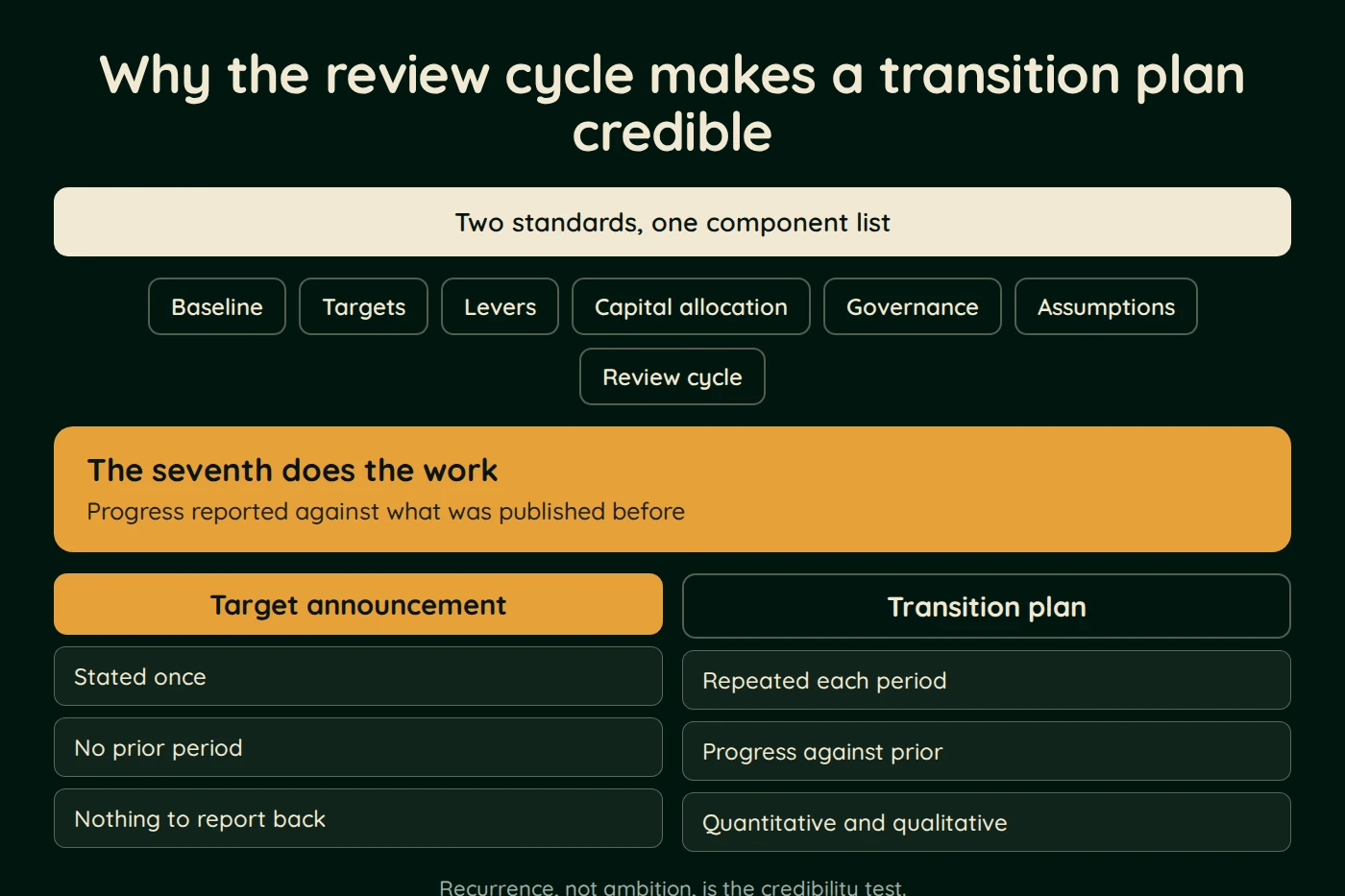
1. Baseline. A base year for which verifiable emissions data are available, with the reasons for choosing that year stated, resting on declared organisational and operational boundaries and a written recalculation policy. 2. Targets. For each target: the metric, the objective, the part of the organisation covered, the period, the base period from which progress is measured, milestones and interim targets, and whether the figure is absolute or intensity based. 3. Levers. An explanation of the decarbonisation levers identified and the key actions planned, including portfolio changes and new technologies in own operations and in the upstream or downstream value chain. 4. Capital allocation. An explanation and quantification of the investments and funding supporting implementation, referenced to taxonomy-aligned capital expenditure indicators. 5. Governance. Whether the administrative, management and supervisory bodies approved the plan, and how it is embedded in and aligned with overall business strategy and financial planning. 6. Assumptions and dependencies. The key assumptions used in developing the plan, the dependencies on which it relies, and how the disclosed activities are resourced. 7. Review cycle. Progress against plans disclosed in previous reporting periods, reported in quantitative and qualitative terms.
Where the two standards part company
| Element | IFRS S2, paragraph 14 | ESRS E1, paragraph 16 |
|---|---|---|
| Duty to hold a plan | Not imposed | Not imposed; paragraph 17 instead requires a statement of whether and when a plan will be adopted |
| Board approval status | No equivalent wording | Expressly required |
| Alignment with financial planning | No equivalent wording | Expressly required |
| Key assumptions and dependencies | Expressly required | Not among the paragraph 16 items |
| Locked-in emissions from key assets | Not among the paragraph 14(a) items | Qualitative assessment required |
Credibility rests on the seventh component more than on the first six. A plan disclosed once creates a recurring obligation to report progress against it, and that recurrence is what separates a transition plan from a target announcement. Assembling the base year file, the lever list, the capital schedule and the assumption log is preparation work. Any assurance is the work of independent accredited third parties.
Sources: IFRS S2 transition plan disclosure guidance, ESRS E1, Delegated Regulation (EU) 2023/2772, GHG Protocol Corporate Standard
The ESG guide sets out how baseline, target and lever evidence is organised into one reporting file. ESG solutions covers preparing that evidence and structuring the disclosure against IFRS S2 and ESRS E1.