


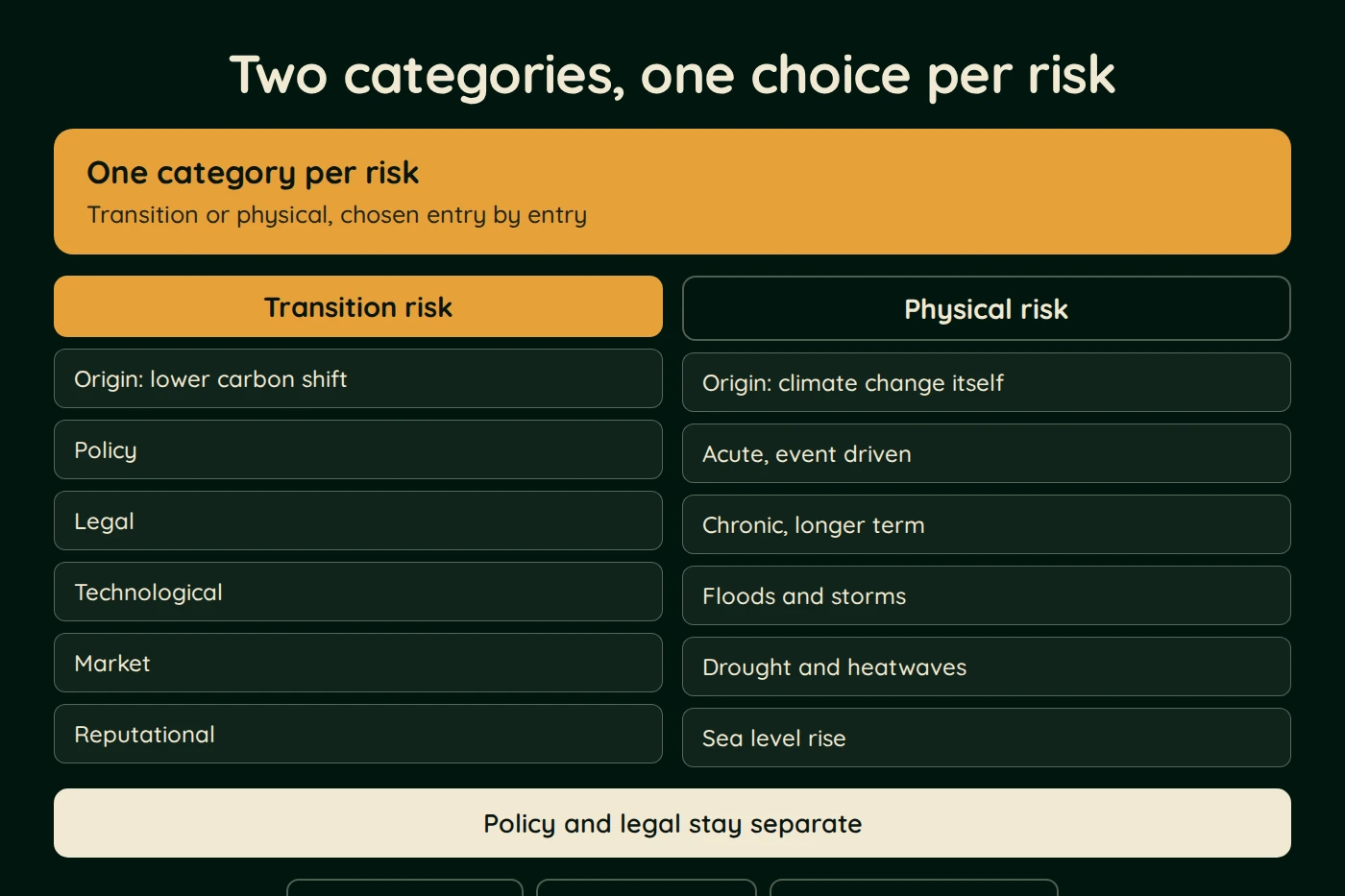
Transition risk arises from efforts to move to a lower-carbon economy, while physical risk results from climate change itself. IFRS S2 names five transition sub-types: policy, legal, technological, market and reputational. Physical risk splits into acute, meaning event-driven, and chronic, meaning longer-term shifts. Each identified risk must be classified into one category or the other.
IFRS S2 applies to two categories of climate-related risk, physical and transition, alongside climate-related opportunities. The split is not presentational. For each risk identified, an entity must explain whether it considers that risk to be a climate-related physical risk or a climate-related transition risk, so the classification attaches to every register entry rather than to the register as a whole.
What each category covers
| Transition risk | Physical risk | |
|---|---|---|
| Origin | Efforts to transition to a lower-carbon economy | Climate change itself |
| Sub-types in the defined terms | Policy, legal, technological, market, reputational | Acute and chronic |
| Examples in the defined term | None beyond the sub-types | Storms, floods, drought, heatwaves, sea level rise, reduced water availability, biodiversity loss, changes in soil productivity |
| Cross-industry metric | Assets or business activities vulnerable to transition risks | Assets or business activities vulnerable to physical risks |
Policy and legal appear as separate sub-types rather than as one combined heading. A register built from the vocabulary of the standard should keep them apart.
Where the time horizon actually sits
Neither defined term carries a time horizon of its own. The only horizon distinction written into the two definitions sits inside physical risk: acute physical risks are event-driven, while chronic physical risks arise from longer-term shifts in climatic patterns, including changes in precipitation and temperature. Horizon enters the disclosure elsewhere, through the resilience assessment, which covers the capacity to adjust or adapt over short, medium and long term and applies to both categories alike. As the time horizon lengthens and detailed information thins, the degree of judgement required increases.
The different work each demands
- Transition risk answers to the strategy record: any transition plan the entity holds, its key assumptions and dependencies, how the activities are resourced, and progress against plans disclosed in earlier periods. ESRS E1-1 adds a qualitative assessment of locked-in emissions from key assets and products, and whether those emissions may jeopardise the reduction targets and drive transition risk.
- Physical risk answers to assets and geography: the ability to redeploy, repurpose, upgrade or decommission existing assets, and scenario inputs relevant to the particular activities undertaken and the location of those activities.
- Both are tested through the same instrument. Scenario analysis is the mandated method for assessing resilience, and the method disclosure must state whether the scenarios used are associated with transition risks or physical risks.
Sources: UK SRS S2, reproducing IFRS S2, ESRS E1, Delegated Regulation (EU) 2023/2772
ESG solutions covers the register work behind that classification: exposure by site and by activity, the evidence trail for each entry, and the data file an entity needs before independent assurance is commissioned. The ESG guide places climate risk inside the wider reporting programme.