


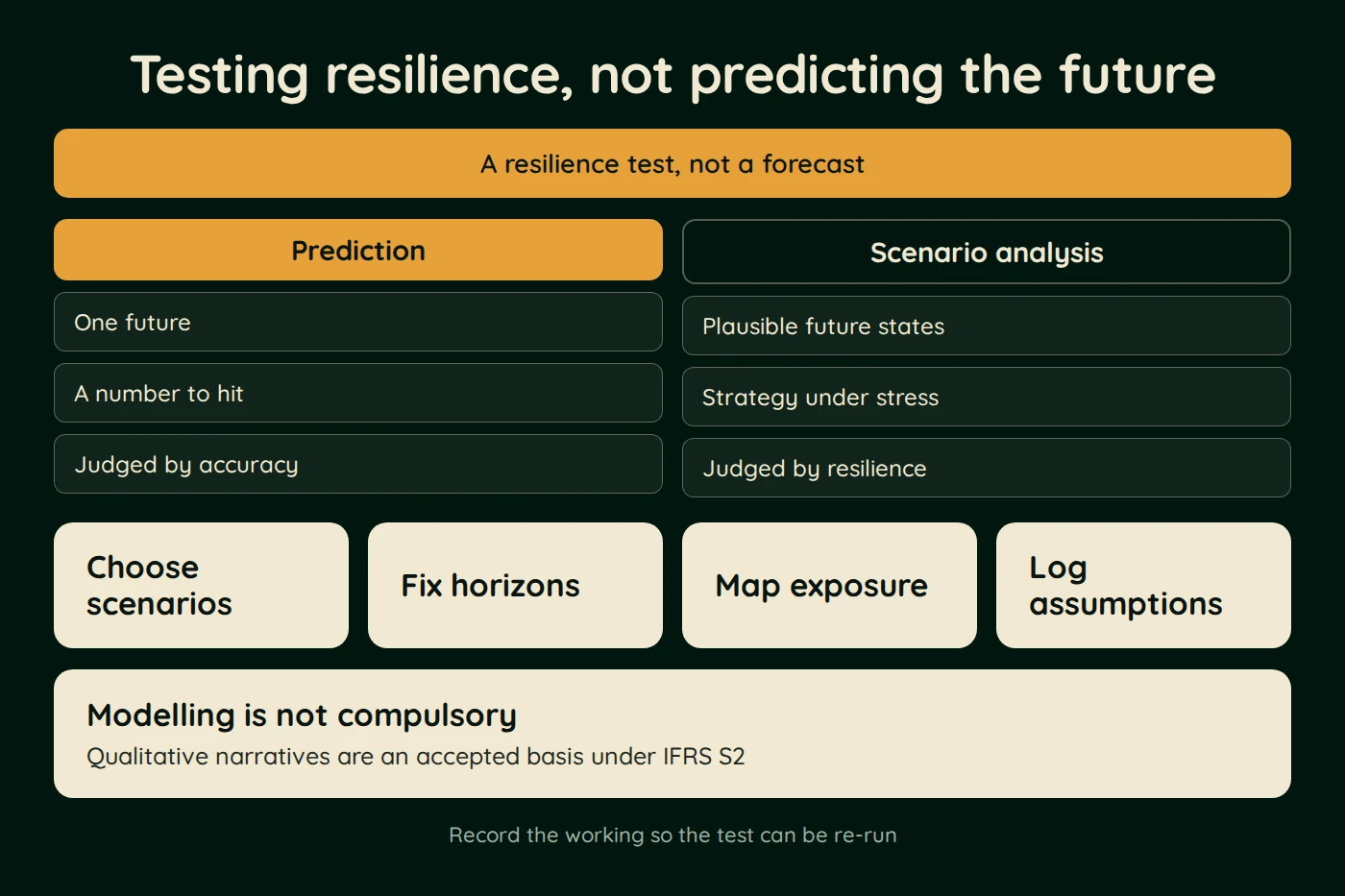
ESG scenario analysis is a structured test of how an organisation’s strategy and business model would hold up under a set of plausible future states, run to assess resilience rather than to predict. Scenarios are selected on a stated basis, horizons fixed, exposures mapped onto assets and financial resources, and every assumption recorded so the work can be re-run.
IFRS S2 makes the instrument mandatory for an entity applying the standard. Paragraph 22 requires disclosure that enables users to understand the resilience of the strategy and business model to climate-related changes, developments and uncertainties, and requires climate-related scenario analysis to be used to assess that resilience, on an approach commensurate with the entity’s circumstances. The application guidance sits at paragraphs B1 to B18.
Choosing scenarios and fixing horizons
Scenario selection is a documented judgement, not a default. The standard requires a reasonable and supportable basis for using a particular scenario or set of scenarios, and treats publicly available scenarios from authoritative sources as obtainable without undue cost or effort. Inputs have to be relevant to the particular activities undertaken and to the geographical location of those activities. Disclosure then states how and when the analysis was carried out, which scenarios were used and their sources, whether a diverse range was included, whether the scenarios used are associated with transition risk or physical risk, and whether one of them aligns with the latest international agreement on climate change. As the time horizon lengthens and detailed information thins, the degree of judgement required increases.
Qualitative and quantitative approaches
Modelling is not compulsory.
| Approach | What it produces | Standing under IFRS S2 |
|---|---|---|
| Qualitative | Scenario narratives, used alone or combined with quantitative data | Accepted as a reasonable and supportable basis for the resilience assessment |
| Quantitative | Modelled effects, for example multiple carbon price pathways associated with a given outcome such as a 1.5 degree Celsius outcome | Likely to strengthen the assessment where risk exposure warrants the approach |
Translating scenarios into exposure
1. Set the perimeter against the two circumstance factors named in the guidance: exposure to climate-related risks and opportunities, and the skills, capabilities and resources available for the analysis. 2. Map each scenario onto the assets and activities it reaches, then onto the availability of and flexibility in existing financial resources. 3. Test capacity to adjust, including the ability to redeploy, repurpose, upgrade or decommission existing assets and the effect of current and planned investment in mitigation and adaptation. 4. Record the significant areas of uncertainty considered, with the assumption and source behind each one.
Cadence is split. The analysis itself may follow the strategic planning cycle, including a multi-year cycle of three to five years, while the resilience assessment reported under paragraph 22(a) is updated at each reporting period.
Sources: UK SRS S2, reproducing IFRS S2 paragraphs 22 and B1 to B18, AASB S2, reproducing IFRS S2 paragraph 22
The ESG guide sets out where resilience disclosure sits inside a reporting file. ESG solutions covers scenario source records, assumption registers and the exposure mapping behind a climate resilience statement, structured so an independent assurance provider can follow the working.